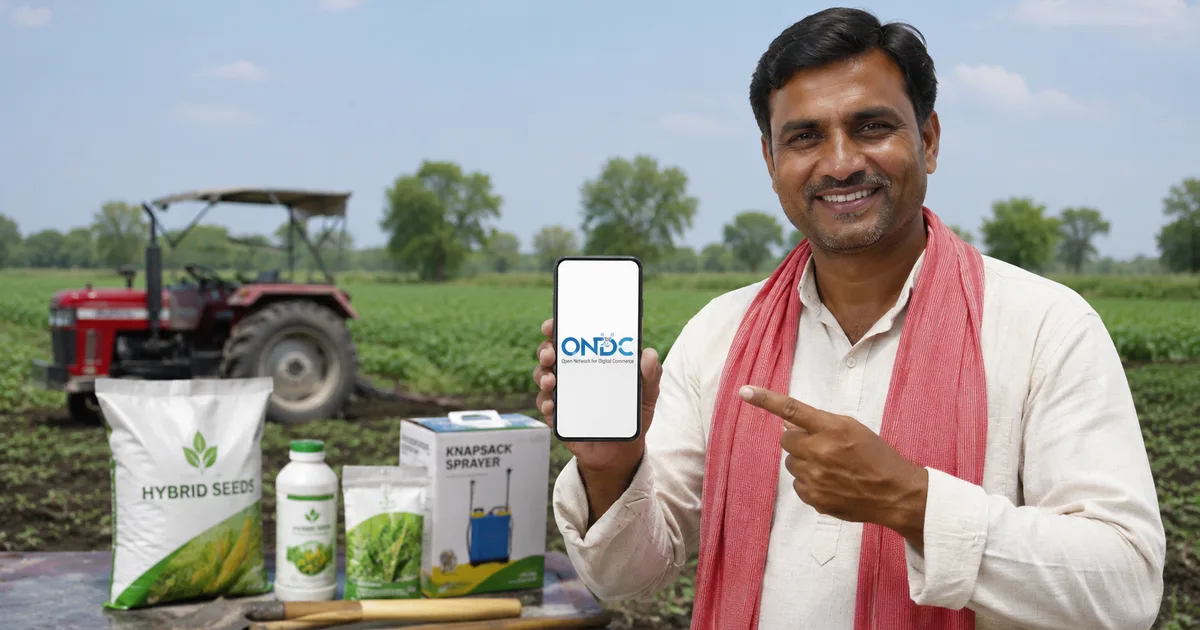
Imagine you're a wheat farmer in Haryana. It's sowing season and you need certified seeds, the kind that actually sprout reliably, plus a soil testing kit and maybe a small sprayer. Your options have always been: go to the local agri input shop where prices are whatever the shopkeeper decides, or rely on government supply that may or may not arrive on time. Then once your crop is ready, you haul it to the mandi, hand it over to an arhtiya (commission agent), and hope the day's price is decent. ONDC for agriculture is trying to change all three of those steps.
ONDC, the Open Network for Digital Commerce, is a government-backed protocol that lets any app connect to any seller or buyer on a shared digital network. We've covered what ONDC is and how it works in detail before. The short version: it's like UPI but for e-commerce. No single platform owns the whole thing. A seller lists once, and buyers across multiple apps can discover them.
Agriculture is one of the sectors where this model could genuinely matter. India has around 140 million farm households. Most are small and marginal, under 2 hectares. They don't have pricing power. They don't have easy access to quality inputs. And they often don't know the real market rate for their produce in real time. That's the gap ONDC is stepping into.
What farmers can buy on the ONDC agri network
On the buying side, ONDC's agriculture network lets sellers list agri inputs, seeds, fertilizers, pesticides, tools, equipment, and farmers can browse and order through any compatible app. Think of it like an open marketplace but without any single company controlling who sells or what price they set.
Seeds are the obvious starting point. Certified varieties from companies or state seed corporations can list on ONDC. A farmer in a remote block of Odisha who can't reach a dealer easily can potentially order and get delivery. Whether that delivery happens reliably in every PIN code is still a work in progress. Rural last-mile logistics is genuinely hard.
Equipment is also there. Small tools, irrigation accessories, seed drills, sprayers. Some of this is already available on mainstream e-commerce platforms, but those platforms charge sellers listing fees and commissions that push prices up. ONDC's open network model is designed to reduce that friction.
One concern worth flagging directly: CropLife India, the pesticide industry body, has been raising alarms about unauthorised and potentially counterfeit pesticide sales on e-commerce platforms. ONDC is not immune to this risk. The network still needs strong seller verification for chemical inputs, where quality literally determines whether a crop survives or gets damaged. Until there's a clearer quality assurance mechanism visible to buyers, I'd be cautious about ordering pesticides from sellers you haven't been able to verify independently (annoying, I know, but the risk is real).
How farmers and FPOs can sell crops on ONDC
This is where it gets genuinely interesting. The selling side of ONDC for agriculture is built around Farmer Producer Organizations, FPOs, which are essentially collectives of small farmers pooled together to have more bargaining power. An FPO lists their produce on ONDC, and buyers, whether processors, exporters, retailers, or bulk purchasers, can discover and place orders through any ONDC-compatible buyer app.
The numbers here are actually meaningful. As of 2026, around 5,000 FPOs have registered on the ONDC platform. NABARD has been actively promoting 6,215 FPOs nationally. The government's broader FPO scheme has been showing traction too. 340 FPOs have already crossed Rs 10 crore in annual sales, which isn't small for what are essentially farmer cooperatives. Getting these onto ONDC gives them digital visibility they simply didn't have before.
And then there's a move that happened recently: 1,392 FPOs on ONDC received unique Dun and Bradstreet (D&B) business identity numbers. That might sound like corporate paperwork, but what it does is give these farmer collectives a verified business identity that international buyers recognise. So a rice FPO in West Bengal could potentially connect with a bulk buyer in the Middle East through this network. That's the ambition, at least.
As of 2026, approximately 5,000 Farmer Producer Organizations have registered on the ONDC platform, with 1,392 of them receiving Dun and Bradstreet business identity numbers to enable access to global buyers.
The e-NAM connection and why it matters
You've probably heard of e-NAM, the Electronic National Agriculture Market. It's been running since 2016 and has over 1,000 mandis connected. The idea was to give farmers real-time price discovery and allow them to sell electronically without physically hauling produce to distant markets.
e-NAM works but has had adoption challenges. Many farmers didn't have smartphones or reliable internet earlier. Buyers sometimes preferred the older way. And the mandi ecosystem has interests that don't always welcome disruption.
ONDC and e-NAM are now being integrated. Uttar Pradesh announced plans to connect agri startups with both ONDC and e-NAM, which signals that the state sees these as complementary systems. The logic makes sense: e-NAM handles mandi-level price discovery and regulated trading, while ONDC's open network can extend reach to buyers who never went near a mandi, direct-to-consumer channels, processors wanting to buy straight from collectives, institutional buyers with specific quality requirements.
This is still early. Don't expect everything to be seamlessly stitched together right now. But the infrastructure is being actively connected, which is more than could be said two years ago.
Which apps actually support this in 2026?
Honestly, this is where things get murky. ONDC's agriculture vertical doesn't have a single flagship consumer app the way Paytm or PhonePe dominate UPI. The design is that multiple buyer apps will integrate agri commerce over time, and some agri-focused platforms are already piloting ONDC integration.
For most farmers right now, the most practical access is through FPO-level intermediaries. The FPO handles the platform side and individual farmers participate through the collective. If you're managing an FPO or are an agri business, the practical path in 2026 looks roughly like this:
- Register your FPO on the ONDC network — this can be done through ONDC seller onboarding or via network participants who specialise in agri onboarding
- List produce with accurate quality grades, quantities, and preferred pricing
- Use the e-NAM portal alongside ONDC if your produce also goes through regulated mandi channels
- For buying inputs, confirm whether any agri app in your region is ONDC-connected before ordering from sellers you don't recognise
For urban institutional buyers or food processors, some general ONDC buyer apps are starting to list agricultural produce from registered FPOs. The inventory is still patchy but growing every quarter.
The reality for small and marginal farmers
The immediate beneficiaries of ONDC agriculture are FPOs and slightly larger farm operations, not the individual smallholder on half a hectare. The platform needs digital literacy and a smartphone with decent connectivity. Both of those are still a stretch for a large chunk of rural India.
The more realistic near-term picture is this: FPOs act as the digital layer for their member farmers. The FPO buys inputs at better prices through ONDC and passes savings to members. The FPO sells aggregated produce through ONDC and gets better rates than the local mandi middleman would offer. Individual farmers benefit indirectly, through lower input costs and higher output prices, without personally navigating any app.
That's not a bad model, if you ask me. It's how a lot of agricultural modernisation actually works, through aggregator institutions rather than purely individual digitisation. But it does mean the benefits flow unevenly. FPOs with good management and digital capacity will do well. Scattered individual farmers not part of any collective will continue to depend on the traditional system for now.
BharatNet Phase 3 and satellite internet options are gradually improving rural connectivity, which will help. But "gradually" is doing a lot of work in that sentence.
The quality problem that doesn't get enough attention
Open networks can attract bad actors. The same openness that lets a small FPO from Manipur sell its orange crop to a buyer in Delhi also lets an unscrupulous seller list substandard seeds or diluted chemicals. That's just the reality of any open marketplace.
ONDC has seller verification protocols, but enforcement at scale across thousands of agri input sellers is genuinely difficult. I'm not sure exactly why this hasn't been addressed more publicly, but it's a real gap. For seeds, check if the seller is registered with the National Seeds Corporation or a state seed certification agency. For pesticides and fertilizers, only order from brands and dealers you can verify. Check ratings from other buyers. And if a price seems suspiciously low, treat it as a warning sign rather than a bargain.
You can read more in our guides on safely using digital marketplaces to check seller credibility before making any purchase. And if you ever encounter fraudulent sellers or fake agri products online, the scam reporting guide covers where to report, including cybercrime.gov.in and the 1930 helpline.
What to watch as the network grows
The government's FPO programme is targeting 10,000 FPOs nationally. Getting 60-70% of those onto ONDC would create a meaningfully large agri marketplace. Budget 2025-26 allocations for agriculture include provisions for digital marketing infrastructure and hybrid seed development, both relevant to how ONDC's agri vertical scales.
Karnataka's move to bring Amazon and BigBasket under new APMC rules is also worth watching. States are figuring out how digital platforms fit into existing agricultural regulation. ONDC's agri vertical will eventually need to navigate APMC laws in states that require mandi-level trading for certain commodities. That regulatory question isn't fully resolved yet, and it could affect how freely produce can be sold directly through ONDC in some states.
There's also the payments side. Most farmers are already comfortable with UPI, and ONDC transactions support UPI payments, which removes one significant adoption barrier. Understanding how ONDC's network and payments layer connects is worth doing if you're planning to use this for any kind of agri business.
So here's where things actually stand: ONDC for agriculture is real, growing, and genuinely useful for FPOs and agri businesses right now. For individual farmers, the benefits are mostly indirect at this stage. The 5,000 FPO milestone on the network is a decent sign of momentum. But this is a five-to-ten year story, not a "your farming life changes this kharif season" story. Useful tools are being built, rough edges exist, and the regulatory picture still has some gaps to fill.