Imagine you lend someone money. Maybe it's just ₹5,000 for a medical emergency. They promise to return it next month. Next month comes, and they hand you a post-dated cheque. You drop it in your bank account, wait a couple of days, and then get an SMS from your bank. "Cheque return charges: ₹250. Reason: Insufficient funds."
Annoying, right? Now imagine that instead of ₹5,000, the amount is ₹5 crore. And the person who took the money is a famous Bollywood actor.
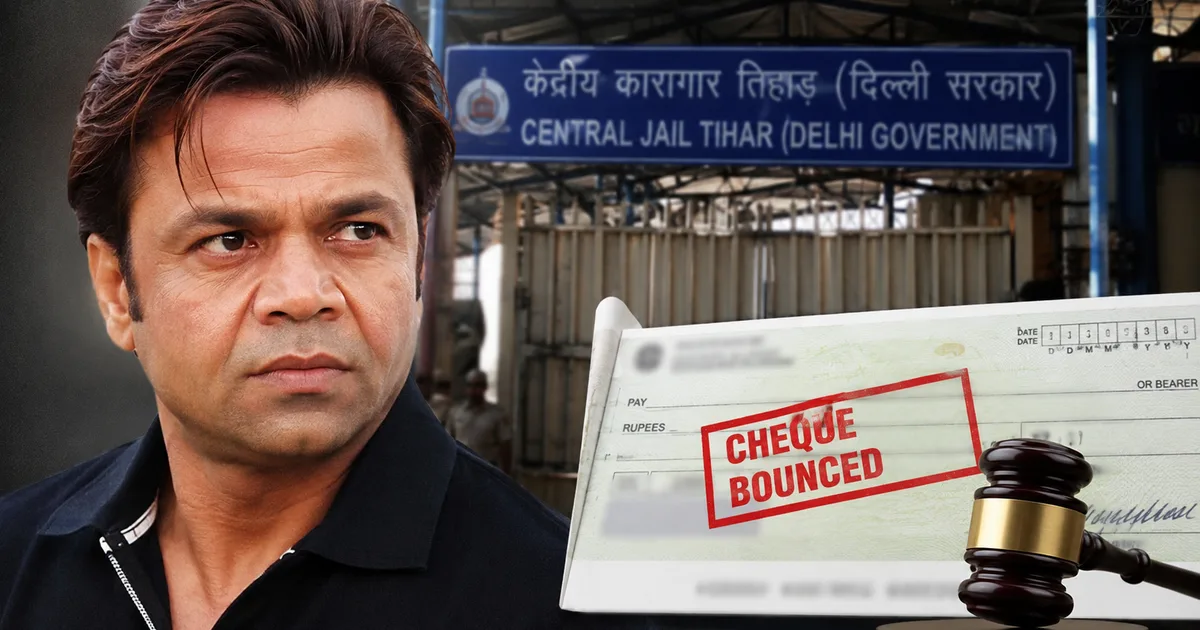
That's exactly what happened in the Rajpal Yadav cheque bounce case. You've probably seen the headlines this week. The Delhi High Court recently sentenced the popular comedian to three months in Tihar Jail.
It sounds crazy when you first hear it. How does a successful actor end up behind bars for borrowing money? But the Rajpal Yadav Tihar jail situation didn't happen overnight. This is a mess that has been dragging on for more than a decade (which makes sense, actually, given how slow courts can be).
I spent a few hours reading through the court documents and news reports. I think the whole thing is a disaster of legal strategy and bad financial planning.
The origin of the ₹5 crore loan dispute
We need to go back to 2010. Back then, Rajpal Yadav wanted to direct and produce a movie. The film was called Ata Pata Laapata.
Movies cost money. So, his company, Shree Naurang Godavari Entertainment, took a loan of ₹5 crore from a Delhi-based businessman named Madhav Gopal Agarwal.
The deal was simple. Agarwal loans the money, the movie gets made, and Yadav pays it back with some profit.
But things went wrong. The movie released in 2012 and tanked at the box office. The revenues didn't even come close to covering the production costs. And that's when the trouble started.
Yadav couldn't pay back the principal amount. The interest kept piling up month after month. By the time the legal notices started flying, the total dues had ballooned to roughly ₹9 crore. I'm not sure exactly why it dragged on so long without a settlement, but it did.
When you owe someone that much money in India, they don't just sit quietly. Agarwal filed a civil recovery suit. He also pressed criminal charges when the payments failed to clear.
Seven cheque bounce cases
Under Indian law, a bounced cheque is a serious offence. Section 138 of the Negotiable Instruments Act makes it a criminal matter, not just a civil dispute. You can actually go to jail for it.
To settle the debt, Rajpal Yadav and his wife issued several cheques to Agarwal. Seven of them bounced.
Seven.
Think about that for a second. If one of my EMI cheques bounces, my bank harasses me for weeks. This guy had seven massive settlement cheques bounce due to insufficient funds.
The Delhi High Court order Rajpal Yadav faced recently was the culmination of years of broken promises. The court noted that he got repeated opportunities to settle the matter. He would make an undertaking in court. He'd agree to pay a certain amount by a specific date. Then he would just fail to do it.
You can read more about how debt recovery works in India in our guide to financial laws. Basically, courts lose patience when you repeatedly break your written commitments. An undertaking in an Indian court is a solemn promise. When you breach it, you're committing contempt of court. That angers judges more than the actual missing money.
A history of broken undertakings
This isn't the first time he's been to jail over this exact same issue. In my experience following these cases, that's pretty wild. In 2013, he spent a few days in judicial custody for submitting a false affidavit in this case. Then in 2018, the Delhi High Court actually sent him to jail for three months for failing to repay the loan.
So when the news broke in July 2026 that he was heading back to Tihar Jail, a lot of people were confused. Had he taken a new loan? No. It's the exact same dispute from 2010.
He just kept failing to pay the agreed settlement amounts.
During a recent court hearing, Yadav's lawyer tried to argue for more time. Yadav himself reportedly called the whole ₹9 crore debt situation an "ego clash."
Calling a court-ordered debt repayment an ego clash is a sketchy strategy. It didn't work at all.
The judge was furious. The court explicitly cited his repeated settlement defaults. Look, you can't just tell a High Court judge that you'll pay ₹1.5 crore by next Tuesday, and then show up empty-handed. Well, you can, but they'll send you to jail.
In May, a sessions court convicted him. They sentenced him to six months. He appealed against it. The Delhi High Court upheld the conviction but reduced the sentence to three months.
The bail and the ₹1.5 crore payment
There was a slight twist recently. Reports from WION indicate that the Delhi High Court granted him bail after he finally paid ₹1.5 crore upfront.
But this doesn't make the rest of the debt disappear. He still owes a massive amount of money.
If you're dealing with online financial fraud, check out our latest scam alerts to stay protected. But this case isn't a scam. It's a straightforward breach of contract and violation of the Negotiable Instruments Act.
The actor recently posted on Instagram, looking completely unfazed. And maybe he is. But the legal reality in India is very clear. A cheque bounce is a criminal offense. If you write a cheque, you better have the funds in your account to clear it.
Why does cheque bouncing lead to jail in India?
A lot of people ask me why cheque bouncing is a criminal offense here. In many other countries, it's just a civil dispute.
The answer goes back to the 1980s. The Indian government wanted to encourage people to use banking channels instead of cash. But nobody trusted cheques. Everyone was afraid the cheque would bounce and they'd lose their money.
So the government amended the Negotiable Instruments Act in 1988. They added Section 138. This made the dishonor of a cheque for insufficiency of funds a criminal offense punishable by up to two years in prison.
This single law changed how Indian business works. It gave people the confidence to accept cheques.
If you issue a cheque and it bounces, the payee has to send you a legal notice within 30 days. You then have 15 days to pay the money. If you still don't pay, they can file a criminal complaint against you within the next 30 days.
This is the exact process that trapped Rajpal Yadav.
He issued the cheques. They bounced. He received the notices. He didn't pay. The complaints were filed.
The courts actually gave him way more leeway than a normal citizen would get. They allowed him to negotiate settlements. They accepted his undertakings. They gave him extensions.
Thing is, eventually, the leniency runs out. The law has to apply equally to everyone, whether you're a regular salaried employee or a famous actor.
When courts reject bail
You might be wondering why he wasn't given more time. Here are the most common reasons courts reject bail in cheque bounce cases:
- You have a history of breaking settlement promises in court.
- You fail to deposit the required percentage of the disputed amount.
- You ignore court summons and have to be brought in via non-bailable warrants.
- You attempt to hide assets or transfer them to family members.
He hit almost all those triggers over the last decade. If you ever find yourself struggling with loan repayments, you should probably consult our legal resources before issuing any settlement cheques.
The financial impact of bad decisions
Let's look at the numbers because they are staggering.
The original loan was ₹5 crore in 2010. Let's assume a standard commercial interest rate of 12 to 15 percent per annum. Over 16 years, the interest alone dwarfs the principal amount. The numbers here are a bit fuzzy without seeing the exact bank statements, but the math is brutal.
He could've settled this early. He could've sold an asset, paid off the ₹5 crore in 2013, and walked away.
Instead, he dragged it through the courts. He paid massive legal fees for lawyers to defend him in the sessions court and the High Court. And the debt just kept growing. Now, in 2026, he is facing a ₹9 crore liability, jail time, and massive public embarrassment.
Honestly, this is why financial advisors always tell you to negotiate and settle debts quickly. Time is your worst enemy when you owe money at high interest rates.
Think about regular folks dealing with housing loans or personal loans in India. A default usually ends with recovery agents showing up at your door or banks auctioning your property under the SARFAESI Act. High-profile individuals sometimes think they can outlast the legal system by filing appeal after appeal. This case proves that strategy is flawed.
When you issue a cheque, the burden of proof is on you to prove you didn't owe the money. The court presumes the cheque was issued for a legally enforceable debt. That's a massive legal hurdle to overcome if you're trying to fight a legitimate loan.
How Tihar jail works for high-profile inmates
So what happens when a celebrity goes to Tihar?
Tihar is one of the largest prison complexes in South Asia. It is massive and crowded. High-profile inmates often get a slightly different experience, usually placed in cells with fewer inmates for security reasons. But it's still jail.
You wake up early. You eat the standard jail food. You sleep on the floor or a very basic cot. There is no special VIP treatment officially allowed, though influential inmates sometimes manage to get minor comforts through informal channels (annoying, I know).
For someone used to the luxury of movie sets and vanity vans, three months in Tihar is a massive shock to the system.
He's experienced it before, briefly. But going back again in your fifties isn't something anyone wants to do. The loss of dignity is permanent. The mugshots and court appearances take a toll.
And remember, he's missing out on work. Every day spent fighting this case or sitting in jail is a day he isn't shooting a film and earning the money he desperately needs to pay off the ₹9 crore debt. It's a vicious cycle.
If you're curious about the latest tech and business news in India, we keep track of how legal issues impact companies in our daily news updates.
What happens next for Rajpal Yadav?
Even with the recent bail after the ₹1.5 crore payment, the legal saga is far from over. If you ask me, the hardest part is yet to come.
The underlying conviction for cheque bouncing still stands. The remaining debt still exists. The businessman who lent him the money still has a legal right to recover the balance amount.
If Yadav fails to stick to the new payment schedule, the court will simply cancel his bail and send him back to Tihar Jail to serve the rest of his sentence.
He can't file another appeal in the High Court for the same conviction. His only higher option now is the Supreme Court of India. And the Supreme Court is notoriously strict about cheque bounce cases. They usually require the accused to deposit a significant portion of the disputed amount just to admit the appeal.
So he needs cash. A lot of it.
And that might be difficult. While he still acts in movies, being in and out of jail makes it hard to get cast in big-budget projects. Producers want reliable actors who will actually show up for the shoot, not someone who might get locked up on a Tuesday morning for a decade-old debt.
It's a sad situation for someone who brought so much laughter to Indian audiences. I grew up watching his comedy scenes. He has incredible timing and talent. To see his career derailed by a bad business decision and poor legal strategy is tough.
But it's also a very clear warning.
Don't take loans you can't repay. Don't write cheques that your bank account can't cash. And if a High Court judge tells you to pay a settlement, you pay it. Because in the Indian legal system, your fame won't protect you from the consequences of a bounced cheque. And honestly, that's exactly how the law should work.