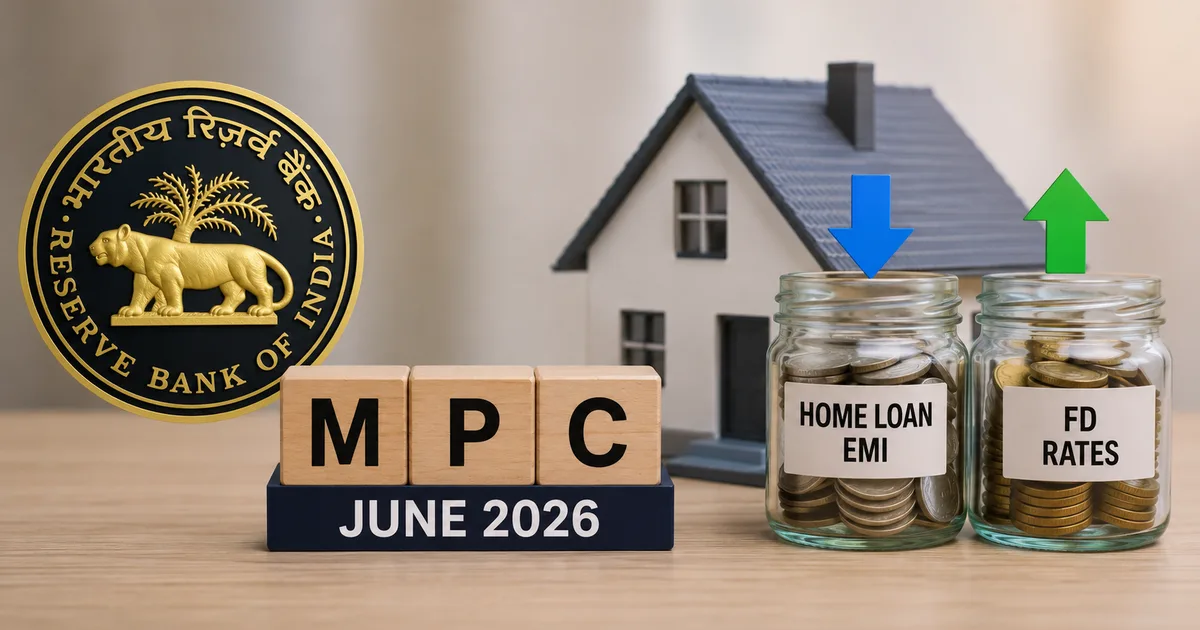
You've probably seen the notifications. "RBI MPC meeting today." "Repo rate decision at 10 AM." Your bank's app may have sent you a push notification. If you have a home loan, you've likely been refreshing news pages wondering whether your EMI is about to change. And if you have a fixed deposit maturing soon, you're wondering whether to lock in rates now or wait.
Here's the short version: at the June 5, 2026 meeting, RBI Governor Sanjay Malhotra and the Monetary Policy Committee held the repo rate at 5.25%. No cut. No hike. A pause.
But that's not the whole story. What happened before this meeting matters just as much, and what this pause actually does to your wallet going forward is worth understanding properly.
What is the repo rate and why does it affect your EMI?
Think of the repo rate as the interest rate at which the RBI lends money to commercial banks. When that rate goes up, banks pay more to borrow from the RBI and pass that cost on through higher loan EMIs and, sometimes, better FD returns. When it falls, the reverse should happen. Honestly, banks are famously not in a hurry to pass on cuts to their borrowers. That part never seems to change.
Your home loan is almost certainly linked to an external benchmark, either the repo rate directly or something called the EBLR (External Benchmark Lending Rate). Most banks reset their home loan rates every quarter. So a repo rate change has a fairly direct line to what you pay every month on a ₹50 lakh or ₹1 crore loan.
The 125 bps cut cycle: what the RBI did before this meeting
Before June 2026, the RBI had already cut the repo rate by a total of 125 basis points in its previous rate-cutting cycle. That's 1.25 percentage points. For someone with a ₹50 lakh home loan over 20 years, that kind of reduction can knock ₹3,000 to ₹4,500 off your monthly EMI, depending on when your bank actually passed on the benefit.
And that's the frustrating part. Not every bank passed on the full benefit quickly. The RBI cuts, banks acknowledge it, and then quietly take several weeks or months to actually reflect the change in your loan account. If your bank still hasn't reduced your EMI by the full amount corresponding to 125 bps of cuts, call them. You're entitled to that reduction.
The Economic Times noted around this time that borrowers who haven't sorted out their existing loans are leaving real money on the table. Negotiating a spread reset with your current bank, or doing a balance transfer to a lender offering a lower rate, can still produce meaningful savings even without a fresh RBI cut. (Annoying that you have to chase this yourself, I know, but that's just how it works.)
What the June 2026 rate hold means in practice
Most economists had expected this pause. Moneycontrol and CNBC TV18 both reported before the announcement that the committee's focus was on inflation and a complicated global picture, specifically the impact of the US-Iran conflict in West Asia, which had been pushing up crude oil prices and adding uncertainty.
India imports around 85% of its crude oil. When oil gets expensive because of geopolitical tensions, it feeds into fuel prices, transport costs, and eventually the price of most goods. That's inflationary pressure. And an RBI worried about inflation doesn't cut rates. It waits.
A small section of analysts had even been predicting a rate hike at this meeting, which would have been a real shock to borrowers. The hold at 5.25% was, in that sense, almost reassuring.
"The committee is widely expected to retain the policy repo rate at 5.25%, a small but vocal segment is predicting an interest rate hike on Friday." - Indian Express, June 5, 2026
What this means for your home loan EMI right now
If you're on a floating rate home loan, which most people in India are, here's what the picture looks like:
- The 125 bps of cuts from the previous cycle should already be showing up in your EMI or loan tenure. Check your last few statements.
- This June meeting changes nothing immediately. Your next EMI will be the same as the last one.
- If the RBI hikes rates in a future meeting due to sustained inflation or global shocks, your EMI will go up.
If your loan was taken before 2019, you might still be on the MCLR (Marginal Cost of Funds-based Lending Rate) system, which is slower to reflect RBI changes. Asking your bank to switch you to an EBLR-linked loan involves a one-time administrative fee, but it's usually worth it for a large, long-tenure loan. Your home branch handles this.
For those considering a balance transfer to a cheaper lender, check our home loan refinancing guide. On a ₹50 lakh loan, saving even ₹500 per month adds up to over ₹1.2 lakh across a 20-year tenure, and the actual savings are often bigger.
What this means for your fixed deposits
For FD holders, the situation runs the other way. When the RBI cuts rates, banks eventually lower their deposit rates too. That's been happening steadily over the last few quarters. With this June pause, though, FD rates are likely to stay stable for a bit.
Upstox reported ahead of the meeting: "FD rates steady for now; inflation outlook in focus." That's useful if you're about to lock in a long-term FD. If the RBI resumes cutting rates later in 2026, August is the next likely opportunity, and deposit rates will follow. Locking in at current rates before that happens could make sense for surplus savings.
Where things stood for major banks in early June 2026:
- SBI was offering around 6.5% to 7% on 1-3 year FDs for regular customers, with senior citizens getting an additional 0.25% to 0.5%.
- Private banks like HDFC and ICICI were in a similar range, with select tenures touching 7.25%.
- Small Finance Banks like AU Small Finance Bank and Jana were advertising up to 8.5% for certain tenures. Higher returns, but with different risk considerations than large public-sector banks.
For senior citizens, the extra rate matters more than it might seem. On a ₹10 lakh FD, the difference between 7% and 7.25% is about ₹2,500 per year. Over a three-year tenure, that's ₹7,500 in extra returns. And you barely have to do anything for it except ask.
Why is the RBI being cautious right now?
The US-Iran conflict in West Asia, which escalated earlier in 2026, has added genuine uncertainty to India's economic outlook. Crude oil prices, the rupee's performance against the dollar, and nervousness in global markets are all under the RBI's watch. I'm not sure exactly how much weight each of these factors carries internally, but together they're clearly enough to keep the committee on hold.
India's GDP growth has been holding up reasonably well. But the RBI doesn't want to cut rates and then have to reverse course if inflation climbs. That kind of reversal is a mess for everyone, from banks to households deciding between a fixed and floating rate loan.
The stance is basically: we've cut 125 bps, let's let that work through the system. Watch inflation. Watch oil. Then decide. Governor Malhotra has been consistent about not telegraphing future moves too clearly, which is standard central banking behaviour but does feel frustrating when you're trying to plan around your loan or savings.
What you should actually do right now
Rather than waiting on what the RBI might decide in August, some practical steps are worth taking this week:
- Check your loan statement. Verify the previous 125 bps of cuts have been reflected in your rate. If not, ask your bank specifically about the next reset date and the revised spread.
- If you're on MCLR, ask about switching to EBLR. The one-time fee is usually small, and future rate changes will flow through faster and more transparently.
- If you have FD money to deploy, consider locking in a 2-3 year FD at current rates before the next potential cut cycle begins.
- Don't hold off on taking a home loan while waiting for one more RBI cut. Current rates in the 8.5% to 9.5% range are not extreme by historical standards. The wait could stretch longer than you expect.
Understanding how repo rate transmission works in India is worth a few minutes if you have a large loan. It's never instant, never perfectly uniform across banks, and the RBI periodically pushes banks publicly to pass on cuts more quickly. Knowing this means you know when to push back.
And if you do get into a dispute with your bank over loan rate revisions, the RBI Banking Ombudsman process is genuinely there for exactly this kind of complaint. Most issues resolve at the branch level once you escalate formally, but knowing the option exists matters.
The June 2026 MPC meeting was a hold. The 125 bps rate cut cycle that preceded it was real and meaningful. Whether more cuts come later depends on oil prices, inflation data, and how the West Asia situation develops. What you can control is whether you've actually captured the benefit of the cuts that already happened. Start there.