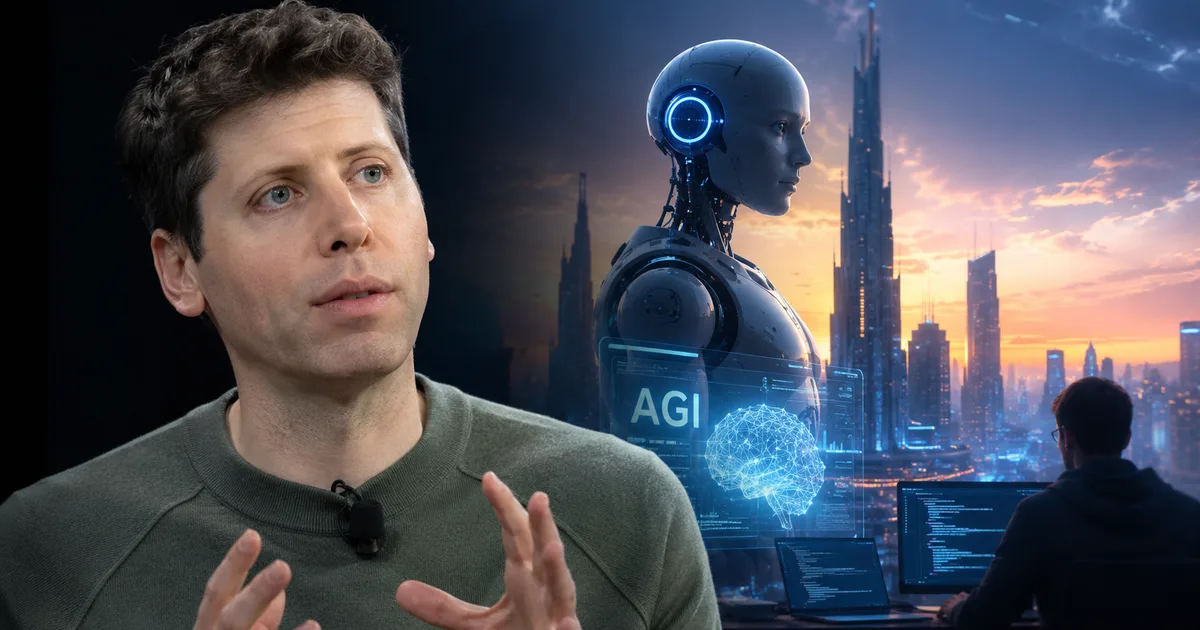
So Sam Altman just dropped a massive bombshell. The OpenAI CEO recently claimed that humanity has already entered the AI singularity. Yes, you read that right. We aren't talking about some distant science fiction future where machines suddenly wake up. He thinks this is the moment right now. Sam Altman's 2026 AI singularity views are dominating every single tech conversation I've had this week. Honestly, I find his confidence both fascinating and a little terrifying. And it begs a massive question. What does this actually mean for the future of AGI and tech jobs? The answer is messy.
If you live in India and work in tech, you're probably feeling the heat. The last two years have been brutal. Layoffs. Hiring freezes. Constant talk about artificial intelligence replacing us all (exhausting, I know). Now the guy leading the charge says the singularity is here. Personally, I think he's being a bit dramatic just to sell more enterprise subscriptions. But we can't ignore the reality on the ground. The tools are getting incredibly smart. They change how we work every single day.
What he said at the India AI impact summit 2026
Things got interesting at the India AI Impact Summit earlier in 2026. The event itself was a mess. Anthropic CEO Dario Amodei even went on record calling it extremely disorganised. But the real headline grabber was Altman. He spent a big chunk of time talking about employment. He talked about how humans fit into an AI-dominated world.
Altman claimed AI won't replace the human part of employment. He argues we'll always need people to make decisions or connect with other people. I want to believe him. I really do. But when you're a 22-year-old fresher in Bengaluru trying to land your first coding gig, that argument feels pretty weak.
Big IT firms like TCS and Infosys are changing their hiring patterns. Wipro is doing it too. They don't just want someone who can write basic Java or Python anymore. They want GenAI skills. They want people who build agents and work with large language models. The days of mass campus recruitment for simple manual testing are over. Same goes for basic bug fixing. And this is exactly what the singularity looks like in real life. It isn't a robot apocalypse. It is just a slow, quiet shift in what employers pay for.
The reality of Indian tech jobs right now
Look, here's the deal with the future of AGI and tech jobs. The Indian IT services industry has a very specific model. Companies in the US or Europe outsourced their basic tech work to India because of the cost advantage. We had millions of young engineers willing to do the work for a fraction of the dollar cost. That model is breaking down right in front of our eyes.
AGI stands for artificial general intelligence. Basically, it means an AI system does cognitive tasks that humans do. If an AI can write code and debug it, why would a client in New York outsource to a team in Pune? They probably won't. They'll just spin up more cloud compute. The AI does it in seconds. This is the existential threat facing the Indian IT sector right now.
I'm not saying every single tech job will disappear tomorrow. But the nature of the work changes fast. I spoke to a friend who manages a mid-sized IT firm in Hyderabad last week. He told me they're actively replacing junior developer roles with AI coding assistants. They only hire senior folks who architect systems and review AI code. The entry-level door is closing. In my experience, this happens more often than anyone admits.
- Entry-level coding and manual testing jobs are shrinking fast across major Indian tech hubs.
- The demand for AI prompt engineers, AI auditors, and system architects is actually going up.
- Soft skills, client communication, and human-in-the-loop management are becoming the main job requirements.
- Freelancers are using AI to take on massive projects that used to require a team of five people.
Nvidia, OpenAI, and the race for massive compute
You can't talk about the singularity without talking about the hardware. The hardware powers it all. The software is just one piece. The real battle is in the data centers. We recently saw reports that Nvidia is in talks to provide $250 billion in backing for a massive OpenAI hub. That's an insane amount of money. Think about that number for a second. It is larger than the GDP of many small countries.
This shows exactly where the power is right now. It is with whoever controls the compute. In the past, human capital was the bottleneck. You needed thousands of engineers to build a big software platform. Now, compute is the bottleneck. If you have enough GPUs, you train a model to do almost anything. This is why these companies raise billions of dollars. They want the physical infrastructure for AGI before anyone else gets it.
So what does this mean for Indian startups? The barrier to entry for building basic software is zero. But building foundational AI models is astronomically expensive. Indian founders must focus on the application layer. They have to find specific local problems to solve. You can't out-compute OpenAI. But you can build a better AI tool for Indian farmers or local retail businesses.
Why the four-hour workweek is a complete myth
One of the funniest things Altman said recently was about productivity. He admitted AI hasn't led to four-hour workweeks. Why? People are simply too competitive. I actually agree with him on this completely. We have this fantasy that once robots do all the work, we sit on a beach in Goa and drink tender coconut water all day.
That isn't how capitalism works. If an AI tool makes you 10 times faster, your boss isn't letting you go home at noon. They want 10 times more output. I've seen this happen in my own work. I use new AI tools to research and outline articles now. It saves me hours (which makes sense, actually). But I don't work less. I just write more articles. Sometimes I spend that extra time trying to make the content better.
"We always adapt to the new normal. If everyone has a tool that makes them 10x faster, the baseline expectation just moves up 10x. You don't get more free time, you just get more pressure to perform."
This competitive drive is hardwired into us. Especially in India. The competition for good jobs and college seats is absolutely brutal here. If a student in Mumbai figures out how to use AI to ace exams, every other student has to match that effort. The numbers here are a bit fuzzy, but the trend is clear. We aren't heading for a leisure society. We're heading for a hyper-productive society where you run twice as fast just to stay in the same place.
Will AGI replace Indian IT services completely?
This is the million-dollar question. Or maybe the billion-dollar question for our economy. Indian IT exports are a massive chunk of our GDP. If AGI actually works the way Sam Altman claims, what happens to all those glass towers in Electronic City and Hitec City? I honestly don't think the industry will collapse. It will morph into something unrecognizable, though.
Right now, companies pay for bodies. They pay an hourly rate for a human to sit at a desk and type. In the future, they'll pay for outcomes. The Indian IT firms will transform into AI service providers. They'll take a messy enterprise problem and feed it into custom AI models. Then they deliver a solution. The human workforce shrinks. The profit margins might actually go up.
We see this shift already. Look at the quarterly results from the big players. They all talk about GenAI deal wins. They're announcing major partnerships with Google Cloud and Microsoft. They want to show the market they aren't dinosaurs. But for the average employee, this means uncertainty. Your job title might still say software engineer. Your day-to-day work will look more like being an AI babysitter.
What happens when AGI gets things wrong?
This is something nobody at these summits wants to talk about. Sam Altman paints this beautiful picture of the singularity where AI solves our problems. But what happens when the AGI hallucinates? What happens when an AI agent for an Indian bank suddenly denies loans to thousands of eligible people? A sketchy bias in its training data could cause it. We give these systems an insane amount of power. We still don't fully understand how they make choices. I'm not sure exactly why we ignore this risk.
I've tested dozens of these models over the last few months. They are brilliant one minute. The next minute, they are completely foolish. An AI can write a perfect machine learning algorithm. Then it fails to count how many Rs there are in the word strawberry. It is bizarre. When you rely on a human, you know their limitations. When you rely on AGI, the failures are unpredictable.
For Indian techies, this means your job involves a lot of quality control. The tech industry will need thousands of people. Their only job is to break the AI, find its blind spots, or fix them before they go live. If you want a secure career path for the next five years, look into AI auditing. Safety testing is another good option. It is going to be massive.
How to protect your tech career in 2026
So what do you do? First, stop panicking. Panic doesn't write good code. It doesn't pass interviews. Second, you have to start using these tools every single day. If you don't know how to prompt an AI to write a Python script, you're already falling behind. You need to treat AI like an intern. A highly capable, slightly stupid intern that works for you.
Stop memorizing syntax. The AI already knows all the syntax for every programming language ever created. You need to focus on system design and business logic. You have to understand how different pieces of software fit together. They need to solve a real human problem. The AI writes the function. But you have to tell it what the function needs to do.
You also need to watch out for the noise. People try to make a quick buck off this panic. We've seen a massive spike in fake AI certification programs. Some random guy on YouTube will try to sell you a guaranteed AI job course for 15,000 INR over a WhatsApp group. It's usually a scam. Always check the credentials of anyone promising you a shortcut. You can check our latest tech scam alerts to see what to avoid.
Sam Altman might be right about the singularity. Or he might just be trying to keep the hype train rolling so Nvidia makes those chips. Either way, the world has changed. The future of AGI and tech jobs isn't some distant debate. It is happening right now in your office and on your laptop. You can't fight it. You might as well learn how to use it.
If you want to understand more about how these changes impact government policies, you should read our detailed explainers on Indian digital laws to see how the regulatory side catches up.