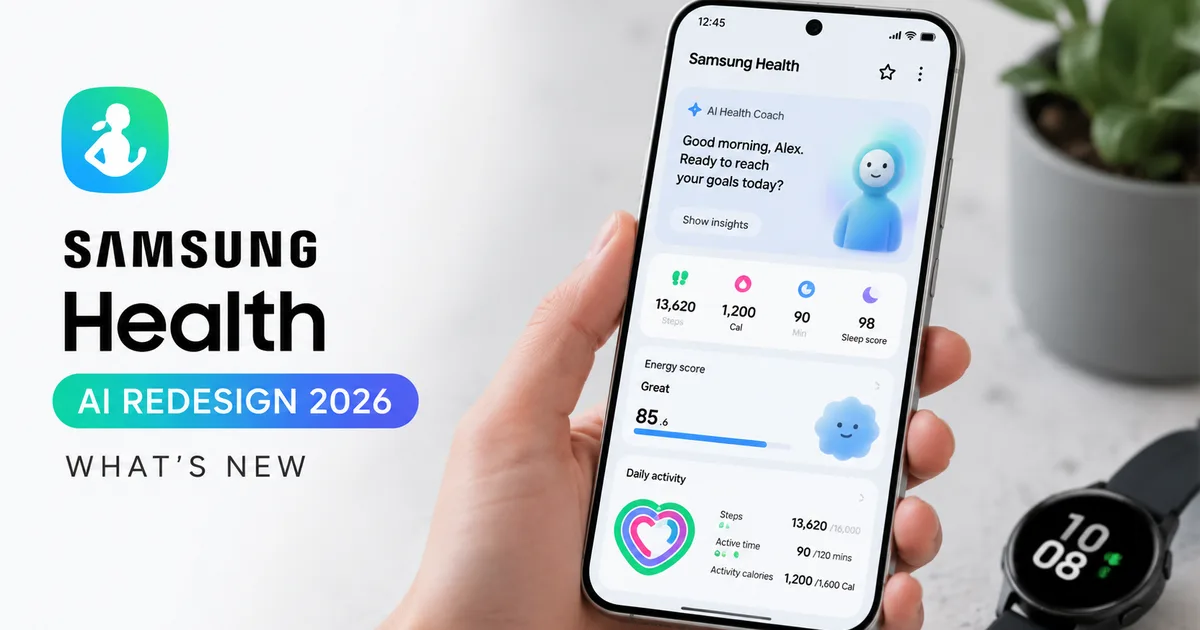
If you're using a Galaxy Watch, tomorrow brings a massive change. The Samsung Health App AI Redesign 2026 is officially rolling out on June 8, and it completely changes how we track our daily wellness. Honestly, I've been using the beta version. The updates feel much more practical than the usual cosmetic tweaks we get every year. Samsung's integrating its Galaxy AI helper directly into your wrist, and it turns raw data into actual advice you can use during your morning walk or gym session. We cover these device rollouts regularly in our latest tech news section.
Look, let's be clear about one thing. A smartwatch isn't a doctor. But if you ask me, if you've spent over twenty-five thousand rupees on a premium wearable, you'd expect it to do more than count your daily steps. This update is a real attempt to bridge that gap. It connects all those isolated metrics that usually sit forgotten in deep sub-menus (which makes sense, actually).
Honestly, it's about time. For years, fitness apps have just dumped numbers on us. You get your resting heart rate, sleep duration, respiratory rate, and blood oxygen levels. But then you end up guessing what they actually mean when you look at them together, which is a mess. This new software is here to do the thinking for you.
What is the new vitals dashboard?
Look, tracking sleep in India during the summer isn't easy. Your AC runs at twenty-four degrees, the ceiling fan is at full speed, the humidity is rising, and your skin temperature fluctuates like crazy. The new vitals dashboard brings all of this into a single screen. So you don't have to scroll through multiple tabs to find out why you feel tired.
Basically, it compiles your sleep metrics, including:
- Sleep heart rate
- Overnight respiratory rate
- Skin temperature fluctuations
- Blood oxygen levels
Instead of displaying these as separate cards, it uses Galaxy AI to look for patterns. In my experience, if your skin temperature went up by 0.5 degrees last night and your sleep heart rate stayed high, the app won't just show you two separate graphs. It'll tell you that your body is likely fighting off mild fatigue. Or maybe it's just struggling with the ambient heat.
Here's the deal: this isn't just about pretty graphs. It groups all your overnight metrics under one simple score. If you've been sleeping poorly because of late-night work calls (which is a total mess), you'll see a clear dip in your readiness. It's like a fuel gauge in a car. You don't need to know the exact chemical composition of the petrol. Just tell me if I can reach Noida without stalling.
Samsung's also updated the layout so it's easier to read when you're moving. The font is bigger. And the colors change based on how you're doing. If vitals are stable, you get a calm, dark gray dashboard. But if something's sketchy, a subtle amber highlight pops up to warn you. It doesn't scream at you. That's a relief because I don't need my watch causing a panic attack at eight in the morning.
How the heart health score keeps you safe
Cardiovascular issues are a massive concern in Indian cities, especially with our high-stress work routines and diet. Honestly, we often ignore the signs until it's too late. That's where the heart health score comes in. It uses your watch's PPG sensor and ECG capabilities to check for irregularities.
But there's a big hurdle here. In India, any medical-grade feature needs approval from the Central Drugs Standard Control Organisation. Samsung has struggled with this before. Regulatory delays are always a headache, but with this update, they've finally got the necessary clearances for the new heart health metrics.
Here's how it actually works. The app combines your daily resting heart rate, active heart rate, heart rate variability, and ECG history to generate a score. It isn't a diagnostic tool. So don't use it to replace a proper medical checkup at a clinic.
Just think of it as an early warning system.
If your heart health score drops consistently over a week, the app will suggest taking an ECG test using the physical buttons on your Galaxy Watch. It's a proactive approach that might help you catch anomalies like atrial fibrillation early.
If you want to set up these sensors properly without draining your battery, we've got some tips in our smartwatch guides.
I tested the ECG feature against a standard clinic monitor last month. Honestly, the readings were remarkably close. But the watch is still incredibly sensitive to any movement. Walk or talk and it fails. You have to sit completely still for thirty seconds (annoying, I know) with your arm resting on a flat table.
The app also tracks sleep apnea. It monitors your blood oxygen levels during the night, which is another major contributor to heart stress. If it detects drop-offs that suggest you're stopping breathing momentarily, it'll flag it. This is really useful for older family members who might not realize they have a sleeping disorder.
Understanding your cardio load
If you've ever gone to the gym after a bad night's sleep and felt like you were lifting weights underwater, you'll know that physical strength isn't constant. Basically, the new cardio load feature measures the strain on your cardiovascular system.
It isn't just about how many calories you burned.
Instead, the watch compares your current workout intensity with your past training history. It looks at your heart rate zones. Then it updates your status, which can range from light to high depending on the effort.
Honestly, this is one of the more useful features they've added. If you're training way too hard, the watch warns you to slow down. If you're slacking, it'll suggest pushing harder. For anyone running in the humid monsoon months in Mumbai or Chennai, this is incredibly helpful. The watch adjusts for the extra work your heart does.
It helps you avoid the common trap of overtraining. If you ask me, we often think that more pain equals more gain. But your body needs recovery time to heal. If your cardio load is constantly in the high zone, you're not getting fitter. You're just wearing yourself down.
Basically, the app displays your cardio load trend over a seven-day period.
This makes it easy to see if you're building stamina or just exhausting yourself. A clear graph shows your load compared to your recovery. So if the lines cross too often, it's time to take a rest day.
How Samsung's approach differs from Google Health
Samsung's redesigned app looks a lot like Google's fitness dashboard. But they handle your data very differently. In my experience, Google's Fitbit integration relies heavily on a premium subscription model to unlock detailed health trends. Pay walling those features is a mess. So if you want your sleep profile on a Pixel Watch, you've to pay monthly.
Samsung isn't doing that.
All the new AI features, including the heart health score and cardio load, are free. No monthly fees for weekly trends. This is a massive selling point in India, where subscription fatigue is real and paying for software isn't something most people want to do.
But there's a catch.
To use all these features, you really need to be in the Samsung ecosystem. The Galaxy AI features require a modern Samsung phone. If you've paired your Galaxy Watch with a OnePlus or a Xiaomi device, you won't get the full suite of AI-powered insights. You'll still get basic tracking, but the smart recommendations won't work.
This is a frustrating limitation. It forces you to buy into one brand if you want the best experience. While Google's app works relatively well across all Android phones, Samsung's features are locked behind their own hardware wall.
Is it worth upgrading your watch?
Let's talk money. If you already own a Galaxy Watch 6 or 7, you'll get this update starting tomorrow. So don't run out to buy the upcoming Galaxy Watch 9. Honestly, Samsung's done a good job of supporting older hardware, which is rare in the tech world.
But if you're using a much older smartwatch, the sensors might not be accurate enough to support the new metrics.
The new features are useful. But they're only as good as your daily habits. A heart health score won't protect you if you don't sleep. And cardio load tracking won't help if you're ignoring the watch's advice to rest. If you want to know about other wellness tools, check out our recommended digital health tools.
Ultimately, this update makes the data you already collect more readable. It doesn't revolutionize wearable tech. But it makes it much more practical for the average user. If you're already in the Samsung ecosystem, it's a solid upgrade that doesn't cost you a single rupee extra.