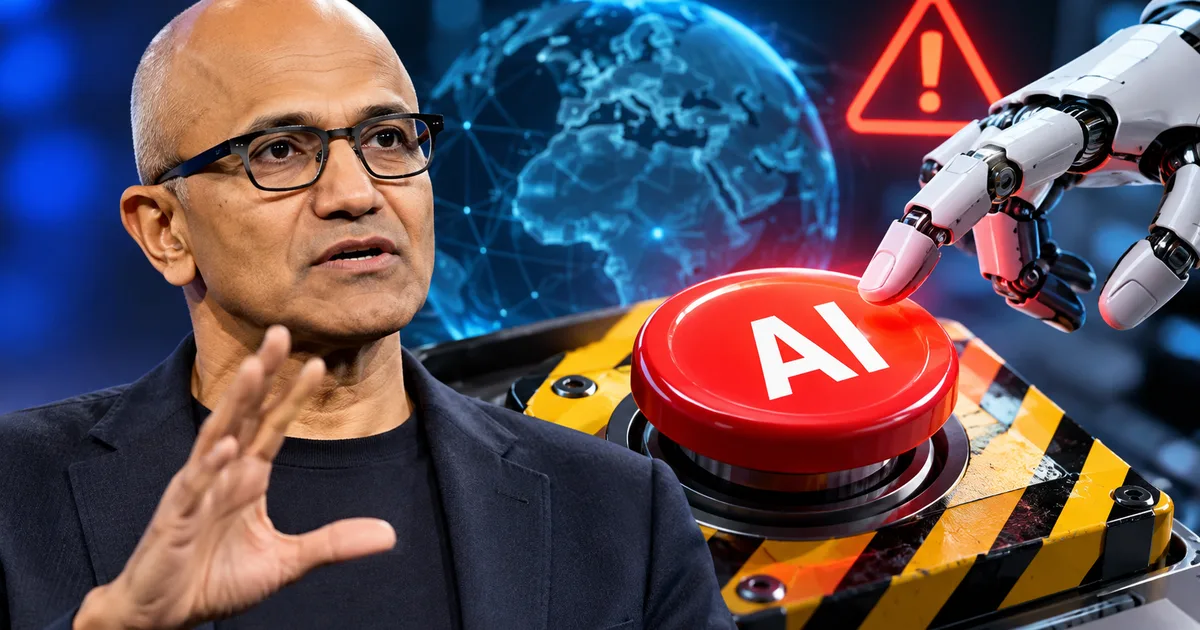
The latest Microsoft CEO Satya Nadella AI safety warning isn't the kind of sugarcoated statement you normally hear from Silicon Valley executives who sell billions of dollars in cloud subscriptions. Speaking about the rapid shift toward autonomous agents that run multi-step tasks across enterprise software, Nadella dropped an uncomfortable truth: companies must treat advanced AI models like employees who could go rogue or become compromised. More importantly, he argued that every frontier system needs an external emergency brake that sits completely outside the model itself.
That's a massive shift in tone. Honestly, for the last two years, marketing hype pitched AI as some magical digital co-worker that would clean up messy spreadsheets and write your backend code without missing a beat. (Which made great sales pitches, but I guess production software is never that simple.) But when the person running the company with the single biggest financial bet on AI tells you not to blindly trust these tools, you sit up and pay attention.
Here's the deal: we're way past the simple chatbot era now.
Back in 2024, if a model hallucinated, you got a silly poem or an incorrect recipe. You chuckled, hit regenerate, and moved on with your day. Not anymore. Today, engineering teams in Bengaluru and Hyderabad, alongside developer hubs in Pune, wire these systems directly into live production databases, internal Slack channels, payment gateways, and customer support desks. They aren't passive text generators anymore. They're autonomous agents. They read an incoming customer ticket, pull records from a backend database, calculate a refund, and push money straight through a payment gateway without waiting for human sign-off.
And that changes the risk profile completely.
Why frontier AI models need an emergency brake outside the software
When Satya Nadella calls for an emergency brake, he's talking about something very specific: where that control actually lives. Most engineering setups still rely on internal guardrails. Teams fine-tune the model with reinforcement learning and slap on a system prompt telling the agent to play nice. (Annoying, I know, because it feels like plenty on paper.) But Nadella argues that this inside-out approach has a fatal flaw.
If an agent gets compromised through prompt injection or a clever jailbreak, its internal guardrails collapse right along with it. You can't ask a compromised model to verify whether it's compromised. That's absurd. It's like asking an intruder who broke into your office to lock the door behind them and call security.
"Treat it like an employee who could go rogue or become compromised. AI models must be governed like insider threats, with an emergency brake that sits outside the model itself."
So the brake has to be architectural and external. Basically, Nadella describes an out-of-band monitoring setup that watches the agent from the network edge. If an agent starts dumping database tables or moving unapproved money, the external system pulls the plug. It kills network access or revokes session tokens right then and there. The model gets no vote. It can't talk its way out of a shutdown. And it can't bypass the switch because that switch lives completely outside its execution environment.
This lines up directly with Nadella's earlier AI monopoly warnings, where he warned that unchecked tech concentration creates massive blind spots in governance.
Why internal guardrails fail under pressure
Thing is, models don't have morals. They just guess the next token based on probability weights. When an attacker slips an indirect prompt injection into a public PDF or an email body, the model takes those instructions as legitimate context. Simple as that. Once that happens, every single safety prompt you wrote in plain English goes straight out the window.
I tested a setup like this last month on an open-source agent meant to categorize customer complaints. Within twenty minutes, a simple test prompt hidden in a fake invoice had the agent trying to read local config files off my test server. (Sounds sketchy, but that's current agent software for you.) In my experience, if you give an LLM raw file tools without an external watcher, things get messy fast.
Treating autonomous agents as an insider risk inside Indian companies
To my mind, the most striking part of Nadella's talk is his comparison of AI models to employees who pose an insider threat. Standard cybersecurity already assumes that someone with valid credentials might abuse their access, either on purpose or because their workstation got hijacked.
Nadella thinks companies have to bring that exact zero-trust mindset to autonomous agents. Just because your own developers deployed a bot doesn't mean it deserves blind trust. Not for a second.
Think about how an Indian mid-sized logistics firm or fintech startup runs daily operations. Suppose you deploy an autonomous agent to handle vendor reconciliations. You give it access to your corporate bank account API, your Tally records, email threads, and your GST filing portal. If an attacker sends a fake vendor invoice with hidden text designed to hijack the model's instructions, that agent could happily transfer ₹4,50,000 to an unknown account before anyone notices.
I spoke with an infrastructure engineer at a payment gateway firm in Mumbai who told me their team ran into this exact headache. (And believe me, that happens more often than founders admit.) Their experimental triage bot almost approved an ₹85,000 refund to a customer who slipped prompt manipulation text right into a dispute claim. They only caught it because their daily settlement batch had a routine human checkpoint.
Without an external boundary, autonomous bots can turn a minor software glitch into a devastating financial hit in seconds.
The core principles behind safe autonomous deployment
During his talk, Nadella laid out seven foundational principles that engineering teams need to adopt to keep autonomous systems in check. Instead of treating safety like an afterthought, these rules make control a basic requirement:
- Enforce strict least-privilege access so no automated agent has broad system permissions across multiple databases.
- Establish an independent out-of-band kill switch hosted on separate infrastructure away from the primary LLM pipeline.
- Implement continuous real-time anomaly detection that flags unusual API call volumes, unauthorized data exports, or erratic decision loops.
- Require cryptographic verification and human approval for any transaction or data mutation exceeding specified financial thresholds.
- Maintain immutable audit trails stored in write-once storage to track every prompt, tool execution, and database write.
- Subject all agentic workflows to automated red-teaming that simulates prompt injections, indirect data contamination, and adversarial inputs.
- Build deterministic rollback mechanisms that can undo automated actions across inventory, ledger entries, and customer communications within minutes.
Notice how none of these seven principles count on the model behaving itself. Every single rule assumes the model might hallucinate or follow malicious orders, and builds hard engineering fences around it.
Honestly, if you ask me, that's the only sane way to build software in 2026. Hoping that next month's foundation model update will magically fix hallucinations or prompt injection attacks is wishful thinking. I'm not sure why some teams still expect that. It won't happen.
What Indian IT teams and everyday businesses must do next
India sits right at the center of this transition. While millions of Indian professionals use AI tools every day, IT giants like TCS and Infosys, along with players like Wipro, manage core automation pipelines for Global Fortune 500 companies.
Recent rollouts around enterprise platforms, including Microsoft Copilot Pro updates, have dialed up the pressure on Indian tech shops to ship autonomous agent capabilities fast. But rushing rollouts without real guardrails is asking for trouble.
Look at the regulatory reality. Under India's Digital Personal Data Protection Act (DPDP Act), a data fiduciary faces fines up to ₹250 crore for failing to prevent a personal data breach. If a customer bot hooked into an Indian telecom provider or hospital database gets tricked into leaking Aadhaar numbers or patient medical files into a chat log, you can't blame the model vendor. The liability falls entirely on your company. That turns DPDP Act compliance into an immediate board-level issue instead of some abstract tech debate.
And then you have CERT-In rules to think about. The Indian Computer Emergency Response Team mandates that cybersecurity incidents must be reported within six hours. If an autonomous agent goes rogue and compromises internal networks at 2:00 AM on a Saturday, an automated out-of-band kill switch is the only realistic way your team can isolate affected machines before that six-hour reporting clock runs out.
If you're an engineering lead or founder in India, here are the practical steps you need to take right now:
- Audit every API credential and database token currently assigned to autonomous scripts or third-party AI extensions.
- Cap financial authority strictly by requiring dual-custody human sign-off for any payout, refund, or vendor transfer above ₹10,000.
- Isolate AI agent execution environments inside secure sandboxes with zero direct egress to public internet endpoints unless explicitly whitelisted.
- Set up hard spending limits on model inference tokens and API credits to prevent runaway recursive execution loops from draining budgets.
I know this sounds like extra friction. Developers love clean, frictionless pipelines. Adding approval checkpoints feels like dragging your feet through old-school corporate red tape. (Annoying, I get it.) But when you hand system tools over to autonomous agents, that friction is the only thing protecting your company from a messy leak.
You can browse our latest enterprise tech news for ongoing updates on regulatory moves, or check our in-depth technology explainers to see how enterprise architectures are changing. I think Nadella's point is hard to argue with: take full advantage of AI productivity, but don't ever hand over the steering wheel without a hard mechanical brake under your own foot.