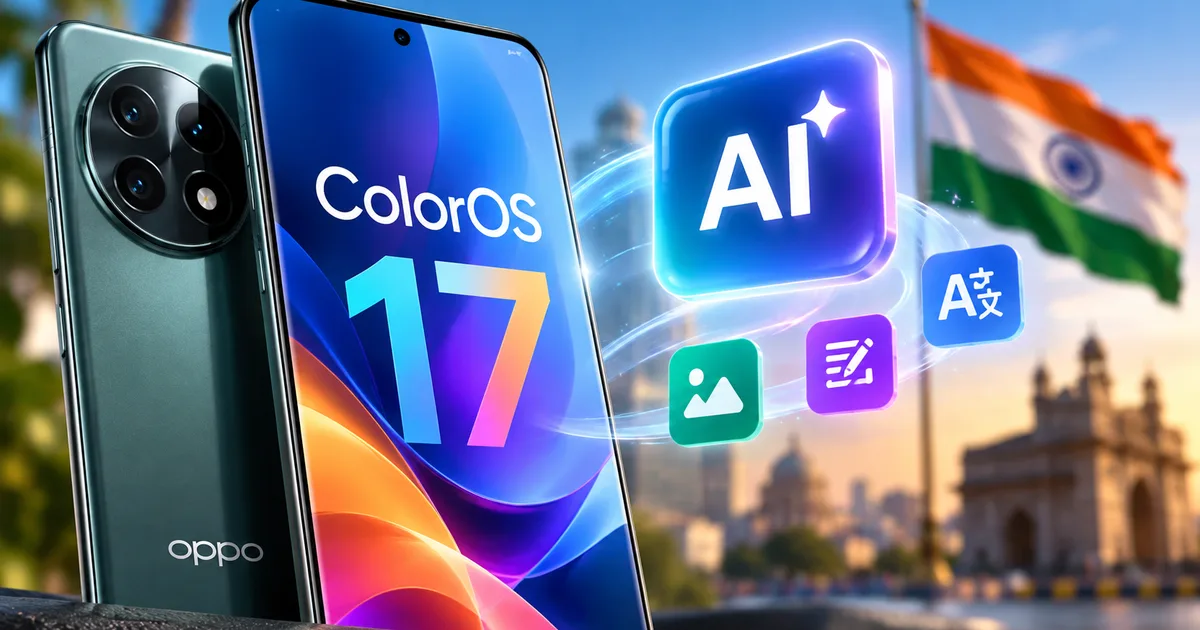
Oppo announced the global arrival of Oppo ColorOS 17 on October 13, 2026, right ahead of its upcoming Find X10 flagship launch on October 21. If you carry an Oppo phone or a OnePlus handset in India, this Android 17 update brings substantial changes to how your device looks and runs during everyday tasks.
I watched the official launch livestream at 2:30 PM IST with a good bit of skepticism. Every single year, phone brands promise smoother animations and smarter software that supposedly gets your life. Most of the time, we end up with bubbly app icons and weird battery drain for the first four days. And of course, there are those pre-installed apps you can't remove without a PC. But this time around, Oppo took a noticeably different route.
They focused heavily on fixing background memory hogging and adding practical automation. Honestly, that caught my attention.
What Living Flow design and new performance engines actually do
Oppo calls the fresh visual interface Living Flow Design. Basically, it drops flat panels for soft glass styling and fluid physics. The transitions react directly to where your thumb touches the glass.
It looks clean. Icons have subtle depth, and notifications settle smoothly onto the display. Switching between open windows is snappy too. But in my experience, visual polish means nothing if your phone turns into a pocket heater the minute you run Google Maps while ordering groceries on Blinkit.
According to performance figures Oppo shared during the launch, the updated rendering architecture cuts graphics processing loads by up to 30%. It also reduces rendering-related RAM use by up to 25%. App launch stability is up by 55% compared with ColorOS 16, while first-time thumbnail loading in the Gallery app speeds up by 50%. Most practical of all, the system keeps around 25% more apps alive in the background without refreshing them.
Manufacturer numbers always show ideal laboratory testing, but if everyday multitasking delivers even half of that 25% memory retention improvement, budget and mid-range devices will feel noticeably smoother when jumping between heavy payment apps.
System engines: Aurora, Polar Light, and Tidal
To deliver those numbers across different hardware tiers, Oppo built three separate software engines right into the operating system.
- Aurora Engine handles touch response times, cutting the tiny delay between your finger hitting the glass and the screen registering the tap.
- Polar Light Engine balances internal memory allocation so applications do not stutter when opening fresh from a cold start.
- Tidal Engine directs CPU core scheduling, managing processor heavy tasks during gaming and maintaining background app state during busy workdays.
Tidal Engine is particularly relevant if you play games like BGMI on a ₹25,000 handset. Instead of dumping raw clock speeds across all cores and scorching your battery, the system shifts processing power dynamically. It gives you steady frame rates. And it stops your phone from turning into an iron box.
What the new ColorOS 17 AI tools change for daily phone use
Phone AI has spent the last two years being mostly a novelty gimmick. Generating silly wallpapers or summarizing two-line emails never felt worth the marketing hype. ColorOS 17 shifts that approach toward direct utility through something Oppo calls AI Mind Pilot.
Here's the deal. Instead of just answering questions inside an isolated chat box, the system handles multi-step tasks across your phone. Oppo partnered with Manus and integrated ChatGPT directly into the software to build Agent Mode.
Agent Mode and the Manus integration
Agent Mode connects directly to your local files and pictures. You can give it a plain voice or text prompt. For instance, you can tell it to find the hotel booking PDFs from your downloads folder and rename them by reservation date. Or you can ask it to draft a travel itinerary for Jaipur. The system searches your local storage and reads the dates. Then it renames the files and compiles an itinerary page without making you open three separate apps.
Oppo provides a free usage tier for these agentic features out of the box. If you already pay for a personal ChatGPT subscription, you can connect your existing account directly to unlock higher usage limits. (Which, if you ask me, is a sensible way to handle ongoing server compute costs rather than slapping an unwanted monthly phone subscription on Indian buyers).
AI Photo Agent and smarter media notes
Photo editing also gets a practical upgrade with the new AI Photo Agent. Instead of fiddling with twenty sliders for exposure and color balance, you can instruct the editor in normal English or Hinglish.
There is also a Style Match feature that reads the tone and color palette of an existing reference photo and applies that aesthetic to your new picture. Oppo says its six dedicated imaging models preserve original skin tones and the natural ProXDR dynamic range. You avoid that oversaturated plastic look common in cheap filter apps.
Meanwhile, AI Mind Space lets you clip web articles and video links into an organized collection. It also handles PDFs and screenshots. The tool automatically summarizes long-form reads and groups related receipts or research materials together. If you frequently save documents like utility bills or DigiLocker certificates, having them automatically cataloged saves a lot of time.
You also get updated AI Notes. It can listen to meeting voice recordings and generate structured transcript summaries. And it translates foreign phrases on the fly (which makes sense, actually, given how often people travel for work). You can stay updated with our daily Indian tech news for hands-on impressions once these tools land on regional test builds.
How the built-in fraud detection tackles Indian spam calls
If you live in India, your phone rings at least three or four times every afternoon with someone claiming your courier package is stuck or your electricity connection will be cut off tonight.
Spam in India is relentless. Despite repeated directives from TRAI and advisory notices from CERT-In, telemarketers and scammers constantly bypass caller ID blocks by cycling through fresh burner SIM cards. ColorOS 17 introduces a feature called AI Call-Anti-Fraud. Honestly, I think it's one of the more practical additions in the entire update.
The tool monitors incoming call scripts in real time on the device. When a caller begins reciting recognizable scam scripts, such as impersonating police officers during fake digital arrest scams or demanding money transfers over UPI, the system analyzes the language patterns and flashes a high-visibility warning on your screen.
It gives elderly family members and unsuspecting users an immediate heads-up before panic sets in. Look, no automated software replaces basic common sense. If someone asks for your UPI PIN or an Aadhaar OTP, you hang up immediately.
Legitimate police officers or tax officials never hold court hearings over WhatsApp video calls. Never. Whenever you encounter financial fraud attempts, report them promptly on the official national portal at cybercrime.gov.in or call the 1930 helpline immediately. We regularly cover how these syndicates operate in our cyber fraud protection guides to help you recognize threat patterns before money leaves your account.
ColorOS 17 eligible devices and the OnePlus 13 beta plan
Whenever a major Android release lands, the biggest question is always whether your current phone gets the software or gets left behind. The rollout begins in China and international markets with the flagship Find X10 series on October 21, 2026.
Shortly after that, the software arrives for OnePlus and Realme devices. Because OnePlus shares the underlying software base with Oppo, the OnePlus 13 beta program opens up first, giving enthusiasts early access before the general consumer release.
If you own a phone from the past two years, your chances of receiving the upgrade are quite solid (though the exact dates for older models are still a bit fuzzy). Here is how the device eligibility breaks down across popular lineups in India:
- Flagship Oppo Find series models including Find X10, Find X10 Pro, Find X8, Find X7, Find N3, and Find N3 Flip.
- Upper mid-range Oppo Reno models including Reno 14 Pro, Reno 13 series, Reno 12 Pro 5G, and Reno 11 5G.
- Mass-market Oppo F series devices including Oppo F27 Pro+, Oppo F25 Pro, and Oppo F23 5G.
- Budget-focused Oppo K series smartphones such as the K12x 5G and K14 Plus.
- Eligible OnePlus devices including the OnePlus 13, OnePlus 12, OnePlus 12R, OnePlus 11, OnePlus 11R, OnePlus Nord 4, and OnePlus Nord CE4.
- Realme handsets running on the shared architecture, specifically the Realme GT 6, GT 7 series, and upper number series models.
You can check our dedicated breakdown of OnePlus ColorOS 17 eligible phones to confirm specific hardware test schedules for your exact OnePlus variant.
ColorOS 17 India rollout timeline and what to do before updating
Oppo confirmed that the first wave of stable ColorOS 17 updates starts rolling out alongside the Find X10 global debut. Indian buyers can expect the Find X10 launch in the country around October 22, 2026.
The broader Indian rollout follows a phased schedule. Flagships get the software first between late October and December 2026. Reno series handsets and mid-range F series phones priced between ₹20,000 and ₹35,000 will see open beta builds and stable over-the-air updates arriving between January and March 2027.
Thing is, you should never rush to tap install on day one without some basic precautions. Early operating system updates often carry subtle bugs and temporary battery drain. And sometimes older banking apps refuse to work properly.
Steps to back up your data before installing
Before accepting any major Android 17 package, take ten minutes to secure your phone:
- Create a complete local backup of your photos, WhatsApp chats, and offline documents to a personal computer or cloud storage.
- Verify your UPI apps, net banking profiles, and DigiLocker credentials so you can log back in without needing branch visits if app data clears.
- Charge your battery to at least 70% and connect to an unmetered Wi-Fi connection to prevent installation failures halfway through the process.
- Leave at least 15 GB of free internal storage so the installation engine can unpack files cleanly without corrupting system partitions.
For a deeper look at month-by-month release windows across every model, check our comprehensive ColorOS 17 India rollout timeline.
Software upgrades should make your daily routine smoother, not more stressful. ColorOS 17 brings noticeable visual polish and practical fraud prevention tools that genuinely matter to Indian phone owners. Back up your files and keep an eye on your updater. Grab the update when the notification hits your phone.