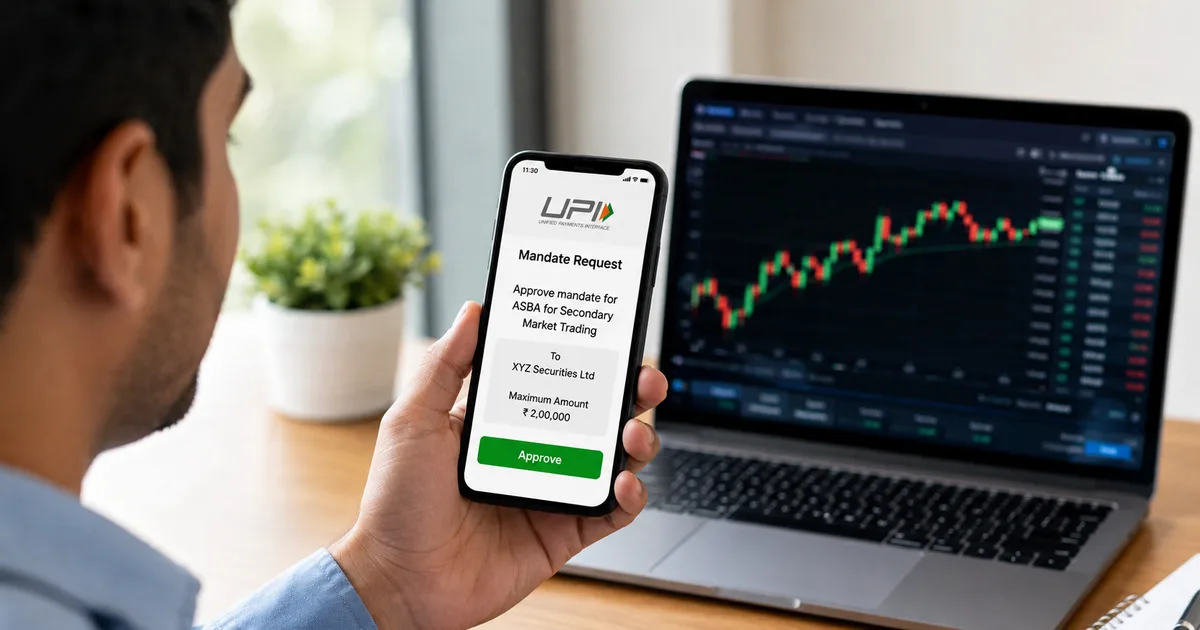
SEBI has mandated that Qualified Stock Brokers (QSBs) must offer either an ASBA-like UPI fund-blocking facility or a 3-in-1 account for secondary market trades, effective from February 1, 2026. If you trade stocks on NSE or BSE through any major broker in India, the SEBI ASBA-UPI mandate directly affects how your money moves during every transaction, and it's a bigger deal than most retail investors realise.
What ASBA actually is — and why IPO investors already know this
If you've applied for an IPO in the last few years, you've already used ASBA. That's Application Supported by Blocked Amount. You apply, the money gets blocked in your bank account. It only gets debited if you receive an allotment. If you don't get shares, nothing moves. No funds sitting idle in some intermediary's pool account for days on end.
Before ASBA, IPO applicants would transfer money to the broker or registrar, wait, and hope it came back if they didn't get shares. Funds could sit there for a week or more. ASBA fixed that. It's been standard for IPOs since 2016.
Now SEBI wants something similar for secondary market trades, meaning the everyday buying and selling of shares on stock exchanges. And honestly, it's surprising this took as long as it did. In my experience, most investors don't realise ASBA exists until they're trying to explain why their IPO money is "blocked" and not "gone."
What the SEBI mandate actually requires
SEBI's circular requires all Qualified Stock Brokers to offer clients one of two options:
- An ASBA-like facility where funds are blocked via UPI but remain in your bank account until settlement
- A 3-in-1 account, where your trading, demat, and savings accounts are all linked through the same bank
Basically, the word "blocked" is doing a lot of work there. Currently, when you buy ₹50,000 worth of Infosys shares, that money moves from your account to your broker's pooled client account before the trade settles. Under the new mechanism, those ₹50,000 stay in your savings account (just blocked via UPI), and they only actually debit on settlement day. That's T+1 for most equity trades.
NPCI built the infrastructure for this. The system extends UPI's existing block mechanism, the same technical plumbing that powers IPO applications and e-mandates, now applied to secondary market trades. Moneycontrol and Business Standard both reported the rollout in detail when SEBI issued the circular. NDTV Profit confirmed the February 1 deadline for QSBs.
Under the SEBI ASBA-UPI mandate, your funds stay in your bank account and are only debited on settlement day — the broker never physically holds your cash during the settlement window.
Why the old system was a genuine problem
This isn't a fix in search of a problem.
The Karvy Stock Broking scandal is the most prominent example of what can go wrong when assets sit with a broker. Karvy pledged client securities worth over ₹2,900 crore without client consent. SEBI cancelled Karvy's broker registration in 2019 after the fraud surfaced. There have been smaller cases too: brokers going bust, client funds stuck in insolvency proceedings when a firm collapsed.
So for the ordinary investor with ₹2-5 lakh parked in a trading account, that's real money at real risk. The ASBA-UPI mechanism removes that risk for the settlement window. Your money stays with your bank. The broker doesn't hold it.
Who counts as a Qualified Stock Broker?
SEBI defined QSBs in a 2021 framework. The criteria cover things like active client count, total trading volume, end-of-day settlement obligations, and a few other operational measures. The list gets updated periodically.
As of 2026, the QSB category covers most brokers you've probably heard of. Zerodha, Groww, Angel One, ICICI Direct, HDFC Securities, Sharekhan, Motilal Oswal: they're all QSBs, or they're structured through bank-linked arrangements that already meet the mandate's intent. Smaller regional brokers may not be covered directly yet. I'm not sure exactly when SEBI plans to extend this to the smaller players, though it has signalled broader adoption is coming.
If you're with one of the top ten brokers in India by active client count, this applies to you. If you're unsure, just ask your broker directly. They should have sent some communication about this already. If they haven't, that's worth following up on.
How the UPI block mechanism works step by step
Here's the practical flow once this system is live with your broker:
- You place a buy order for 10 shares of HDFC Bank at ₹1,800 each — ₹18,000 total
- Instead of transferring ₹18,000 to the broker's pool account, the broker's system sends a UPI block request to your bank
- Your bank blocks ₹18,000 in your account — shown as "blocked funds," the same way IPO applications via UPI work
- On settlement day (T+1), ₹18,000 gets debited directly from your account to complete the trade
- If your order doesn't execute or gets cancelled, the block is released and your full balance is available again
For long-term investors buying stocks once a month, this change will be mostly invisible. The app works the same. Settlement works the same. The difference is structural: your bank holds your cash right up until settlement, not your broker.
Active intraday traders have more to think about. Multiple simultaneous blocks could tie up significant balance even if most orders get cancelled quickly. SEBI and NPCI have built in provisions for fast block release on cancelled orders, but expect some friction during the early implementation months, particularly with brokers that run complex order management systems (annoying, I know). I'd give it a few months before declaring any specific broker's implementation smooth.
The 3-in-1 account as the alternative
Not every investor wants to manage UPI blocks for every trade. SEBI's second option is the 3-in-1 account, which links your savings account, demat account, trading access, and settlement records all under one institution. SBI Securities, ICICI Direct, HDFC Securities, and Kotak Securities all offer this.
The logic is clean. If your money never leaves the bank and is just moving between internal accounts at the same institution, the systemic risk is much lower.
3-in-1 accounts have traditionally come with higher brokerage costs and fewer platform features compared to discount brokers like Zerodha or Groww. This mandate doesn't change that trade-off. It just makes 3-in-1 accounts the officially recognised alternative for investors who'd rather not use the UPI block approach. If you're already with a bank-backed broker and have this setup, you're likely already compliant, but confirm it anyway.
What investors should actually do right now
The mandate has been in effect since February 1, 2026. Here's what makes practical sense:
- Check your broker's app or website for any announcement about ASBA-like facility or UPI block mechanism for secondary market trades
- If you're with a major QSB, contact customer support to ask whether the feature is live and whether you need to opt in explicitly — some brokers may require consent or a settings update
- If you have a 3-in-1 account with a bank-backed broker, confirm your setup already meets compliance requirements
- Check your bank's UPI transaction limit — ensure it covers your typical single trade size, since the block request routes through UPI and daily limits vary by bank
SEBI's enforcement posture has tightened considerably in recent years. Brokers who lag on compliance face inspection risk and potential penalties. If your broker has gone quiet on this, push for clarity rather than assuming everything is sorted behind the scenes.
For a broader understanding of how UPI powers India's financial infrastructure, the explainers section covers the technical side in plain language. If you're thinking about switching brokers based on features or compliance, the tools section has comparison resources. And for the wider regulatory picture around SEBI's investor protection reforms, the guides section goes into more depth.
The bigger regulatory context: SEBI Vision 2030
This ASBA-UPI mandate is part of SEBI's broader Vision 2030 push, a series of regulatory reforms aimed at improving market integrity and protecting retail investors. The Economic Survey 2026 specifically called out SEBI as one of the more proactive regulators stepping up its reform agenda. Combined with India's shift to T+1 settlement in 2023 (which put Indian equities ahead of most global markets in settlement speed), the structural safety of Indian stock markets for retail investors has genuinely improved over the last three years.
Is it all perfect? No. Implementation quality will vary by broker. Edge cases around UPI block timeouts and partial order fills will surface in the first year (intraday positions especially). But the core idea is sound: your money stays in your own bank account until it actually needs to move. That's just good investor protection. Long overdue for the secondary market, if you ask me. If you want to understand related risks around broker account fraud and trading infrastructure scams, the scam alerts section has specific coverage worth reading.