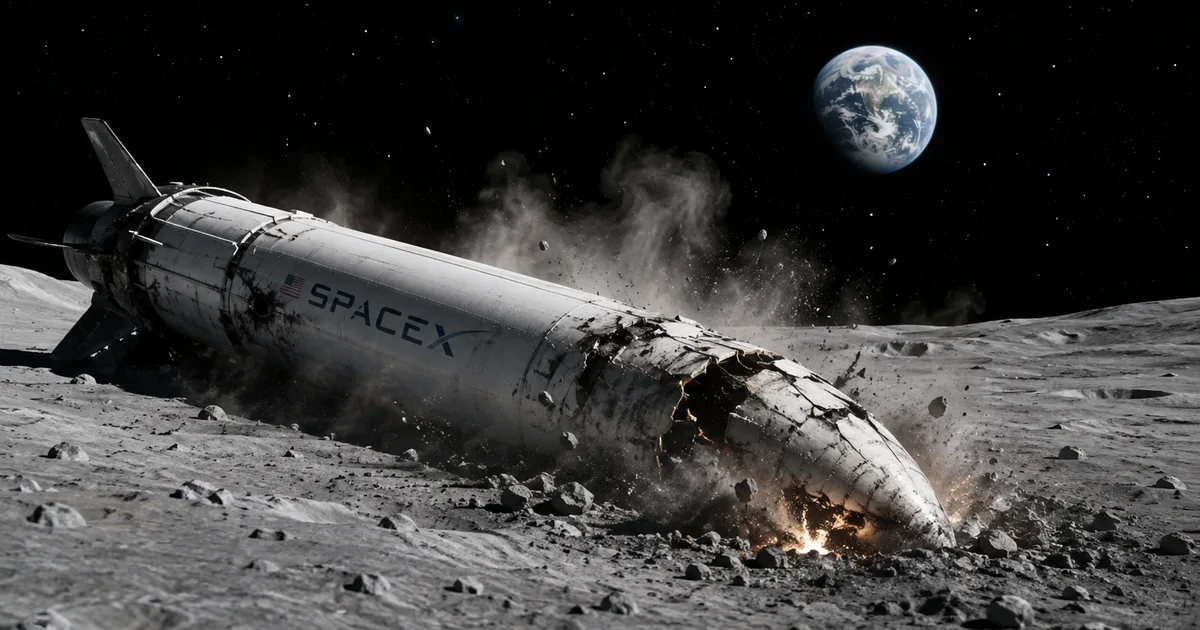
Look, space is messy. But the recent news that a piece of a SpaceX rocket crashes on the Moon 2026 is still pretty wild. Basically, an old part of a Falcon 9 rocket just slammed into the lunar surface at roughly 8,700 kilometres per hour. It kicked up a massive cloud of dust near the Einstein crater. And honestly, this isn't some highly calculated scientific mission gone right. It's essentially a four-tonne piece of space garbage that was just drifting around for over a year before finally finding a parking spot the hard way.
I've been following this story since scientists first noticed the stray stage drifting through space. The crash exposes a huge, growing problem. This stuff directly affects everyone. Even us sitting here in India relying on satellites for our daily UPI payments.
How a SpaceX Falcon 9 ended up as a lunar projectile
So, how does a highly advanced piece of machinery built by Elon Musk's company end up randomly hitting the moon? Here's the deal. Back in early 2025, SpaceX launched two lunar landers, and the rocket did its job perfectly. But the upper stage didn't have enough fuel to return to Earth's atmosphere to burn up. This is the part that actually pushes the payload into its final trajectory. It also lacked the energy to escape the Earth and Moon gravity completely.
So it just hung out for months. It was caught in a chaotic, tug-of-war orbit between the Earth's and the Moon's gravity.
(I know, sounds complicated but it's not. Imagine a car running out of petrol exactly in the middle of nowhere and just rolling aimlessly for a year until it hits a wall.)
The 8,700 kmph collision
On August 5, that wall happened to be the moon. Tracking data shows the 8,818-pound (roughly four tonnes) metal cylinder smashed into the far side of the moon near a feature called the Einstein crater. We're talking about an impact speed of around 8,700 kmph. A crash like that is expected to instantly carve out a crater about 60 feet wide and 12 feet deep. The numbers here are a bit fuzzy, honestly. But it is massive.
To put that in perspective, that's like crashing a fully loaded tempo traveller into a solid wall at the speed of a hypersonic missile.
Why you couldn't see it from Earth
If you were hoping to step out onto your balcony in Mumbai or Bengaluru, look up, and see a tiny explosion, I have bad news. The crash happened on the far side of the moon. That's the side constantly facing away from Earth.
Even if it had happened on the near side, you wouldn't have seen it with the naked eye. The flash of light would be minimal. There's no oxygen on the moon for a traditional fire or explosion, so the kinetic energy simply vaporizes the metal. It just kicks up a massive cloud of lunar dust.
"The impact will create a new crater and throw up a large plume of dust, which we hope to observe using satellites currently orbiting the Moon," noted astronomers tracking the event.
In fact, NASA and India's own ISRO often use their lunar orbiters (like Chandrayaan-2's orbiter) to look for these fresh craters to understand the moon's surface better. I think it's a clever way to study the soil.
Is this normal? (Spoiler: sort of)
You might be thinking, "Should we be worried about companies just throwing their trash at the moon?"
Yes and no. Stuff hits the moon all the time. Meteoroids bombard it daily. Man-made objects are a bit rarer, though not unprecedented. NASA deliberately crashed Saturn V rocket stages into the moon during the Apollo missions to calibrate seismometers they'd left on the surface.
But this SpaceX crash was completely unintentional. And that's what has the space community a bit on edge. It's one thing to plan a crash for science. It's another to just lose control of a four-tonne metal tube. You can't just shrug when it hits a celestial body.
For more on how tech impacts our daily lives, check out our deep dive guides.
The real issue: space junk and our daily lives
Here's where it actually matters to you and me. A massive rocket stage was drifting completely untracked for a while. This points to a huge blind spot in how we monitor deep space.
Right now, if you want to buy a Rs 10 cutting chai at a tapri, you probably pull out your phone and scan a PhonePe or Google Pay QR code. That transaction relies on GPS and telecom networks. Those networks rely on satellites. If space becomes a junkyard of dead rockets and broken satellites, the risk of collisions in Earth orbit goes up fast. A major collision could wipe out the satellite networks we use for everything from banking to weather forecasting. It's a mess, in my experience covering this.
India is actually taking this very seriously. ISRO recently implemented strict protocols to ensure their rocket stages either burn up in the atmosphere or are moved to "graveyard orbits" where they can't harm anything. They've even done controlled re-entries for the upper stages of the PSLV rockets.
But when private companies like SpaceX are launching rockets almost every week, the sheer volume of hardware going up is staggering.
Who polices space?
Honestly, nobody really does. There are treaties from the 1960s that say countries are responsible for the damage their space objects cause. The rules around "space littering" are incredibly vague, though. If a stray piece of space junk damages an Indian communication satellite, proving who owns it and getting compensation is a legal nightmare. (Which makes sense, actually, given the distances involved).
This is why organizations like CERT-In are constantly monitoring cyber threats. We lack a similar, aggressive global body for physical space traffic management. We desperately need better tracking.
What happens next at the Einstein crater?
Now, the race is on to get a look at the impact site. Earth-based telescopes are useless since the crash happened on the far side. But humanity has a few eyes in the sky around the moon.
NASA's Lunar Reconnaissance Orbiter (LRO) and India's Chandrayaan-2 orbiter will likely sweep over the area in the coming weeks. They'll take high-resolution photos of the fresh crater.
This is actually a weird silver lining. Scientists love fresh craters. The rocket smashed into the surface and dug up material from beneath the top layer of lunar dust. Scientists can learn more about the moon's composition by analyzing the light reflected from this newly exposed dirt. It's essentially a free, albeit chaotic, excavation project.
If you're curious about other tech fails and scams, read our latest scam alerts to stay safe online.
How did we even know it was going to hit?
Let's talk about how this was discovered. The tracking was entirely done by independent astronomers, not governments. Bill Gray is an independent software writer who tracks near-Earth objects. He was the first to realize the trajectory of this object was on a collision course with the moon.
Think about that. Governments globally spend billions of dollars on defense and space monitoring. Yet it was an independent researcher running software who sounded the alarm. The US Space Command tracks objects in low Earth orbit, basically where the International Space Station and most satellites live. They don't heavily monitor deep space, though.
This is a massive hole in our global infrastructure. If we can't reliably track a four-tonne rocket stage, what else are we missing? I'm not sure exactly why it's ignored so much.
India's role in cleaning up space
This is where India is quietly doing some really impressive work. You don't hear about it as much as the flashy SpaceX launches. But ISRO is heavily focused on sustainability in space.
They have an initiative called Project NETRA (Network for space object Tracking and Analysis). The goal is to give India its own capability to detect and track space debris. It warns our satellites of potential collisions. We've over 50 operational satellites in orbit. The INSAT series powers your DTH television. The IRS satellites help farmers predict weather. Billions of rupees and important daily services depend on these assets staying safe.
ISRO has also successfully demonstrated a "zero orbital debris" mission. They recently conducted an experiment where the final stage of a PSLV rocket was deliberately lowered in altitude after deploying its satellites. This ensured it'd burn up in Earth's atmosphere rather than lingering as hazardous junk.
It's a stark contrast to the "launch and forget" mentality that caused this SpaceX lunar crash.
The cost of space junk
Let's talk money. A standard communication satellite costs upwards of Rs 1,500 crore to build and launch. If a random piece of metal moving at 25,000 kmph hits it, that money is instantly vaporized. It is a massive scientific loss, and a financial one.
And the cost gets passed down to us. Internet and cellular services get more expensive if telecom companies lose satellites. Crop predictions fail if weather satellites are knocked out. This leads to agricultural losses. The economy of space is directly tied to the economy on the ground.
If you're interested in how government policies affect tech costs, read our detailed explainers.
What's the SpaceX response?
SpaceX hasn't said much publicly about this specific crash. Elon Musk's company is incredibly focused on reusability. Their Falcon 9 first stages land themselves and are reused multiple times. This is a huge engineering achievement that's completely changed the launch market.
But the second stages aren't currently reusable. These are the parts that go higher and faster. Most are directed to burn up in the atmosphere. But things don't always go according to plan, as this incident shows.
The lack of official comment exposes the gray area of space law. Currently, there are no fines for crashing a rocket into the moon. There's no space RTO to issue a challan. (Annoying, I know).
The future of lunar exploration
The timing of this crash is heavily ironic. We're currently in the middle of a massive global rush to return to the moon.
- NASA is pushing forward with its Artemis program to put humans back on the surface.
- ISRO is in the planning stages for Chandrayaan-4, which will be a complex sample return mission.
- China is aggressively pursuing plans to build its own permanent lunar infrastructure.
With so much traffic heading to the moon in the next decade, we desperately need traffic rules. We need international agreements on how to dispose of hardware. The moon might seem big and empty. But the desirable spots, like the water-rich south pole where Chandrayaan-3 landed, are limited.
We can't have a situation where future lunar bases are dodging random rocket stages falling from the sky.
A wake-up call for tech regulations
Ultimately, the SpaceX rocket crash is a perfect example of technology moving faster than regulation. We see this everywhere. AI tools generate deepfakes, and social media algorithms spread misinformation. The tech is deployed. Then governments scramble to write rules years later.
But in space, the consequences of moving too fast and breaking things are permanent. You can't just release a software patch to clean up thousands of pieces of shrapnel in orbit.
The bottom line for Indian tech watchers
So, what's the takeaway here? A SpaceX Falcon 9 upper stage hitting the moon isn't the end of the world. It won't affect the tides. And it won't break the moon.
But it is a loud warning shot. India is expanding its space footprint with missions like Gaganyaan, so we need to ensure we protect space as we explore it. The cleanliness and safety of our orbital highways are incredibly important right now.
Because eventually, the trash is going to hit something a lot more valuable than empty rock.