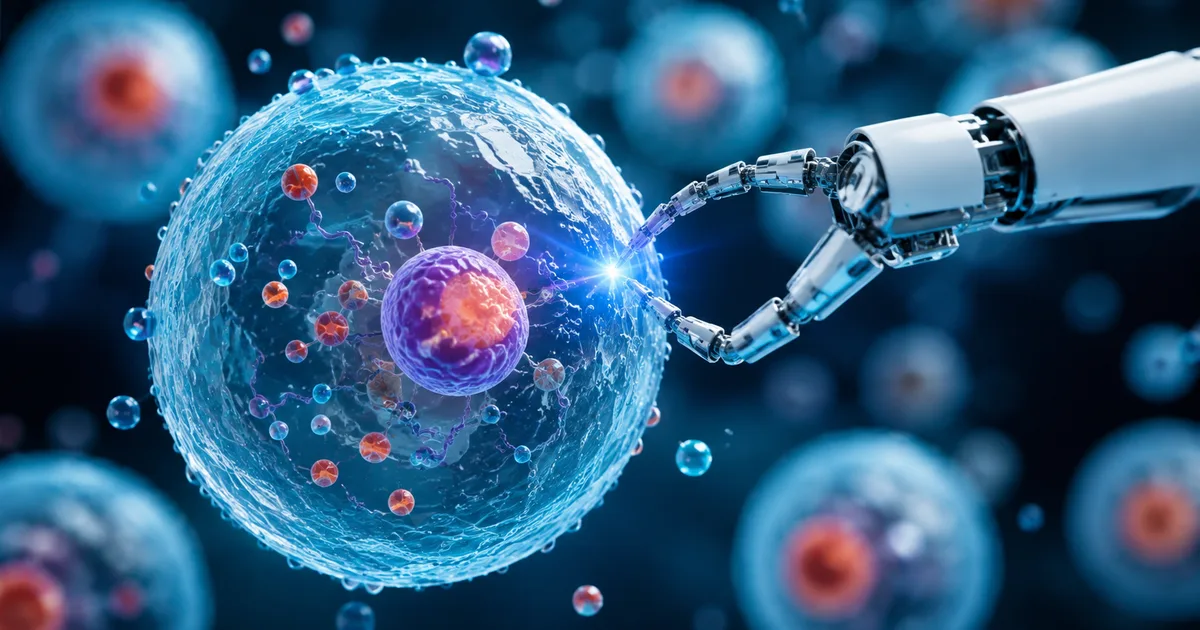
Look, biology used to be messy. We studied things that already existed. We observed cells under microscopes and tried to figure out how they worked. But right now, we're watching the start of something completely different. The synthetic cells breakthrough 2026 is happening before our eyes. Honestly, it's equal parts terrifying and amazing. Scientists at the University of Minnesota have actually built a cell from scratch. They call it SpudCell. They didn't modify an existing bacteria. They put together chemical components and made something that acts alive.
You might be thinking this sounds like science fiction. I get it. But this is happening right now in real labs (which makes sense, actually, given the funding). The University of Minnesota Twin Cities team managed to create a synthetic cell with a complete life cycle. The Times of India reported that these cells can grow and reproduce entirely on their own. They're calling them 'beautiful blobs'. And it's hard to disagree when you see the potential here.
This is the creation of artificial life using lab-made DNA. The researchers demonstrated that core life processes run perfectly well on synthetic parts. They literally built the basic component of life from scratch.
The SpudCell project demonstrates an unprecedented level of control over the genetic software that powers living cells, proving that we can design biological machines from the ground up.
What exactly is SpudCell and how does it work?
To understand what's happening, you need to know how cells normally function. Natural cells have DNA and a whole messy soup of proteins. They're incredibly complex. SpudCell is different. The scientists stripped away all the evolutionary baggage. They built a streamlined version of a cell. It only does what it absolutely needs to do.
They used non-living chemical components and mixed them in a very specific way. Then, those components started acting like a living organism. The synthetic cell absorbs nutrients from its environment. It grows larger and divides into two new cells. This is a complete life cycle. Harvard scientists who worked on similar projects even witnessed Darwinian evolution in real time. The cells started adapting to their environment.
I know, sounds complicated. It's actually quite simple in concept, if you ask me. Think of it like building a computer from individual transistors instead of buying a pre-made laptop. You know exactly what every single part does because you put it there yourself.
The difference between modifying and creating
People often confuse this new research with genetic engineering. Let me clarify the difference. We've been doing genetic engineering for decades. When scientists modify a crop to resist pests, they take an existing plant and insert a tiny piece of new DNA. They edit a document that someone else wrote.
The SpudCell project is completely different. The scientists started with a blank document. They built the cell membrane from basic lipids and synthesized the DNA from chemical precursors. Every single molecule in that cell is there because a human decided to put it there.
This gives researchers an incredible level of control. Natural cells have thousands of genes that do things we don't fully understand. They have built-in survival mechanisms that can interfere with medical treatments. A synthetic cell only has the genes we give it. If we want it to produce a specific protein, it'll do exactly that. It won't randomly mutate to survive a harsh environment unless we program it to do so.
How artificial intelligence writes genetic code
We have to talk about how they managed to do this so fast. The answer is artificial intelligence. A few years ago, designing a synthetic genome would take decades of trial and error. Humans simply can't process the billions of possible genetic combinations fast enough.
So this is where AI steps in. Machine learning models predict how proteins will fold. They simulate how different chemical components will interact before anyone mixes them in a test tube. The algorithms learn the language of biology. Then they start writing their own sentences.
We have detailed explainers on how large language models work for text. The same concept applies to DNA. The AI looks at millions of natural genomes. It figures out the rules. Then it generates a completely new sequence that has never existed in nature. Scientists take that sequence and print it out using chemical synthesizers. Finally, they put it into a synthetic cell wall.
I spoke to a developer working on biological machine learning last month. They explained that biological data is essentially just text. DNA is written in four letters: A, C, T, and G. An AI model like a transformer doesn't care if it's reading English or a genetic sequence. It just looks for patterns.
When you feed billions of genetic sequences into an AI, it learns the grammar of life. It learns which sequences create a strong cell wall and which sequences cause a cell to self-destruct. This is why the breakthrough happened this year. The AI models finally reached a point where they accurately predict the physical shape of a protein just by reading its genetic code. (Which is wild to think about.)
Without AI, this breakthrough would've taken another fifty years. The algorithms are running simulations 24/7. They find the exact right combination of lipids and proteins to make a stable cell membrane. They design the synthetic DNA that tells the cell how to reproduce.
The Indian context for synthetic biology
You might be wondering why an Indian reader should care about a lab experiment in the US. Think about your medical bills. Think about the cost of insulin or cancer treatments in India. Our healthcare system relies heavily on biologically manufactured drugs.
Right now, pharmaceutical companies use modified bacteria to produce things like insulin. It's a highly inefficient process. The bacteria often do things we don't want them to do because they have their own evolutionary programming. Synthetic cells change this completely.
If Indian pharmaceutical companies adopt this technology, they can design cells that do exactly one thing. They can build a cell that only eats sugar and pumps out cheap insulin. The cost of manufacturing life-saving drugs could drop dramatically. A vial of medicine that costs thousands of rupees today might cost fifty rupees in a few years. I'm not sure exactly why it's taken this long to rethink the manufacturing pipeline, but the math is undeniable.
But there's a catch. The companies that own the patents to these synthetic cells will control the market. We saw what happened with Covid vaccines. If India doesn't invest heavily in synthetic biology and the AI models that power it, we'll be paying a heavy premium to foreign corporations. We need our own startups working on this.
Funding and the local startup scene
Indian startups are beginning to wake up to this reality. We've seen massive investments in AI recently. Sarvam AI hit a massive valuation recently, and other companies are securing Series B rounds to build domain-specific models. But most of the money is going toward chatbots and customer service tools.
We need that capital flowing into biotech. The infrastructure is somewhat there. We have the computational power. We have the data scientists. But mixing biology and tech requires a different type of risk tolerance. Indian venture capitalists usually want returns in three years. Biotech takes ten.
Basically, if you run a small tech business or a lab, this is the sector to watch. The government is pushing digital initiatives like DigiLocker and Aadhaar to streamline data. They need to push just as hard to fund computational biology.
Agriculture and the end of chemical fertilizers
India is heavily dependent on agriculture. A huge portion of our population relies on farming. The government spends thousands of crores every year on fertilizer subsidies. It's a massive drain on the economy.
Synthetic cells offer a completely different approach. Right now, farmers spray chemicals onto the soil. Much of it washes away in the rain and pollutes our rivers. With synthetic biology, scientists design artificial microbes. These microbes live in the root systems of crops like wheat and rice. They pull nitrogen directly from the air and feed it to the plant.
The microbes are programmed to die off after the harvest. They can't spread uncontrollably because they lack the genetic code to survive outside very specific conditions. This could eliminate the need for chemical fertilizers in India. It would save the government billions in subsidies and increase crop yields for farmers across the country.
Data privacy and the DPDP Act
Then there's the issue of data. To train the AI models that design these cells, you need massive amounts of biological data. You need human genomes. You need medical records.
India has a vast, genetically diverse population. That makes our genetic data incredibly valuable to pharmaceutical companies. The Digital Personal Data Protection (DPDP) Act of 2023 was a start. It sets rules for how companies handle personal data. But genetic data is a different beast entirely.
If an AI company uses your anonymized genetic data to design a synthetic cell that cures a disease, you certainly don't get a cut of the profits. The DPDP Act needs specific amendments for biological data.
I checked the latest guidelines from the Ministry of Electronics and Information Technology. There's very little mention of synthetic biology. The regulators focus heavily on deepfakes and social media algorithms. In my experience, they are usually fighting yesterday's battles. They miss the bigger picture.
Cybersecurity risks and biological malware
The intersection of AI and biology also brings new security risks. CERT-In regularly issues warnings about malware and ransomware. But what happens when the code you're worried about is biological?
Right now, the equipment to print DNA is highly regulated. You can't just buy a DNA synthesizer online. But as the technology gets cheaper, the risk of bad actors getting their hands on it increases. We need strict cybersecurity protocols for labs working on synthetic biology. It's a mess waiting to happen.
If a hacker breaches an Indian pharmaceutical lab, they don't steal credit card numbers. They alter the genetic sequences sent to the synthesizers. The government needs to mandate offline backups and air-gapped networks for any facility handling artificial life research.
How to spot the inevitable scams
Whenever a new technology emerges, the scammers are right behind it. We've already seen fake investment schemes for AI startups. You can bet that synthetic biology will be next.
If you get a WhatsApp message offering early investment access to a miracle synthetic cure company, delete it. These scams usually follow a specific playbook:
- They ask for immediate payment via UPI to secure your spot.
- They promise guaranteed daily returns that make no financial sense.
- They use fake government logos or claim they're backed by the RBI.
- They pressure you to act within a few hours before the window closes.
Here's the deal. Real biotech companies don't raise funding through WhatsApp forwards. They don't ask retail investors for a quick ten thousand rupees via UPI. If you see these messages, you should report them immediately to the national cybercrime portal at cybercrime.gov.in or call the 1930 helpline. We track these scams constantly in our cyber scams section, and the patterns are always the same.
Who owns the rights to artificial life?
This brings up a massive legal headache. You can patent a genetically modified organism. But what happens when you create an organism entirely from scratch? Does the company own the concept of that specific life form?
Imagine a scenario where a foreign company patents a synthetic cell that cleans up oil spills. The Indian government wants to use it to clean up a port in Mumbai. Do we have to pay a licensing fee for every single cell that reproduces in the water? The cells replicate on their own. They grow and divide. Are we infringing on a patent every time the cell naturally divides? The numbers here are a bit fuzzy on how you'd even track that.
The legal frameworks don't exist for this. The World Trade Organization has rules for pharmaceutical patents. They don't have rules for self-replicating synthetic organisms. Indian policymakers need to get ahead of this before it becomes a crisis.
The immediate future of healthcare
So what changes for you right now? Honestly, nothing today. You aren't going to get a synthetic cell injection next week. The technology is still in the lab. The researchers are just proving that it works.
But within five years, the clinical trials will start. You'll see latest tech news updates about synthetic cells used to target tumors. The cells will be programmed to swim through your bloodstream and destroy cancer cells. All of this will happen without harming healthy tissue.
The synthetic cells breakthrough 2026 is a permanent shift in how we understand biology. We went from reading DNA to editing it. Now we're writing it from scratch.
The AI models will only get faster. The chemical synthesizers are getting cheaper. What takes a university lab millions of dollars to do today will be possible in a small startup lab in Bengaluru for a fraction of the cost in a few years.
We have to decide how we want to handle this. Do we want to regulate it heavily and risk falling behind? Do we want to let it run wild and deal with the consequences later? The answer is probably somewhere in the middle. The Indian government needs to establish clear rules for synthetic biology research. They need to fund it. And they need to protect the genetic data of Indian citizens.
This is the code of life. And we finally have the keyboard.