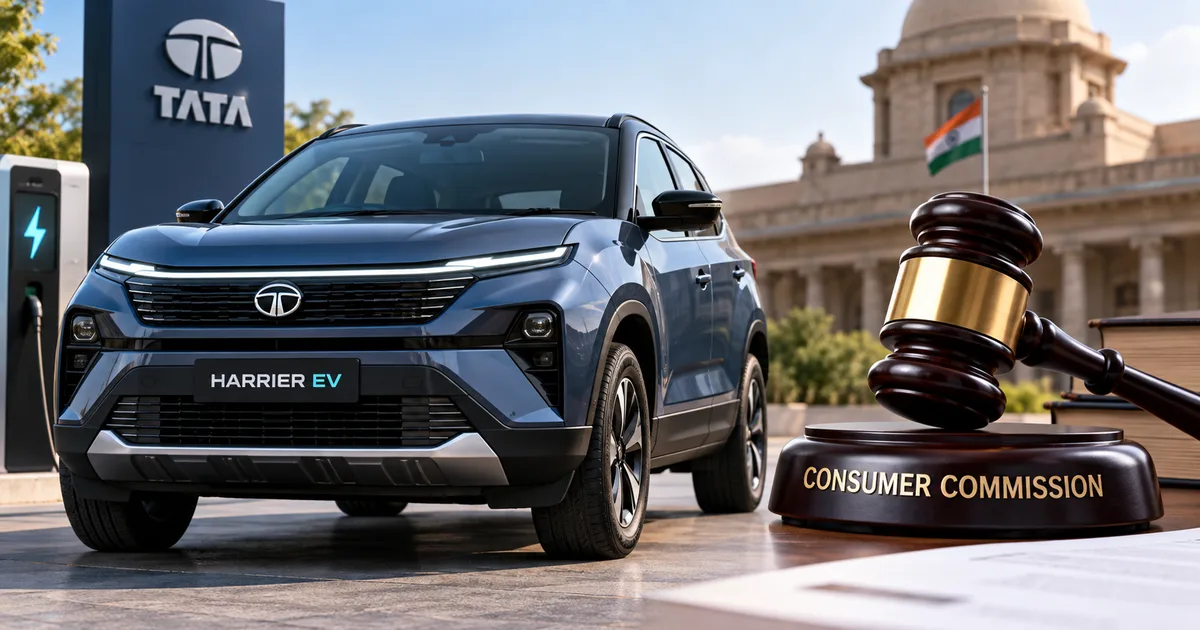
Imagine buying a brand new electric SUV for nearly Rs 28 lakh. You drive it out of the showroom. You're feeling pretty good about the upgrade and the money you saved on road tax. Then, a few days later, you walk up to the car, and the smart key does absolutely nothing. The doors stay locked. You're stranded on the side of the road in the heat. You manage to get it towed to the dealership. The service centre says they fixed a minor software glitch, and you drive off. But then it happens again the next week. And again the month after that.
This is exactly what happened to a buyer in Hyderabad. And it led directly to the recent Tata Harrier EV Consumer Commission Order 2026. The Hyderabad district consumer commission stepped in. They ordered Tata Select Motors to take the defective EV back from the owner.
I've been looking through the details of this order, and if you ask me, it matters a lot to anyone planning to buy an EV in India right now. Car companies and their dealers often hide behind complex warranty clauses when things go wrong. But this order shows that consumer courts are starting to push back hard against dealerships that sell cars they can't fix.
The Rs 27.98 lakh headache
The facts of the Hyderabad case paint a clear picture. A partnership firm named M/s Refrigeration Equipment and Solutions, represented by Pawan Bagrecha, bought a Tata Harrier EV Empowered + 75 APC on August 1, 2025. The invoice value was Rs 27.98 lakh. They financed a large chunk of it through a bank loan. This means they were paying monthly EMIs for a car they often couldn't drive.
Within days of taking delivery, the serious problems started. The smart key would simply lose its connection with the car. It was a mess. The central locking system would fail to lock the car when parked. This left it vulnerable to theft. Or it would refuse to open entirely when the owner needed to get inside. The buyer was literally stuck on the road multiple times. If you've ever been stranded in Indian traffic because your car electronics took a nap, you know the frustration.
So, the buyer did what any of us would normally do. They went back to the authorised dealer, Tata Select Motors. The service centre staff checked the car. They blamed a generic software glitch, updated the system, and sent the car back to the owner. But the central locking fault kept returning.
The buyer submitted chat records. They also provided emails and call logs. These showed a clear pattern of complaints raised over several months (which makes sense, actually). It was always the same two problems. At one point, the vehicle even stopped moving mid-way on the road. That created a massive safety hazard.
You can read more about similar consumer rights issues and tech regulations in our Tech Explainers section.
The dealership defense falls apart in court
When the buyer finally had enough of the towing and workshop visits, they approached the consumer commission. They asked for a full refund of Rs 29,29,395. They also asked for Rs 10 lakh for mental agony and another Rs 10 lakh in punitive damages.
The dealership tried a very common legal defense. They argued they only sold and serviced the vehicle as a franchise. They claimed they couldn't be held financially responsible for a manufacturing defect built into the car at the factory. They said the manufacturer, Tata Motors, should be the one answering these questions. But the buyer hadn't made the manufacturer a party to the case.
The dealer also pointed out that the buyer hadn't submitted an independent automobile engineer's report. They wanted this to prove a physical manufacturing defect existed. Basically, the dealer argued that they responded promptly to every complaint. They said they resolved the software issue when it came up, and they replaced the physical lock mechanism under warranty. So, they felt there was no deficiency in service on their end.
This is where things went wrong for the dealership.
The commission is led by President B Uma Venkata Subba Lakshmi, along with members C Lakshmi Prasanna and B Raji Reddy. They looked closely at the dealer's own service history records. The official job cards actually worked against the dealer. They proved the fault was persistent and never fully resolved by the mechanics. The same smart key issue kept getting logged again and again in the months following the first repair attempt. Job cards from December 2025 clearly described the key and locking issues as "old problems". In my experience, paperwork always tells the real story.
"On perusal of the record, it is evident from the reply communication dated 21st August at Ex.A6 that the complainant has reported the issue of smart key..."
The commission concluded that the dealer acknowledged the problem but failed to fix it permanently. They ordered Tata Select Motors to take back the Harrier EV and refund the purchase price. They deducted 10 percent for depreciation since the car was used for a few months. They also ordered the dealer to pay Rs 50,000 as compensation for the mental agony and harassment. Plus, the dealer has to pay Rs 15,000 to cover the legal costs of filing the case. The order came down on September 7, 2026.
Not an isolated incident for the brand
This isn't the only recent case where Tata Motors or its authorized dealers have faced severe pushback from consumer courts over defective Harrier models. The Hyderabad case specifically involved an EV and recurring software failures. But a separate District Consumer Disputes Redressal Commission in Kangra, Himachal Pradesh, recently dealt with a major mechanical failure in a diesel Harrier.
In that Kangra case, a doctor bought a Tata Harrier XZA+ Dark Edition in May 2022 for Rs 21.40 lakh. The SUV developed annoying steering vibrations within the first 1,000 km. The power steering assembly was replaced under warranty. But the real problem came later. The timing belt failed twice before the car even reached 30,000 km on the odometer. A timing belt on a modern diesel engine is a component that is generally supposed to last anywhere from 90,000 to 1,00,000 km. When it snaps, the engine dies instantly.
The first failure left the doctor's family stranded on a highway for hours. The second failure happened at just 26,700 km. An independent expert report found a misaligned timing bracket assembly. This misalignment was causing the belts to wear out prematurely.
The Kangra commission ordered Tata Motors directly to either replace the SUV with a completely new vehicle or refund the full Rs 21.40 lakh purchase price with interest. They noted that sudden vehicle stoppages on high-speed highways create serious safety risks for everyone.
You can see how repeated quality control issues might affect investor sentiment. It is similar to the market discussions around the Ola Electric Share Price 2026.
What this means for electric vehicle buyers in India
So why should you care about a random consumer court order in Hyderabad? Because it sets a precedent for the Indian EV market. Modern EVs are essentially giant, heavy computers rolling on wheels. When a mechanical part fails in an older petrol car, your local neighbourhood mechanic can often figure it out and get a spare part. When the central locking computer module in a modern EV decides to freeze and lock you out, you're entirely at the mercy of the official brand service centre. Nobody else has the proprietary diagnostic software to talk to the car. I'm not sure exactly why they lock it down so hard, but they do.
Dealerships rely heavily on wireless software updates to fix EV bugs. Sometimes that works perfectly. But when it doesn't, buyers get trapped in an endless loop of service centre visits. Dealerships just keep flashing the software or replacing small electronic modules under the standard warranty. They're hoping the customer will eventually get tired of complaining and just accept a buggy car.
Thing is, the Hyderabad order tells these dealerships they can't just keep applying temporary band-aids to a fundamentally broken car. They can't call it routine warranty service. If a car can't reliably unlock its own doors so the owner can drive it, the car is legally defective. And dealers can't just pass the financial burden when they were the ones who took the buyer's cheque.
If you're looking at buying upcoming electric models like the Tata Curvv EV 2026 Launch, you need to know exactly what your legal rights are if things go wrong.
How to protect yourself when buying a new car
India still doesn't have a specific lemon law that automatically forces carmakers to replace defective vehicles after a certain number of failed repair attempts. You have to fight for your refund manually through the consumer court system. If you find yourself stuck with a sketchy new car, here is exactly what you need to do to build a winning case.
- Document absolutely everything immediately. The buyer in the Hyderabad case won partly because they had a solid paper trail. They submitted detailed call logs. They also provided WhatsApp chat records with the service advisor and emails proving they flagged the same issue repeatedly.
- Never leave the service centre without a printed, stamped job card. Make sure the service advisor accurately writes down your specific complaint, not just a generic "general check up" note. The official service history showing repeated complaints was the single biggest piece of evidence in court.
- Take raw videos of the defect when it happens. If your car refuses to start or the infotainment screen goes black, record it on your phone. Make sure to capture the date and time in the video. Dealerships routinely claim they can't replicate the issue when the car is sitting in their air-conditioned workshop.
- Escalate your complaints in writing. Don't just rely on angry phone calls with the local service manager. Send official emails to the dealership's higher management and always copy the manufacturer's official customer care email ID.
Filing a consumer case takes real time and patience. It can easily take two or three years to get a final order like this (annoying, I know). But legal rulings like the Tata Harrier EV Consumer Commission Order 2026 show that the courts will hold dealers accountable if you have the patience and the hard evidence to back up your claims.
If you want to stay updated on consumer rights and technology shifts, keep an eye on our Latest Tech News page. Car companies are packing more and more complicated software into our vehicles every single year. Sometimes, that software fails completely. When it does, you shouldn't be the one paying the financial price for a 2,000 kg metal brick blocking your driveway.