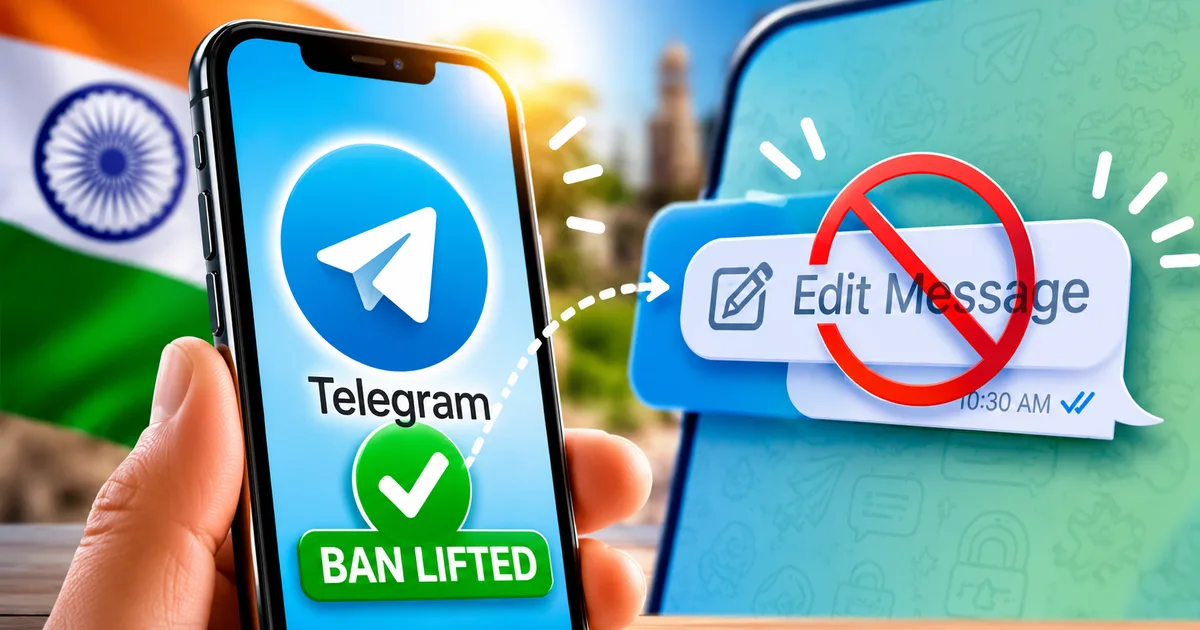
The temporary Telegram ban lifted in India today, but if you opened the app expecting to edit a typo in your group chat, you'll be disappointed.
You can send messages, but you can't edit them. The edit option is completely gone. It's frustrating. But there's a very specific, logical reason behind this block. Basically, it's all about preserving evidence during the ongoing paper leak investigations.
The app had a rough couple of weeks in India. If you tried to access your chats last week, you probably got stuck on the "Connecting..." screen. That's because the government temporarily blocked Telegram after leaks emerged on the platform. Specifically, the leaks were related to the highly controversial NEET-UG medical entrance exam. Students across the country protested, demanding answers. The government acted fast, ordering internet service providers to shut down the app's servers.
Naturally, the company tried to fight this block in court. But the Delhi High Court rejected their appeal, upholding the temporary ban until June 22. That brings us to today. The ban is officially over, and the app is back on the app stores. But MeitY, which is the Ministry of Electronics and Information Technology, wasn't ready to let everyone go back to normal business just yet. They decided that while the app can run, the message-editing feature must stay blocked until June 30.
Why Telegram was banned during the NEET UG paper leak
To understand the editing ban, we have to look at the original mess. Back in early June, rumors started circulating that exam papers for the NEET-UG test were selling on Telegram. These were not small study groups sharing mock tests. These were channels with thousands of members offering leaked answer sheets for cash. The government had to act. So they invoked Section 69A of the Information Technology Act to block the app. That's the law that lets the government block websites and apps to protect public order or national security.
Thing is, blocking a massive app like Telegram isn't easy. Our internet service providers, operating under rules from the Telecom Regulatory Authority of India (TRAI), had to block thousands of IP addresses. If you want to see how these blocks work, check out our tech explainers. The block was leaky. Some people used VPNs, others used proxy settings within the app itself to bypass the ban. But for the vast majority of regular Indian internet users, the app was dead. The Delhi High Court agreed that the threat of leaked papers circulating before the re-exam was too high, so they let the block stand.
I spoke with a few engineering students in Bengaluru who said they didn't even realize the app was blocked because their proxy servers were running. But for the average uncle or auntie trying to download a PDF, it was impossible. The app store removal was the real blow. When an app disappears from the Google Play Store and Apple App Store, it stops getting updates. That makes it a security risk. A recent advisory from CERT-In also warned that during such blocks, side-loaded versions of Telegram could contain malware. This is why checking out our digital safety guides is so important before you install any unofficial app.
And it wasn't just about NEET. Telegram has been under scrutiny for a long time. In India, it's the default platform for piracy, stock tips, and fake government schemes. But the NEET paper leak was the breaking point. It affected millions of students who worked for years to get a medical seat. The scale of the outrage forced MeitY to take the most extreme step available: a complete temporary block.
How the CBI investigation affects your chats
Now, let's talk about the edit button. Why would the government care about you correcting a typo? Here's the deal: editing is a loophole for people spreading illegal content. Let's say a scammer posts a leaked question paper in a channel. A hundred students see it and take screenshots. Ten minutes later, the scammer edits the message. They replace the leaked paper with a standard textbook question. Now, when the police show up to investigate, the channel looks clean. The evidence is gone. The edited message shows no trace of the leak.
By forcing Telegram to turn off the edit button, MeitY is locking the chats in place. Senders can't change what they sent. This helps the Central Bureau of Investigation track the original source of the leaks. They can look at the messages and know they haven't been altered. It's like a digital seal on a crime scene. Investigators can trace the exact time a paper was uploaded and match it with bank transfers or UPI logs from students who paid for it. The block stays active until June 30 because that's when the NEET-UG re-exam process wraps up and the initial investigative reports are due.
Honestly, it's a smart move. If edits were allowed, the investigation would become a game of whack-a-mole. Senders would constantly modify their posts to hide their tracks. Disabling the feature takes away their biggest shield. It's annoying for you if you make typos, sure, but it's a small price to pay to keep the investigation clean.
I talked to a cybersecurity lawyer who explained that under Section 79 of the IT Act, Telegram has to comply with government orders to maintain its safe harbor status. If they don't comply, they can be held legally responsible for the content shared on their platform. By disabling the edit feature, Telegram is trying to stay in the government's good books.
What you can and cannot do on Telegram right now
Since the ban is lifted, you can use the app again without proxies or VPNs. But the experience won't be fully normal. Here's a quick breakdown of what works and what doesn't:
- You can send text messages, photos, and videos to any chat.
- You can join new groups and subscribe to channels.
- You can't edit any message after sending it, even in private chats.
- You can't change captions on photos or videos once they're sent.
- You can delete messages, but some logs might still be visible to server administrators.
The edit restriction applies to all Indian phone numbers. Even if you travel abroad, if your account is registered with an Indian +91 number, the edit option won't appear. Telegram had to implement this geo-restriction at the database level to comply with MeitY's orders and get the ban lifted. It shows how much control the Indian government has over global tech platforms these days.
And this isn't the first time a feature has been restricted. We've seen similar moves with other apps in the past. But restricting a core messaging feature is rare. It shows the urgency of the NEET investigation.
Why this is a lesson in digital privacy
This whole situation highlights a major misunderstanding about Telegram's privacy. Many people think it's a secure, private app. It's not. By default, your standard chats aren't end-to-end encrypted. They're stored on Telegram's cloud servers. This means Telegram can see your messages, and if they cooperate with the government, they can hand them over. Only secret chats are fully encrypted on your device.
So, if you're sharing anything sensitive, standard Telegram chats are not the place. Switch to Signal or WhatsApp for default encryption. This ban is a clear reminder that tech platforms will compromise user features to protect their market presence in India. India is one of Telegram's largest markets, with over 100 million active users. Losing India would be a massive blow to Pavel Durov's company. So, they did what they had to do: they disabled editing for a few weeks to keep the app running here.
Also, it's worth checking out latest tech news to see how other platforms are handling similar government directives. The pressure on tech companies is only going to increase.
The temporary ban on Telegram in India highlights the tension between user convenience and law enforcement needs, showing that platforms will disable core features like message editing to comply with local regulations.
For now, we have to live with the typos. Once June 30 passes, the restriction should lift, and the pencil icon will return. Until then, proofread your messages before hitting send. Or you'll have to delete the whole message and type it again. It's a bit of a hassle, but it's the reality of using the internet in India today.