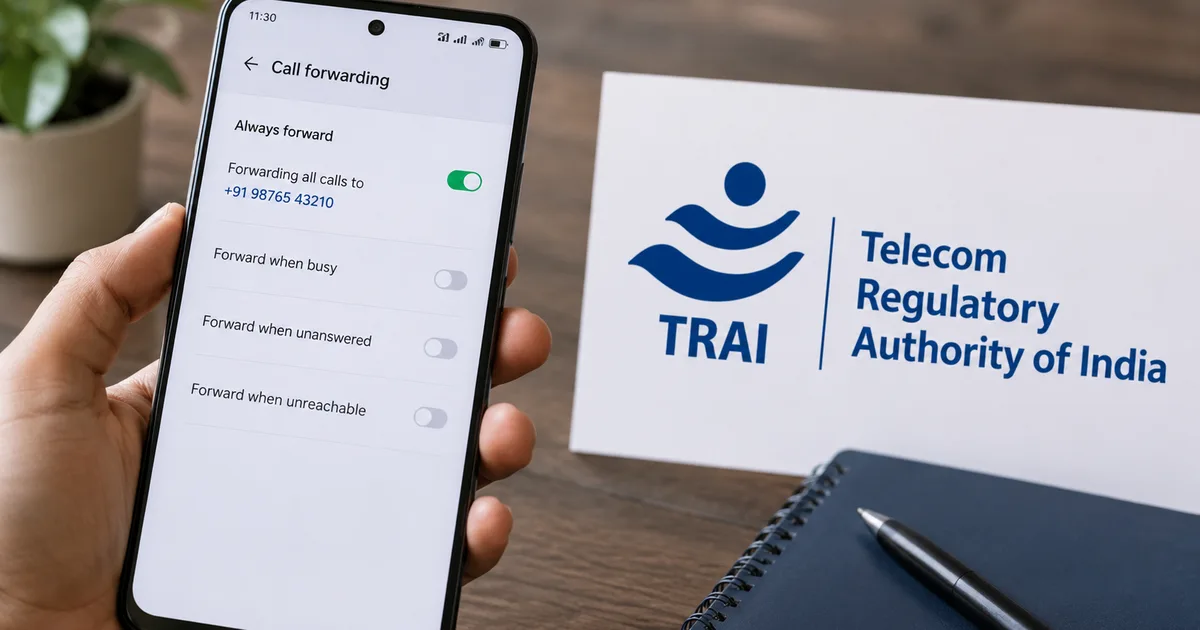
If your spam call count has dropped recently on Jio or Airtel, TRAI's new AI-based call forwarding rules are likely part of the reason. The Telecom Regulatory Authority of India is pushing telecom operators well beyond complaint-based blocking into real-time, AI-driven detection of sketchy call patterns, including how calls are being routed and forwarded across networks. This is a big shift in how India's telecom ecosystem handles the spam problem, and it affects every mobile user in the country.
The scale of the problem is hard to grasp. TRAI Chairman Saumya Swaminathan confirmed that Jio, Airtel, and Vodafone Idea are together flagging and blocking roughly 40 crore spam calls and messages every single day. That's not a typo. 40 crore. And even at that scale, scam calls still get through, because spammers keep adapting, particularly through call forwarding chains that disguise where a call actually comes from.
What TRAI is changing with the new AI detection rules
The core shift is from reactive to proactive. Under the older system, a number had to pile up enough user complaints before blocking happened. Now, telcos are being directed to deploy AI models that watch traffic patterns in real time, looking for things like unusual call forwarding chains, SIMs that suddenly start making thousands of short calls, or numbers whose usage behaviour doesn't match their registered identity.
One directive stands out. TRAI has told all telecom operators to share suspected spam caller data with each other within two hours of detection. If Airtel's AI flags a number, Jio and Vi get that information within two hours. A spammer can't just port to another network and carry on, which is exactly what was happening before, routinely. (Honestly, I'm surprised it took this long to close that gap.)
TRAI has directed telecom operators to share information about suspected spam callers with each other within two hours of detection — closing one of the biggest loopholes spammers exploited for years by switching networks after being flagged.
There's also a KYC data-sharing component. Telcos must now share customer KYC information across networks specifically for AI-based spam identification. That might sound alarming, but what it means in practice is fairly narrow. The shared data is used to check whether a number's call behaviour matches its registered user profile. Your personal details aren't going to a competitor's marketing team. It's a pattern-matching exercise, not a data sale.
The draft TCCCP Regulations 2026: what's actually changing
TRAI recently extended the deadline for stakeholder feedback on the Draft Telecom Commercial Communications Customer Preference (TCCCP) Regulations 2026. The final version isn't published yet, but from what's been shared publicly, the draft covers considerable ground:
- Mandatory AI-based analysis of call and message traffic at the network level — not optional for operators
- Lower thresholds for blocking numbers flagged by AI systems, meaning fewer complaints needed before action is taken
- Specific rules around call forwarding: if a number uses forwarding chains that obscure the original caller, it can be flagged automatically
- Stricter registration requirements for bulk SMS senders and telemarketers, with built-in traceability from day one
- Cross-operator data sharing protocols for suspected fraudsters and identified spam sources
The lower threshold piece is genuinely controversial. Several telecom and business associations have pushed back, arguing that false positives, real businesses getting wrongly flagged by AI, will go up. TRAI's position is that at 40 crore spam attempts a day, the balance has to shift toward blocking faster even if a few legitimate numbers get caught temporarily. There's supposed to be a dispute process, though the details are still being worked out (annoying, I know).
Honestly, that trade-off seems right to me. A legitimate business that gets wrongly flagged can dispute it and get unblocked. A fraud victim who lost money to a scam call can't un-lose that money.
How spammers use call forwarding and what the AI catches
Most people know call forwarding as the feature that redirects your calls to another number when you're busy. Simple enough. But spammers have turned it into an obfuscation tool.
Here's a common pattern: a fraudster registers a SIM with minimal verification in a remote location. They set up a layered forwarding chain. The number you see on your screen forwards to another number, which forwards to the actual fraud operation. By the time a complaint is filed about the number you called back, the original SIM is gone and deactivated. TRAI's AI detection looks for exactly these forwarding patterns, particularly when the forwarded calls show characteristics inconsistent with normal personal use: short burst durations, high volume across many new contacts, unusual hours.
This connects directly to the broader scam ecosystem that our digital fraud explainers cover in detail. A spam call isn't usually just an annoyance. It's often the first step in a fraud that ends with money leaving someone's bank account.
What changes for you as a regular mobile user
Short version: it should get better, but gradually.
The rules are rolling out in phases. Here's what's changing or will change for ordinary Jio, Airtel, and Vi subscribers:
- Fewer calls from spoofed numbers — AI should reduce calls where the number on your screen doesn't match where the call is actually coming from
- Faster blocking once a number is flagged, without waiting for dozens of complaints to pile up
- Cross-network protection — a spammer flagged on one operator gets reported to all others within hours, not days
- Tighter integration with the existing Do Not Disturb registry for stronger DND enforcement
If you run a small business and use your personal number to call customers, pay close attention to this. Your number could get flagged if your calling patterns look unusual to the AI. Say, you suddenly started calling many new contacts after launching a business, or you send bulk WhatsApp messages for promotions. The fix is to register your number as a commercial entity through your telecom provider's official framework. A bit of paperwork, but it protects you from false-positive risk.
Getting wrongly flagged and what to do
The dispute mechanism is one area where TRAI still needs to fill in details. What we know so far: if your number gets flagged, you can raise a complaint through your operator's customer care, and eventually through TRAI's official portal. What we don't know yet is how long resolution takes and whether the process works smoothly for ordinary users who aren't telecom-literate. I'm not sure exactly why these specifics haven't been published yet, but they need to be before full rollout.
For context on how TRAI's telecom compliance framework has evolved over the past year, the telecom regulation guides section covers the 2025 SMS traceability rules and CNAP caller ID rollout that preceded these AI detection measures.
TRAI's wider AI-in-telecom agenda for 2026
These spam detection rules aren't happening in isolation. TRAI held a 'Responsible AI in Telecom' session at the India AI Impact Summit 2026 in May, and co-hosted a pre-summit event with STPI specifically on AI in Telecommunications. Both events focused on using AI for network management, fraud detection, and consumer protection, with governance guardrails built into the design, not added later as an afterthought.
TRAI's 2026 roadmap touches on 6G readiness, network slicing, and AI governance across the telecom sector. But the spam detection work is what matters right now for most people. 6G is years away. The 40-crore-a-day spam problem is today's problem.
At the India AI Impact Summit 2026, TRAI outlined a framework for responsible AI in telecom that centres digital resilience and consumer protection — not just network optimisation for operators.
There's one open question that hasn't been settled publicly: if an AI system wrongly blocks a legitimate call, a hospital reaching a patient or a bank sending a transaction OTP, who is liable? TRAI hasn't answered this clearly yet. It sounds like an edge case until it happens to someone in a medical situation. This needs to be resolved before full rollout, not after.
What you should do right now
Some practical steps given where things stand in May 2026:
- Register on DND if you haven't already. Go to the TRAI DND app or trai.gov.in and register your number. The new AI rules work alongside DND, not as a replacement for it.
- Check your call forwarding settings. If you've set up forwarding on your number for any reason, make sure it's only pointing to numbers you actually intend. Unusual forwarding chains are exactly what the AI models are trained to catch.
- Report spam calls in your carrier app. On Jio, Airtel, and Vi apps you can flag a number as spam right after a call. This feeds into the AI model's training data and makes detection more accurate over time.
- If you run a business, register formally. If you make high-volume customer calls, talk to your telco about registering as a commercial entity under the TCCCP framework. It reduces your false-positive risk significantly.
If you're dealing with actual cyber fraud, not just annoying spam calls, dial 1930 (the National Cyber Crime Helpline) or file at cybercrime.gov.in. These AI detection rules operate at the network level to reduce spam volume. Financial fraud that starts with a call still needs to go through the proper cyber fraud reporting process.
The TCCCP Regulations 2026 are still in draft form as of May 2026, and TRAI has extended the feedback window, so some details could still shift. Worth watching closely if you work in telecom, bulk messaging, or run a business that depends heavily on outbound calling. For everyone else: the direction is clear, the scale is serious, and the AI tools being deployed are more sophisticated than anything India's telecom networks have used for spam detection before. Whether that's enough to make a real dent in those 40 crore daily spam attempts, we'll find out over the next few months.