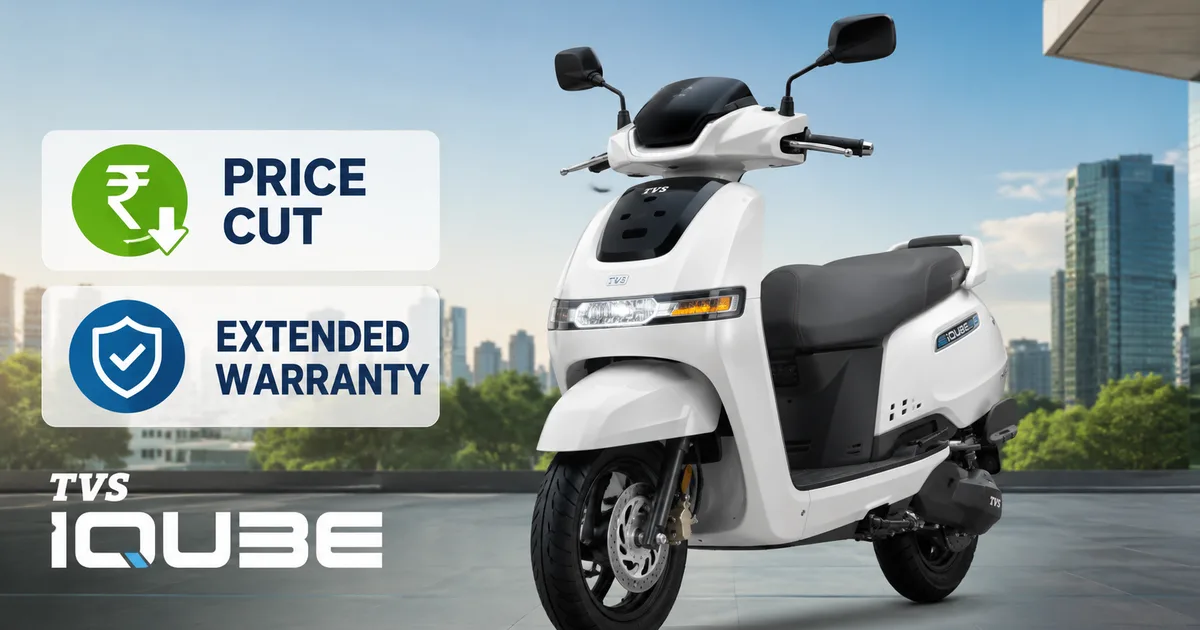
Buying an electric scooter in India is usually a headache. You have to balance range anxiety and battery life (and the massive upfront cost, obviously). If you're looking at the TVS iQube August 2026 offers, you probably noticed the price cut and discounts going around right now. I spent some time going through the on-road prices across different cities. I also looked at the exact running costs and figured out what the battery warranty details actually mean for a daily commuter.
Petrol prices aren't dropping anytime soon. A normal petrol scooter costs you around two or three rupees per kilometer. But the iQube runs at just 16 paise per kilometer. That's a massive difference if you ride 30 or 40 kilometers every single day. I'll break down exactly how much the different variants cost right now and what you get for your money. Plus, we'll see whether the festive discounts make this the right time to buy.
Breaking down the TVS iQube August 2026 offers and price cut
TVS has rolled out some solid festive offers for the iQube line-up this month. Depending on where you live, the on-road price changes. But the base 2.2 kWh variant is sitting comfortably around Rs. 1.26 lakh to Rs. 1.28 lakh. The company clearly wants to move volume before the year ends.
The pricing strategy is smart. They have a scooter for the budget buyer and a premium model for someone who wants maximum range. Here is the exact pricing for the different variants available right now:
- iQube 2.2 kWh: Rs. 1.26 Lakh to Rs. 1.28 Lakh
- iQube 2.3 kWh: Rs. 1.26 Lakh to Rs. 1.28 Lakh
- iQube 3.1 kWh: Rs. 1.38 Lakh to Rs. 1.47 Lakh
- iQube 3.5 kWh: Rs. 1.50 Lakh to Rs. 1.55 Lakh
- iQube MillionR Special Edition: Rs. 1.54 Lakh to Rs. 1.59 Lakh
These numbers are aggressive. The EV market is extremely crowded right now. I think you can really see TVS trying to stay competitive against the Bajaj Chetak and Ather models (which makes sense, actually). If you keep an eye on our latest tech news, you know the price wars in the electric vehicle space are brutal right now. Companies are sacrificing profit margins to get scooters on the road.
City-wise on-road price variations
I checked the numbers for a few different places to see how taxes affect the final price. In Parbhani, the base model comes to Rs. 1,25,823 on-road. The ex-showroom price there is Rs. 1,18,087. You add Rs. 1,178 for RTO and Rs. 6,558 for insurance.
In Jagatsinghpur and Kendujhar, it's slightly higher at Rs. 1,28,059. The ex-showroom base in those cities is Rs. 1,20,809. The RTO charges are lower at Rs. 640. But the insurance sits at Rs. 6,610. Delhi buyers are looking at an on-road price of around Rs. 1.27 lakh.
Taxes and state subsidies change everything. Some states completely waive road tax for EVs. Others still charge a small processing fee. Always ask your dealer for a printed breakdown of the on-road price. Honestly, dealerships sometimes sneak in handling charges or accessory kits you don't actually need. Tell them you only want the scooter and the mandatory insurance.
TVS iQube battery warranty details explained
Battery life is the biggest worry for anyone buying an EV in India. It's a completely fair concern. Replacing an electric scooter battery out of pocket is a mess. It can cost nearly half the price of the scooter itself.
TVS usually has a standard warranty of 3 years or 50,000 kilometers on the iQube battery pack. This covers manufacturing defects or severe battery degradation. You need to read the fine print carefully. The warranty usually requires you to follow their exact service schedule. And you can't use sketchy third-party fast chargers. If you do, you risk voiding the warranty completely.
"The TVS iQube MillionR continues with the same 3.5kWh battery and electric motor as the standard model. It offers a claimed IDC range of 145km on a single full charge."
That quote highlights something important. The 3.5kWh battery pack gives you a 145km range under test conditions. But in the real world, dealing with Indian traffic and potholes, expect something closer to 100km or 110km. That's still enough for city riding. If you charge it every night, you won't run out of juice during a normal commute.
We explain battery degradation limits in our tech explainers section often. Basically, lithium-ion packs degrade slightly over time. After three years, your maximum range might drop by 10 or 15 percent. I'm not sure exactly why people skip the extended warranty, but you should really look into the options at the dealership. Paying a few thousand rupees upfront for an extra year or two of battery coverage is almost always worth the money.
The 16 paise per kilometer reality check
Let's do some math on the actual running costs. ZigWheels data shows the iQube has a running cost of Rs. 0.16 per kilometer.
How do they get that exact number? They calculate it based on an electricity rate of Rs. 6.5 per unit. If you ride 50 kilometers every single day, your daily charging cost is just Rs. 8. Your total monthly charging cost is Rs. 240.
Think about that for a second. Rs. 240 a month to travel 1,500 kilometers. A petrol scooter giving you 45 kilometers per liter needs over 33 liters of petrol for that same distance. At Rs. 100 per liter, that's Rs. 3,300. You save over Rs. 3,000 every month just on fuel.
It's the same logic driving the broader EV market, which you can read about in our analysis of the Ola Electric share price 2026. The upfront cost hurts. But the monthly savings are very real. Over three years, you easily save a lakh in fuel costs alone.
Inside the MillionR special edition
TVS recently announced they hit a milestone of one million iQube families. To celebrate this sales record, they launched the MillionR Special Edition.
It's priced around Rs. 1.54 lakh to Rs. 1.59 lakh on-road. It keeps the big 3.5kWh battery with the 145km IDC range. You get some cosmetic upgrades and specific badging over the standard models.
Honestly, unless you really care about the special edition badging, the standard 3.1 kWh or 3.5 kWh variants have the exact same core riding experience for slightly less money. But if you have the budget and want the top-tier model parked in your driveway, it's a solid machine. In my experience, TVS knows how to build a scooter that lasts.
Financing your iQube and EMI math
Not everyone drops over a lakh in cash for a scooter. Financing is how most of these two-wheelers get sold in India.
If we look at a standard loan profile for a mid-tier variant, you might put down a down payment of Rs. 25,897. The loan amount is Rs. 99,926. With an interest rate of 9.45 percent over 36 months, your monthly EMI comes out to Rs. 3,199.
If you ask me, the scooter practically pays its own EMI since you save around Rs. 3,000 a month on petrol. That's the main selling point for EVs right now. You shift your petrol budget to your EMI budget. After three years, the scooter is yours. So you ride almost for free.
Smart features and display tech
TVS keeps the iQube relatively simple compared to the Ather 450X. But it still has enough tech to keep you happy. The scooter has a digital dashboard that connects to your smartphone via Bluetooth. You get call and SMS alerts right on the screen. This is handy when you're stuck in traffic and don't want to pull your phone out.
The higher variants have turn-by-turn navigation built into the display. This is incredibly useful in a busy city. You also get basic connected features through the TVS app. You can check ride statistics and battery health monitoring.
I actually like that TVS didn't overcomplicate the interface. Some electric scooters have touchscreen dashboards that lag and freeze in the hot Indian sun (annoying, I know). The iQube display is bright. It's legible. And it just works. Sometimes boring and reliable is exactly what you want from a daily commuter vehicle. The physical buttons feel tactile. The software rarely crashes.
Motor performance and ride quality
The electric motor on the iQube is hub-mounted. It delivers power smoothly rather than giving you an aggressive jolt when you twist the throttle. TVS clearly tuned this scooter for family use. It won't win any drag races against an Ather. But it easily keeps up with city traffic.
I think the suspension is the real winner here. It absorbs bumps and broken tarmac exceptionally well. If you've ever ridden a stiffly sprung sports scooter over a speed breaker, you know how much it hurts your lower back. The iQube is plush. The seat is wide and flat. So it's comfortable for a pillion rider as well.
How the iQube compares to the competition
I honestly think you have a lot of options in this budget. The TVS iQube isn't the only electric scooter worth your money today.
The Vida VX2 starts around Rs. 99,490. It's cheaper. But the service network is still growing. Buying a scooter is easy. But getting it fixed when something breaks is the hard part.
The Bajaj Chetak sits at Rs. 1.19 lakh. It has a metal body. It looks like a classic Vespa. But the tech screen and software feel a bit dated compared to Ather or TVS.
The Ather 450X and the new Ather Rizta are the direct competitors. The Rizta is priced around Rs. 1.20 lakh. Ather gives you better performance. TVS gives you a more traditional scooter feel and a softer suspension setup for bad roads.
There's also the Honda Activa e at Rs. 1.18 lakh to Rs. 1.19 lakh. We all know Honda dominates the petrol scooter market. But they're playing catch-up in the EV space right now. Finally, the River Indie at Rs. 1.43 lakh has massive storage space. It's a niche product for a very specific buyer.
Charging infrastructure and range anxiety
Look, I need to talk about charging. The biggest mistake new EV buyers make is assuming they can rely on public charging stations. You can't. Public charging networks in India are still a mess. Half the time the chargers are broken. Or someone parked a petrol car in the EV spot.
If you buy an iQube, you need to be able to charge it at home. If you live in an apartment complex, talk to your society committee before you buy the scooter. Getting permission to install a charging point in the basement parking can be a nightmare in some buildings.
If you have an independent house with a parking spot and a plug point, you're golden. Charge at home. Ride to work. Charge at home again. That's how you actually win with an electric scooter today.
Should you buy an EV in August 2026?
If you ask me, right now is a strange time for the Indian auto industry. We're seeing companies raising prices on regular petrol cars. Just look at the Maruti Suzuki August 2026 price hike. Meanwhile, two-wheeler EV makers are throwing massive discounts at buyers to increase their market share.
Thing is, the TVS iQube August 2026 offers are genuinely good. The price cut on the base 2.2 kWh model makes it very accessible for a lot of people. If your daily commute is under 40 kilometers, that base model is all you need. Don't overspend on the bigger battery if you don't actually need the range. If you ride 80 kilometers a day, then grab the 3.1 kWh or 3.5 kWh version.
The battery warranty covers you for the first three years. The running costs are basically pocket change. The scooter is comfortable and practical. It's backed by a company that has thousands of service centers across India. The numbers here are a bit fuzzy depending on your electricity rate, but you save money either way.
If you're tired of paying for petrol and want a scooter that just works, the iQube makes a lot of sense right now.