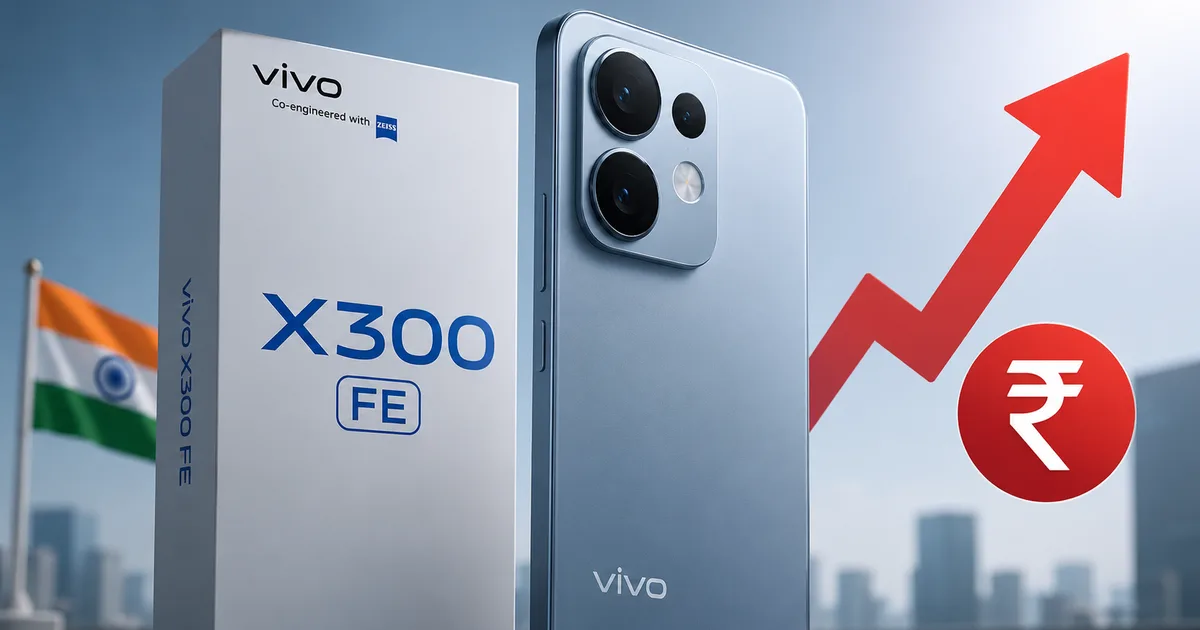
So, we need to talk about the Vivo X300 FE Price Hike in India 2026. Because honestly, the situation is a bit absurd now. When Vivo first launched the X300 FE, it was the sweet spot. It gave you most of the X300 Ultra's camera magic without the flagship price. I actually liked the phone back then. The cameras took brilliant portraits, and the battery life was dependable. It felt like a genuinely fair deal for the Indian market. But things changed fast. As of this week, Vivo quietly slapped a second price hike on the handset. The total increase is a massive ₹10,000 above the original launch price. The top variant is brushing the one lakh rupee mark at ₹99,999. And if you think you can just buy the base model to save cash, wait until you hear about the catch with the new 8GB RAM version. It's enough to make anyone rethink their decision to buy.
The second price hike: what are the new rates?
Here are the exact numbers so you can see what we're dealing with. Vivo updated the pricing on both Flipkart and their official Indian store. This wasn't a single jump. They hit us with a ₹3,000 hike a while back. That annoyed people, but it didn't kill the phone's appeal. Now they added another massive hike on top of it. Basically, it changes the entire value proposition of the device.
Here's the current pricing structure for Indian buyers:
- The new 8GB RAM + 256GB storage base model: ₹84,999
- The 12GB RAM + 256GB storage mid-tier model: ₹89,999
- The 16GB RAM + 512GB storage top variant: ₹99,999
That ₹99,999 figure is a hard pill to swallow for a Fan Edition device. Honestly, the whole point of these models was to keep things affordable. You strip away the curved glass, or maybe use a slightly older processor. Then you pass the savings on to the buyer. But a lakh for a stripped-down phone? That puts it in direct competition with flagships from Apple and Samsung. I don't care how good the Zeiss camera tuning is. At this price point, Indian buyers expect absolute perfection. Not a compromised phone.
The catch with the new 8GB model
Notice that new 8GB RAM variant I just mentioned? Vivo introduced it to the Indian market right next to this latest price increase. On paper, it sounds like a decent move. It offers a lower entry price for folks who don't need excessive amounts of memory. The problem is the math.
This new 8GB model at ₹84,999 actually costs more than what the 12GB model cost when the phone originally launched.
You're literally paying more money for less RAM than early adopters did just a few months ago.
I find this pricing strategy deeply frustrating. I understand companies need to adjust prices sometimes. Supply chains are complicated. And the Indian rupee fluctuates against the dollar. But launching a downgraded version and pricing it higher than the original version feels like a slap in the face to buyers who waited for reviews. If you were holding out for a price drop during the upcoming festive sales, this new baseline wipes out any discount you might have gotten. You can check our explainer on smartphone pricing strategies for more context on how brands pull these moves. It happens more often than you'd think. Though rarely this blatantly.
Why are prices surging? The memory cost issue
So what's Vivo's excuse for making the phone so expensive overnight? Vivo's official store updates point to rising memory and storage component costs. And to be fair, they aren't making this up. The global semiconductor market is going through a rough patch right now about memory chips. (The numbers here are a bit fuzzy, but the trend is real.)
For the last couple of years, RAM and NAND storage were dirt cheap. Smartphone makers loaded up mid-range phones with 12GB or even 16GB of RAM because the chips cost them next to nothing. Now, big memory suppliers like Samsung and SK Hynix are scaling back production to force prices back up. They want their profit margins back. And they're getting them.
When component costs rise globally, the consumer always absorbs the impact. But mid-cycle retail price hikes of ₹10,000 are exceptionally rare in the highly competitive Indian smartphone market.
This means every gigabyte of RAM costs Vivo more today than it did six months ago. But a ₹10,000 total increase? I'm not sure exactly why it went up that much. I'm not convinced memory prices have spiked quite that much to justify a hike this severe. Usually, brands absorb these fluctuations. Or they quietly downgrade components on newer batches without touching the sticker price. Raising the retail price this aggressively suggests they might have priced the phone too low at launch. And now they're scrambling to fix their profit margins in India.
Bank offers and discounts
If you're still dead set on buying the Vivo X300 FE despite everything I just said, you should at least try to soften the blow with some bank offers. Because paying the full sticker price right now is a mess.
Currently on Flipkart and the official Vivo store, you can usually find flat discounts using specific credit cards. HDFC and SBI cardholders can typically grab an instant discount of ₹3,000 to ₹4,000 during normal sale days. Sometimes Vivo throws in an exchange bonus if you trade in your old phone. This might give you an extra ₹2,000 to ₹3,000 bump over the normal Cashify exchange value of your device.
But honestly, even with a ₹4,000 bank discount and a decent exchange value, you're still paying way more than the original launch price. If you don't urgently need a phone this week, my advice is to wait. We aren't too far away from the massive Flipkart Big Billion Days and Amazon Great Indian Festival sales. During those sales, the bank offers get much more aggressive. The base prices might temporarily drop back down to reality (which makes sense, actually). You can keep an eye on our latest tech news coverage for updates when those sales go live.
Better alternatives under ₹1 lakh
Look, at ₹85,000 to ₹100,000, you're swimming in premium flagship waters. You don't have to settle for an overpriced Fan Edition phone. You have options. Really good ones.
Consider the Samsung Galaxy S24. The base model routinely drops below ₹70,000 during sales. Even the larger S24 Plus can be found around ₹85,000 if you know where to look. You get a cleaner software experience and a superior display. The cameras are fantastic. You're buying a proper flagship, not a watered-down version of one.
Then there's the iPhone 15. Yes, the iPhone 16 is right around the corner. That means the iPhone 15 is seeing massive price cuts in India right now. You can easily pick one up for under ₹70,000 on Amazon or Flipkart. If you care about video recording, the iPhone is a much smarter place to park 70 grand than a Vivo FE model. It will also hold its resale value for three years.
Finally, look at the OnePlus 12. It costs around ₹65,000 for the base model. It has a massive battery and insanely fast charging. The camera system holds its own against phones that cost thirty thousand rupees more. It honestly makes the current pricing of the X300 FE look sketchy by comparison. You can read more about these options in our smartphone buying guides.
What does this mean for the upcoming smartphone market in India?
This situation with Vivo affects more than just one phone. In my experience, it indicates a broader trend we are likely to see across the Indian tech market as we move deeper into 2026. If Vivo is struggling to maintain its margins due to component costs, you can bet Xiaomi and OnePlus are feeling the exact same pressure.
We've gotten very used to getting incredible specifications for relatively little money in India. The sub-₹30,000 segment has been a bloodbath of value for years. But if the cost of memory and storage keeps climbing, these brands have to make a choice. They either raise prices like Vivo just did. Or they start cutting corners on other components like the display quality.
I suspect we'll see fewer phones launching with 12GB of RAM as the standard base model. Brands will likely revert to 8GB to keep the starting price looking attractive on the launch day slides. So if you see a good deal on a phone with 12GB or 16GB of RAM right now, it might be worth grabbing it. You can browse our price tracker tools to monitor these shifts.
Final thoughts
The Vivo X300 FE isn't a bad smartphone. Not at all. The cameras are genuinely impressive for taking photos of your family, and the overall performance is solid for daily use. But a good phone at a bad price is a bad deal. And right now, this is a terrible deal.
Increasing the price by ₹10,000 and introducing an 8GB variant that costs more than the original 12GB model is a bizarre strategy. It alienates potential buyers. It pushes the phone into a price bracket where it gets outclassed by better hardware from Apple and Samsung.
If you find the X300 FE on a clearance sale months from now for ₹60,000, go ahead and buy it. It's a great device at that price point. But at ₹84,999 and above? Keep your hard-earned money in your wallet. (Annoying, I know.) There are much better ways to spend a lakh in India today.