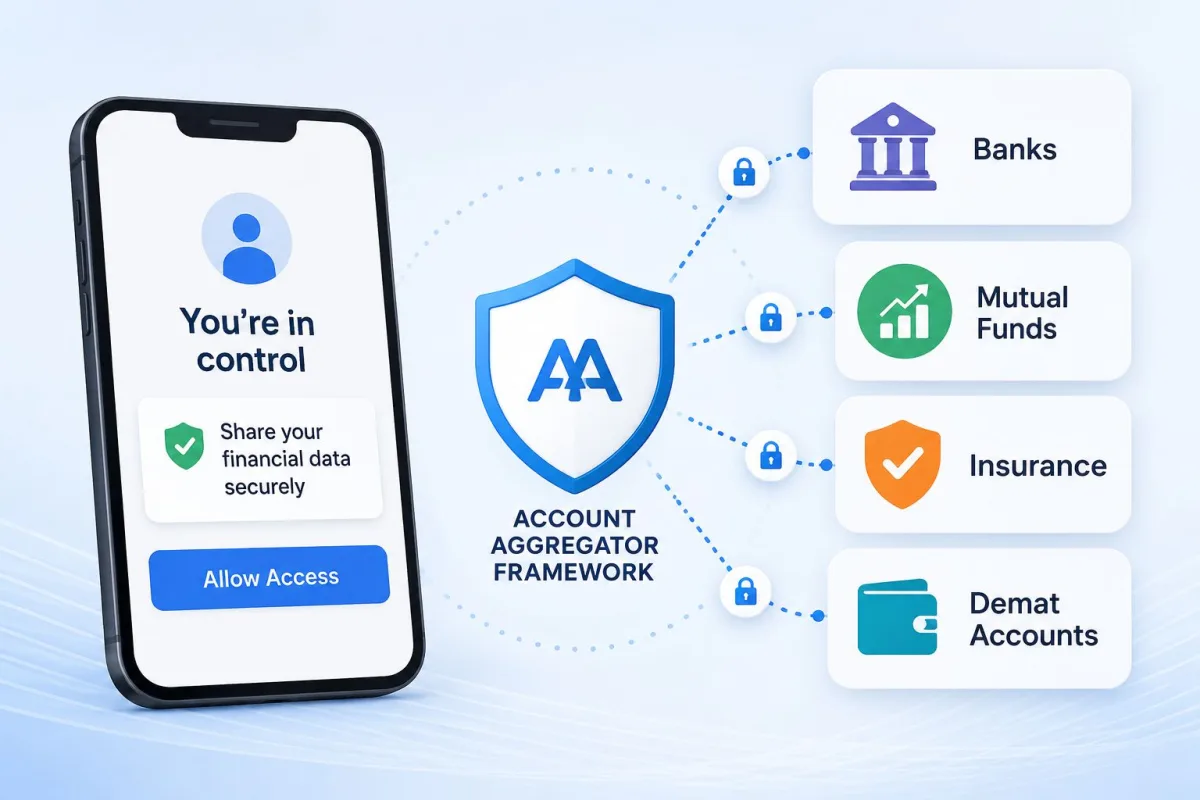
Imagine you're applying for a ₹5 lakh personal loan on a fintech app. Instead of uploading six months of bank statements, hunting for PDFs, or making a branch visit, you get a notification on your phone asking: "Do you consent to share your financial data with XYZ Lender?" You tap yes, the lender gets what it needs in seconds, and your loan gets processed the same day. That's the Account Aggregator framework at work, and in 2026, it's becoming one of the more genuinely useful pieces of India's digital finance stack.
Most people haven't heard of it by name. But if you've applied for a loan through a digital lender in the last year or two, there's a decent chance you've already used it without knowing.
What exactly is an Account Aggregator?
The Account Aggregator (AA) framework is a consent-based financial data sharing system set up by the Reserve Bank of India. It's been operational since 2021, but 2026 is arguably when it's hitting its stride, both in terms of scale and actual usefulness to ordinary people.
Think of it like a courier service for your financial data. The courier can only move a package if you personally hand it over and specify exactly where it's going, how long it can travel, and what's inside. The courier never opens the package. It just transports it. That's basically the whole model.
There are three types of players in this system:
- Financial Information Providers (FIPs) — entities that hold your data. Your bank, mutual fund house, insurance company, EPFO, or tax authority.
- Financial Information Users (FIUs) — entities that need your data. A lender evaluating your loan, a wealth manager building your portfolio, or an insurer assessing your risk.
- Account Aggregators (AAs) — the RBI-licensed middlemen who carry data from FIPs to FIUs, but only with your explicit consent. They're not banks. They don't store your data permanently. They're just the encrypted pipeline.
Sahamati is the industry body coordinating this whole ecosystem. Think of it as the NPCI equivalent for the AA space, and we'll come back to it.
How the consent flow actually works
This is where most explanations lose people, so let me walk through it with a real example.
You're applying for a home loan. The lender needs to verify your income and check your financial health. Traditionally, that means bank statements, ITR documents, salary slips — a pile of paperwork that takes days to collect and more days for the lender to process manually.
With AA, it goes like this:
- The lender sends you a consent request through an AA app — Finvu, OneMoney, CAMSfinserv, or PhonePe's AA service.
- You see exactly what data is being requested — your savings account transactions for the last 12 months, say — and for how long the consent is valid.
- You approve or reject. Partial approval is also an option.
- Your bank (the FIP) sends that data, fully encrypted, directly to the lender (the FIU). The AA never reads it.
The whole thing takes under two minutes. Compare that to waiting three days for a bank statement PDF to get processed. And you can revoke consent anytime. That's not a marketing claim — it's written into the RBI regulation.
Who's running this, and how big has it gotten?
"The Account Aggregator ecosystem is expected to unlock new frontiers in formal credit access for millions of Indians currently outside the traditional lending system." — Ministry of Finance, Government of India
In early 2026, former RBI Deputy Governor R. Gandhi was appointed chairman of Sahamati. That matters. When a former Deputy Governor of the central bank steps in to lead the AA industry body, it tells you this framework has moved well past the pilot phase.
The numbers back that up. As of 2026, over 100 million consents have been processed through the AA ecosystem. The Finance Ministry has publicly noted that AA is expected to unlock new frontiers in formal credit access, which is significant in a country where a large portion of the population still can't get loans because traditional lenders can't verify income. According to a report covered by The Hans India, AI-driven lending models working alongside AA data could potentially address up to $170 billion of India's credit gap.
Mint described the current phase as "Account Aggregator 2.0" — an inflection point where banks, NBFCs, and fintechs are actively building products around the framework rather than just running cautious experiments. India's digital finance infrastructure is genuinely shifting from payments (where UPI already won) to data, and AA is the layer that makes that shift real.
What financial data can actually be shared through AA?
More than most people realise. The framework currently covers:
- Bank accounts — savings, current, and term deposits
- Mutual fund holdings and transaction history
- Insurance policy details
- EPFO provident fund data
- GST filing data — very useful for small business owners applying for working capital loans
- Income tax return data from the IT department
- Securities and equity holdings via SEBI-registered depositories
Each data type requires separate consent. A lender can't ask for everything in one go unless you agree to each category individually. You can say "share my bank transactions but not my mutual funds" and the system will honour that. Honestly, that level of granularity is something I didn't expect when I first looked at how this worked.
For small business owners, this matters a lot. Getting a business loan used to mean months of documentation. With AA pulling GST data, bank statements, and ITR information together with your permission, a lender can assess creditworthiness in hours rather than weeks.
How to share financial data safely using Account Aggregator
The system is designed with safety built in. But there are still things worth knowing before you tap "approve."
Use only licensed AAs
Not every app claiming to be an Account Aggregator is legitimate. RBI maintains a list of licensed AAs. Current approved ones include Finvu (by Cookiejar Technologies), CAMSfinserv, OneMoney, PhonePe AA, and NADL (by National E-Governance Services). If someone sends you a link to an unfamiliar app asking for financial data access, check whether it's legitimate before you proceed. Sketchy-looking links asking for consent are a real thing. Our guide on spotting fintech scams can help you verify.
Read the consent screen carefully
I know, sounds obvious. But the consent screen actually shows you specific things:
- Which accounts are being accessed
- What data type — transactions, balance, or full statement
- The stated purpose of the request — loan processing, portfolio review, etc.
- How long the consent is valid, and whether it's one-time or recurring
- The name and registration details of the requesting entity
If any of those fields look vague, or the purpose doesn't match what the lender told you, don't approve. A legitimate lender won't pressure you to approve within 30 seconds. And if they do pressure you, that's a red flag on its own (annoying, I know, but it happens).
Check and manage your active consents
Every AA app has a consent dashboard where you can see all your active consents and revoke any of them. Check this periodically. Once every couple of months is reasonable. Revoke anything you don't recognise or no longer have a reason for.
Don't share your AA login with anyone
Your AA app account is separate from your bank login. Don't share its password or OTP with anyone, including people claiming to be bank officers or loan executives over the phone. The actual consent process doesn't require you to hand someone else your credentials. If it does, something is wrong.
Three real-world uses where AA saves real time
According to Outlook Money, these are the three scenarios where AA is already making a noticeable difference for ordinary users:
- Loan applications — Faster income verification means faster decisions. Some digital lenders are now promising same-day approvals for personal loans under ₹10 lakh when AA data is used.
- Insurance applications — Insurers can assess risk more accurately with real financial data shared with consent, which can sometimes translate to better-priced policies.
- Wealth management — Financial advisors and robo-advisory apps can get a complete picture of your existing portfolio before making recommendations, rather than working with incomplete information.
A fourth use case is quietly emerging: tax filing. If your CA or tax advisory app can pull your capital gains data, bank interest, and dividend income through AA, the ITR process gets dramatically simpler. Our DigiLocker and ITR guides cover related ground if you want to go deeper.
What AA doesn't do — clearing up common confusion
AA doesn't give anyone permanent access to your accounts. Every consent has an expiry. A one-time consent for a loan application is done the moment the data is transferred.
AA doesn't replace your bank relationship or allow anyone to move money. Your bank is just one of the FIPs in the system. Your funds stay where they are. The AA framework has no ability to initiate transactions. So no, a lender can't debit your account just because you gave AA consent — that's a separate process entirely.
And AA isn't the same as linking your bank to a fintech app for UPI payments. UPI moves money. AA shares information about money. Different systems, completely different purposes. (I'm not 100% sure how many people mix these two up, but I've seen enough confused questions online to know it's common.)
Some people also worry this is another backdoor for companies to harvest financial data permanently. The RBI regulation is explicit: AAs cannot store or process the actual financial data. They're just the encrypted channel. Whether compliance is being maintained in practice is a fair concern, and CERT-In monitors cybersecurity compliance across the digital finance space. But structurally, the architecture is privacy-first in a way that's better than most data-sharing systems I've come across.
What's changing in the AA space in 2026
The big shift right now is AA becoming the backbone for AI-driven lending. Lenders are combining AA data with bureau data from CIBIL, Experian, and CRIF to build more accurate risk models. This is particularly relevant for first-time borrowers — students, gig workers, small traders, homemakers entering the formal economy. People without long credit histories but with months of transaction data that tells a real story about income and spending behaviour.
R. Gandhi's appointment at Sahamati is partly about managing this next phase responsibly. Scaling from millions of consents to hundreds of millions requires standardisation, governance, and trust-building at a national level. Not just among fintechs but among ordinary users who need to understand what they're agreeing to. That part, if you ask me, is harder than the technology.
There's also ongoing discussion about expanding AA to health data, linking ABHA records with insurance processes. Still early-stage, and the numbers here are a bit fuzzy, but it gives you a sense of where this infrastructure is heading.
For now, if you're applying for any financial product in 2026 — a loan, a credit card, an insurance policy — there's a reasonable chance you'll encounter an AA consent request. Knowing what you're looking at, why it matters, and what to watch out for puts you in a meaningfully better position than most people who just tap "approve" without reading anything. Don't be that person.