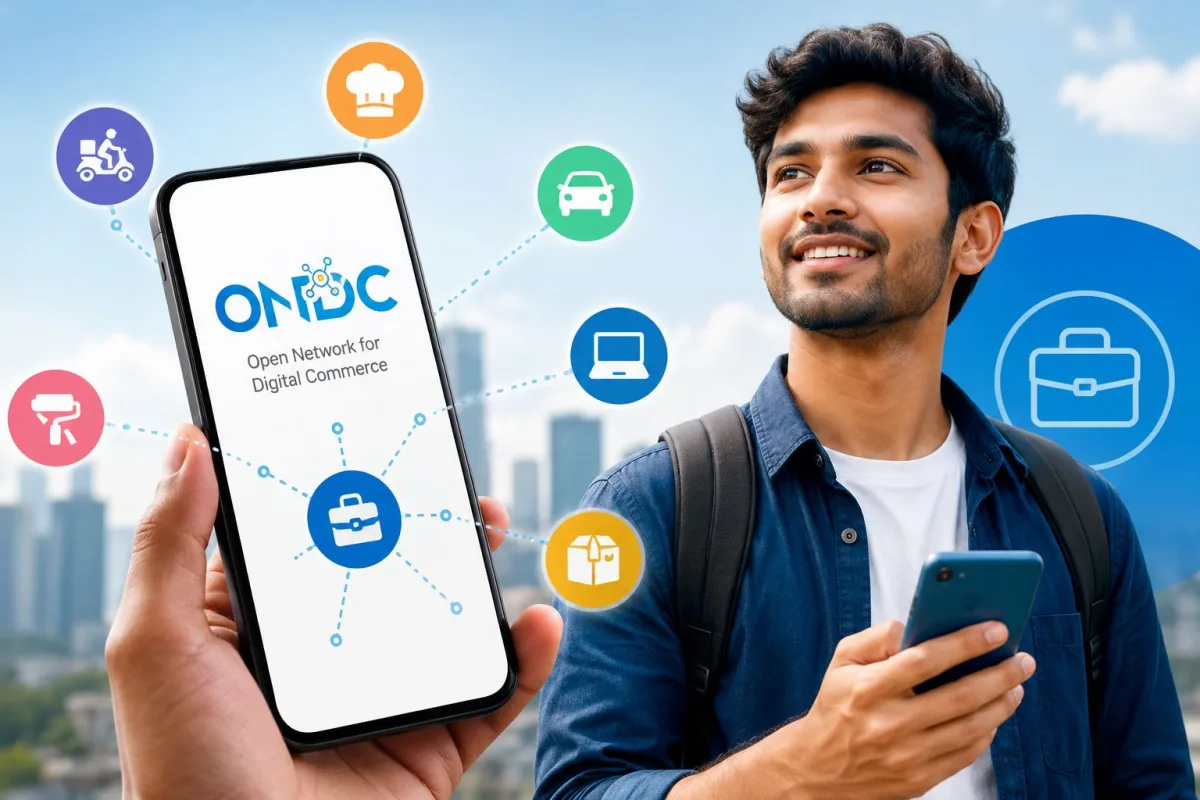
Here's a scene that plays out millions of times a day in India. Ravi, 24, from Hyderabad, drives for Rapido in the morning and picks up plumbing work in the afternoon, with a weekend security shift somewhere in between. Three separate apps. Three separate profiles with ratings that mean nothing outside each platform. His Aadhaar is verified, his track record is solid, but it's locked inside proprietary databases he can't access. ONDC for Jobs is India's attempt to fix this. It's an open employment network where a job posted on one platform can be found through a completely different app, without either the worker or the employer needing to be on the same platform.
If you've read our explainer on how ONDC works for shopping, the idea carries over directly. A store on the ONDC commerce network can be found by any buyer app. Same logic here. A job on the ONDC Jobs network can show up in any participating job-search app, and the platform where you search doesn't have to be the platform where the employer posted it.
What ONDC for Jobs actually is
ONDC (Open Network for Digital Commerce) is a government-backed initiative under the Department for Promotion of Industry and Internal Trade (DPIIT). It runs on the Beckn protocol, which is an open-source specification that different apps adopt so they can talk to each other. Think of it like email. Gmail can send to a Yahoo address because both follow the same protocol. ONDC applies that same logic to commerce, and now to hiring.
The network has three main roles on the jobs side:
- Buyer apps are what a job seeker uses to search. Apps like Apna or Naukri that have joined the ONDC Jobs network fall here.
- Provider apps are where employers and gig platforms post available work, from Urban Company to a local logistics startup to a state government employment board.
- The ONDC registry is a central verified list of all network participants, maintained by ONDC itself.
When you search 'delivery work near me' on a buyer app, that query goes out across every registered provider app on the network. Results come back from all of them. You apply through your own app, and the application routes through the network to the employer's side. From your end, it just looks like a better job search. The back-and-forth between platforms is invisible.
(I know this sounds complicated. It really isn't from the user's side. The whole point is that you don't have to think about it.)
Why gig workers in India need this so badly
India's Economic Survey 2024-25 puts the gig workforce at 12 million people, roughly 2% of total employment. That number is widely considered an undercount, honestly. Financial Express has reported around 23 million young people doing gig-type work in India, many stuck at around Rs 22,500 a month with no real ability to move up. The problem isn't a shortage of work. It's the total absence of portability between platforms.
Quick commerce alone added hundreds of thousands of delivery jobs across Indian cities in the last two years. But those workers are spread across Blinkit, Zepto, Swiggy Instamart, and a bunch of others, each running its own completely separate hiring and ratings pipeline. A person who's been reliable on one platform is invisible to every other.
A delivery partner in Nagpur with three years of spotless ratings is officially nobody to a logistics company using a different app. His reputation is locked in a database owned by a platform that has every incentive to keep him there. Every new platform means re-uploading documents and starting from zero stars again, like none of it ever happened.
ONDC for Jobs, in its stated goal, wants to create a portable work identity. Your Aadhaar-linked profile and your rating history would travel with you across apps. Your skill certifications come along too. You stop rebuilding from scratch every time you switch platforms.
India also notified all four Labour Codes, which include gig workers in social security provisions for the first time. The e-Shram portal already has over 300 million registered unorganised workers (which is a staggering number when you actually sit with it). When ONDC for Jobs connects more deeply to those systems, gig workers could find work and access protections through the same network. That's a meaningful change if it actually gets implemented at scale.
ONEST: the skilling layer that feeds into jobs
ONEST (Open Network for Education and Skilling Transactions) is a closely related network, also built on Beckn, that handles course discovery and verifiable credentials. The idea is that a certificate earned on one skilling platform becomes machine-readable proof of skill when you apply for jobs on the ONDC network. No more 'we can't verify this certificate.'
For someone in a tier-3 city who finished a SWAYAM course or a state skill development program without a formal degree, this matters a lot. On a connected ONEST-ONDC system, that credential is verified and timestamped and attached to your worker profile automatically. A young woman in Rajasthan who completes a digital marketing certificate on a regional portal could apply for remote work listed by a Bengaluru startup, through whichever app she already uses.
The National Skill Development Corporation has been working on ONEST-ONDC compatibility. It's moving, but not at a speed that changes the picture for most people this year. In my experience watching these government tech rollouts, that's pretty normal. Check the guides section for more on ONEST and how to get verified credentials onto your worker profile.
Which apps actually support ONDC for Jobs in 2026
Honestly, the full picture is still developing. The official ONDC website doesn't always have current participant information. Here's what's actually happening:
- Apna has been the most active early participant, particularly for blue-collar and grey-collar work. If you're looking for driver, delivery, security, or skilled trade gigs, this is worth installing.
- Naukri (Info Edge) dominates white-collar hiring in India. Their April 2026 JobSpeak Index showed hiring activity up in IT and BFSI sectors. Full ONDC Jobs integration is still rolling out on their side.
- Several state government job portals, including from Rajasthan and Andhra Pradesh, have connected or are in pilot phase.
- Smaller gig platforms and local contractor networks find the ONDC network useful because it gives them discovery reach they couldn't build independently.
The major consumer platforms like Zomato, Swiggy, Ola, and others haven't opened their worker-hiring pipelines to the network. This isn't accidental. Their competitive moat depends partly on workers staying inside their own ecosystem. Whether ONDC eventually mandates more open participation is something everyone in this space is watching, and if you ask me, that's the real fight here.
What to actually do right now
If you're a gig worker or job seeker:
- Download Apna and complete your profile with Aadhaar verification. Your profile becomes discoverable across the network even when you're not actively searching.
- Keep your e-Shram registration current. It's connected to gig worker protections and may tie into ONDC verification flows as the network matures.
- Watch for ONDC integration announcements in apps you already use. Several platforms are adding this quietly, without much publicity.
If you're a small business or contractor looking to hire, registering on ONDC-compatible platforms means your listing can reach people on apps you've never heard of. That's genuine reach. You don't get that from posting on a single platform.
One thing to watch out for: fake 'ONDC Jobs' portals do exist, sometimes asking for a registration fee or an Aadhaar OTP for work that turns out to be nothing (annoying, I know). Real ONDC network participation is free for workers. If anyone charges you to apply through 'ONDC,' that's a scam. Read our guide on fake job scams in India before engaging with any unsolicited offer. If you've already been targeted, report it at cybercrime.gov.in or call the 1930 helpline.
India's Economic Survey 2024-25 counted 12 million gig workers at roughly 2% of the total workforce. Independent estimates, including reporting by Financial Express, put the actual number closer to 23 million people doing gig-type work across the country.
ONDC for Jobs is solving a problem that is real for tens of millions of Indian workers. The technical architecture exists and the protocol is open. Some platforms are genuinely live on the network. What's still being worked out is whether the platforms that hold the most workers will actually open up, or just participate enough to comply while keeping their real hiring pipelines closed. That negotiation is what 2026 looks like for this network. Follow our news section for the latest on ONDC network developments.