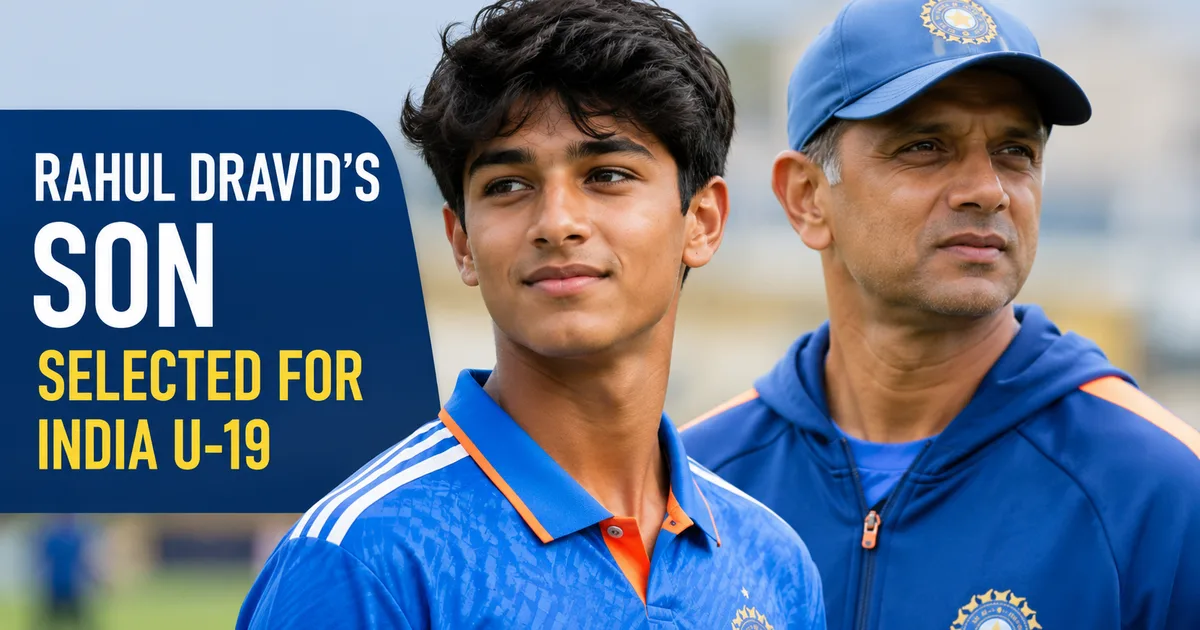
If you follow Indian cricket, the name Dravid is royalty. But today, the spotlight's on his younger son, Anvay Dravid. The Board of Control for Cricket in India (BCCI) recently announced the India Under-19 squad for the upcoming tour of Sri Lanka, and Anvay's name is right there on the list. He's been selected as a wicketkeeper-batter for the one-day series. If you've been tracking domestic age-group cricket, this announcement isn't a surprise. But for the average fan, it raises a simple question: who's this teenager carrying one of the heaviest surnames in sports?
Look, sports fans love a legacy story. We've seen it with Sachin Tendulkar's son Arjun, and we're seeing it again here. But let's be clear. Having a famous father gets you noticed, if you ask me, but it doesn't score runs for you in the middle of a hot afternoon in Hubli or Alur. You still have to face the red ball. And you still have to stand behind the stumps for ninety overs. That's exactly what Anvay's been doing for the last few years in Karnataka's grueling junior cricket setup.
If you want to understand how junior cricketers progress in India, check out our guide on how domestic selections work in our cricket explainers. The path is long and mentally draining, in my experience. Parents spend huge sums. A decent cricket kit alone costs around INR 15,000. And academy fees can range from INR 5,000 to INR 12,000 per month, often paid quickly through UPI at local clubs. Then there's the paperwork. Before a teenager even gets to trial for the state, parents must upload birth certificates and school records on DigiLocker to satisfy strict age-limit checks (annoying, I know). The BCCI uses Aadhaar cards and bone density tests, specifically the TW3 method, to stop age fraud. It's a highly regulated system.
Anvay Dravid's journey in Karnataka age-group cricket
Karnataka State Cricket Association has a reputation for being a tough breeding ground. Competition's fierce. Anvay started making noise at the Under-14 level. He didn't just play. He captained the Karnataka Under-14 team in the 2020-21 season. That's a big deal. Honestly, I think captaining a state side at that age requires tactical awareness and respect from teammates. He showed both. So he progressed to the Under-16 level, playing in the Vijay Merchant Trophy, which is the premier multi-day tournament for that age group.
His style is different from his older brother. His brother, Samit Dravid, is an all-rounder who bowls medium pace. He bats in the middle order and has already made waves, playing in the Under-19 squad and representing Karnataka in the Cooch Behar Trophy. But Anvay chose a different path. He decided to put on the wicketkeeping gloves. Wicketkeeping is a thankless job. You crouch for hours. Your knees take a beating (which sounds brutal, actually). And people only notice you when you drop a catch. But Anvay's coaches in Bangalore have noted that his glovework's neat and his reflexes are sharp.
But what about his batting? In age-group cricket, you can't survive as a pure wicketkeeper anymore. You must contribute with the bat. Anvay's a right-handed batter who's shown he can anchor an innings when needed. During his Under-14 captaincy days, he scored an important half-century against Goa and proved he could handle pressure. He isn't a wild hitter. His technique is organized. That's expected, given his home environment. In a country where thousands of kids want to be the next big batter, I think his focus on a specialized role's smart.
How selection for the India U-19 squad actually works
The selection of a teenager for the national Under-19 team isn't a sudden event. It's the result of selectors tracking players over time. The junior selection committee, appointed by the national board, tracks performance across several tournaments. Selectors travel to various venues to watch players in different conditions. They look for consistency and fitness. If you ask me, this is how the board gets hold of raw talent that can be polished for international cricket.
The national junior selection committee monitors several big domestic tournaments throughout the year:
- The Vinoo Mankad Trophy, which is the national one-day tournament for Under-19 players.
- The Cooch Behar Trophy, a four-day tournament that tests the endurance of young athletes.
- The Vijay Merchant Trophy, which is the premier multi-day tournament for Under-16 players.
After these domestic tournaments, the best performers are invited to the National Cricket Academy in Bengaluru. Here, they undergo intense training camps. The camp goes far beyond simple net practice. Players receive specialized coaching and fitness assessments. According to reports from ESPNcricinfo, these camps help selectors assess how players perform against high-quality bowling. Only fifteen to eighteen players make the final cut. For the upcoming Sri Lanka tour, Anvay Dravid secured his spot in the one-day squad. And Rajat Baghel is the other wicketkeeper selected. I think that's a massive achievement.
This selection shows the depth of Indian cricket's youth system. With thousands of kids training at academies, getting into the top fifteen is a massive achievement. The competition at the Under-19 level is almost as intense as the senior team. Many players who star in these tournaments go on to play in the Indian Premier League or represent the senior national team. It's the main gateway to professional cricket in India. So you can read more about how youth development shapes the sport in our sports news section. In my experience, these tournaments make or break careers.
Dealing with the pressure of being Rahul Dravid's son
Let's talk about the elephant in the room. The Dravid name is heavy. Rahul Dravid is one of the greatest batters in cricket history, with over 24,000 international runs. He has a reputation for unmatched defensive technique. Also, he coached the India Under-19 and India A teams, and coached young talents like Prithvi Shaw and Shubman Gill. Later, he coached the senior national team to a T20 World Cup victory (which was huge, honestly). When your father has achieved all that, public expectations are immense. Every low score is analyzed. And every selection is questioned by critics online.
According to reports from NDTV Sports, Anvay Dravid's selection for the one-day squad comes more than three decades after his father Rahul Dravid made his mark in junior cricket, marking another chapter in the family's cricketing history.
Honestly, it's just not fair to the kids. But that's the reality of Indian cricket. Anvay and his brother Samit have had cameras following them since their school cricket days at Mallya Aditi International School. Every century they scored made regional headlines. The media just loves lineage stories. But people close to the family say Rahul Dravid and his wife Vijeta have tried hard to keep their sons grounded. I think they just want them to enjoy the game first, without worrying about the family legacy.
You can see this grounded approach in how the boys have progressed. There was no fast-tracking. Anvay had to perform in the local leagues, play for his school, get selected for zonal teams, and finally play for Karnataka. He had to earn his state cap just like any other kid from Shimoga or Mysore. The board's selectors are highly professional. And they know that picking a player based on name alone backfires quickly on the international stage.
What lies ahead for the India U-19 squad in Sri Lanka
The India Under-19 tour of Sri Lanka is scheduled to begin on July 4, 2026. It's a big test for this young group. Playing in Sri Lankan conditions is never easy for junior cricketers. Honestly, the pitches in cities like Colombo or Galle can be slow and turn from day one. For a wicketkeeper, this's a tough test. You've got to stand right up to the stumps for spinners. And you must deal with uneven bounce and sharp turn. It requires immense concentration and quick reflexes.
For Anvay, the tour is a chance to establish himself. He's selected only for the one-day series. Wicketkeepers in the multi-day squad are different. So every game he plays will be under scrutiny. He needs to show what he can do as a finisher or middle-order anchor. Also, his keeping needs to be clean. Wicketkeepers who can bat are in high demand in modern cricket. And a good performance here could open doors to the senior Karnataka team or future India A tours. In my experience, these opportunities don't come often.
This tour is also a transition. A new batch of Under-19 players is coming through. They'll form the core for the next Under-19 World Cup. The coaching staff's going to monitor how these teenagers adapt to international pressure. For Anvay Dravid, it's the start of his own international journey. He's got the heritage and the training. But now he has to write his own story on the field.