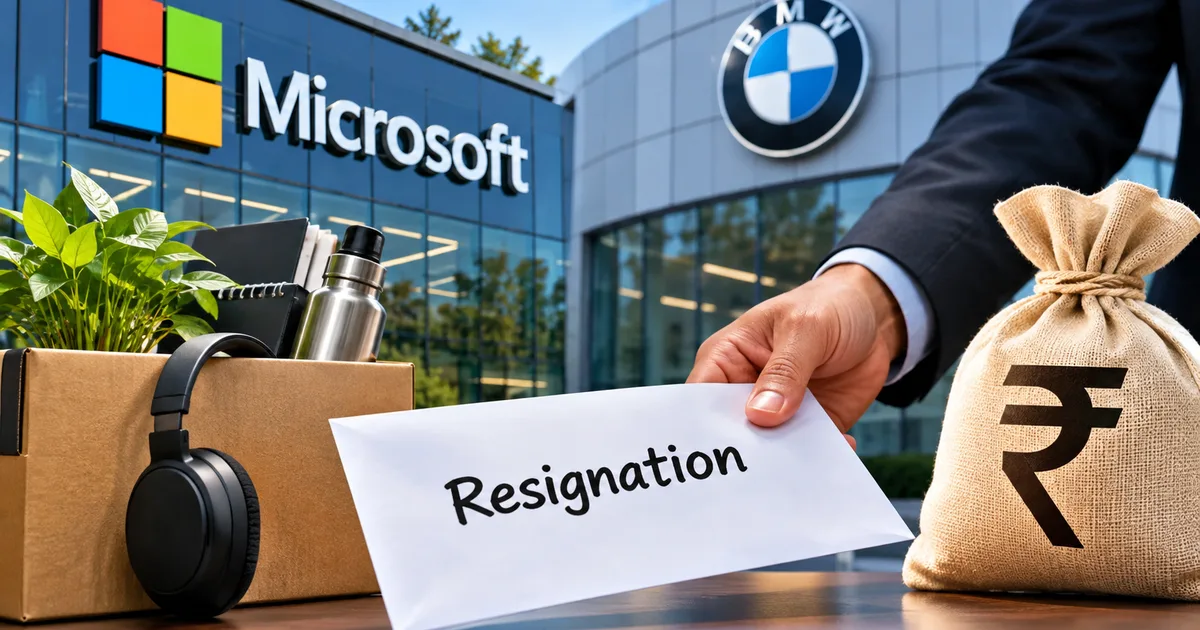
Imagine your manager calls you into a conference room tomorrow morning, sets down a cup of chai, and offers to pay employees to quit on the spot with a massive lump sum. Inside the envelope, there's a formal offer: hand in your resignation today, and the company will wire months of salary directly to your bank account. No heated performance reviews. No security escort. If you choose to leave, they just wire the money and wish you well.
Sounds bizarre, right? But that's exactly what happened when tech and auto giants like Microsoft and BMW rolled out voluntary buyout programs. In late October 2026, Microsoft introduced an exit package for around 60,000 eligible workers across India, the United States, the United Kingdom, and Canada. Around the same time, reports showed German automaker BMW offered voluntary departure checks reaching up to $730,000. That comes out to roughly ₹6.1 crore for certain senior staff in Europe (which is a massive sum by any standard). If you ask me, cutting huge checks to get people to walk away looks like corporate madness on paper. But when you look at the economics and workplace psychology behind it, the strategy makes cold, calculated sense.
Here's the deal: companies aren't doing this out of charity.
Why tech giants pay employees to quit during quiet market shifts
Over the past two years, the tech sector went through pure whiplash. First came aggressive hiring sprees during the remote-work boom. Then came sudden, brutal layoff rounds. If you work in Bengaluru, Hyderabad, Chennai, or Pune, you probably know someone who woke up on a Tuesday morning to find their corporate laptop locked and their Slack access revoked. I'm not sure exactly why HR departments handle these cuts so crudely, but that kind of abrupt firing creates deep anxiety across teams. It wrecks team morale. It also damages the employer brand on job boards, while remaining engineers spend their days looking over their shoulders instead of focusing on sprint tasks.
A voluntary exit offer takes a completely different path. Instead of management picking names off a secret spreadsheet and blindsiding staff, the company lets workers decide their own fate. If an engineer feels burnt out, or wants to move back to their hometown to care for aging parents, the buyout package is a clean, dignified exit. For the employer, it trims payroll without triggering ugly press coverage and messy legal battles over severance terms.
In my experience, sudden layoffs leave team culture a total mess. I tracked this closely when analyzing the Oracle layoffs and severance packages, and the contrast in company culture is staggering. Abrupt cuts leave behind a fearful workforce. Voluntary buyouts let people walk away with their dignity and a solid financial cushion intact.
Honestly, it also is a quiet filter. When an employer puts cash on the table for anyone wanting to walk, the most disengaged workers are usually the first ones to pack their bags. That leaves behind a core team that genuinely wants to stick around.
The Microsoft voluntary exit offer and its Indian IT impact
On 26 October 2026, Microsoft officially announced its voluntary buyout program across four major markets. The offer targeted eligible employees at level 70 and below in selected business units across India, the US, the UK, and Canada. Level 70 at Microsoft covers senior individual contributors and principal software engineers. Basically, we're talking about seasoned technical talent here, including architects who built foundational platforms.
Microsoft Chief Financial Officer Amy Hood explained the corporate thinking in an internal memo to staff:
"Our intent is to offer employees agency if they choose to leave the company on their own terms. We expect very few people to select this offer because of the growth opportunities here at Microsoft."
Amy Coleman, Microsoft Executive Vice President and Chief People Officer, noted that the package includes standard severance terms alongside formal career transition resources. Eligible employees have until early December 2026 to make up their minds, with final departures wrapping up before the end of the year.
Microsoft leadership publicly estimated that 3,000 or fewer employees will take the buyout. That comes out to around 5% of the 60,000 eligible workforce. You might wonder: why bother with all the legal paperwork and internal planning if you only expect a small slice to bite? I think that small fraction makes a massive difference to annual operating overhead. The internal numbers here are always a bit fuzzy, but cutting high salaries saves serious money fast.
For Indian engineers on Microsoft campuses in Bengaluru and Hyderabad, voluntary buyouts carry unique weight. Standard 90-day notice periods in Indian tech can be a drag (annoying, I know). Taking a buyout means an immediate cash settlement and expedited provident fund transfers. You also avoid the awkward stigma that often tags along with forced retrenchment on your resume.
What the Canadian university study discovered about buyout math
Paying people to leave sounds like an expensive gamble, but recent academic research shows why finance chiefs love the idea. A study in the Journal of Management Accounting Research examined how staff respond when an employer offers cash to resign. The research team included Leslie Berger and Lan Guo from Wilfrid Laurier University, Kelsey Matthews from the University of Waterloo, and Bradley Ruffle from McMaster University.
The researchers discovered that employee attachment to an organization dictates who accepts an exit payout:
- Employees with weak organizational attachment almost always take the money and leave quickly.
- Employees with strong organizational attachment stay put regardless of how much cash is dangled in front of them.
- The financial incentive creates the biggest shift among workers sitting squarely on the fence.
Thing is, the most fascinating discovery happened after departures were finalized. The researchers tracked the workers who actively turned down the payout offer and chose to stay. Those employees subsequently put in significantly greater work effort than they did before the offer arrived. Once a professional consciously turns down millions of rupees to stay at their desk, their psychological commitment to the company surges. They chose to stay. They made an active choice to stay on the team.
A separate 2026 experiment in the Journal of Behavioral and Experimental Economics tested 1,000 participants in an online work environment. Workers who turned down a modest cash payment to quit ended up completing 33% more tasks than a control group that was never offered buyout cash. If you ask me, the psychological link between turning down an exit package and putting in harder work is genuine (even if baseline motivation plays a role).
Look at our collection of tech explainers and you'll see how often modern corporate management relies on behavioral economics. A buyout offer is a powerful psychological loyalty test disguised as severance.
How BMW approached voluntary buyouts in Europe
While Microsoft focused on software engineers, German automaker BMW tackled a completely different industrial challenge. The auto sector is pouring money into electric vehicles and digital platforms. Retooling traditional vehicle assembly lines means the company needs fewer mechanical workers and far more electrical specialists.
BMW faced rigid European labor regulations that make firing tenured factory workers nearly impossible without protracted union disputes. So, the company put large packages on the table. Senior employees with decades of service could reportedly claim payouts reaching up to $730,000. In Indian currency, that's over ₹6.1 crore (which sounds like an astronomical figure for a factory role).
Why would an automaker spend that much upfront? Simple arithmetic.
In my experience, legacy manufacturers prefer big upfront buyouts over prolonged strikes every single time. A senior technician in a German manufacturing plant costs the company wages, pensions, healthcare, and state social security contributions year after year. If that technician is ten years away from retirement, keeping them on the assembly line could cost BMW twice that buyout figure. Offering a lump sum allows BMW to trim headcount peacefully and reallocate capital into electric battery production.
How voluntary separation schemes work in the Indian workplace
In India, paying employees to quit isn't a new concept. Public sector giants like BSNL, MTNL, Air India, and state-run banks used voluntary separation schemes for decades to trim massive legacy workforces. What's changing now is how multinational tech corporations bring this exact playbook into Indian private tech hubs.
When an Indian IT firm or tech multinational offers a buyout, the package generally bundles several key financial components:
- A tax-adjusted lump sum payout calculated on months of basic salary per year of completed service.
- Full encashment of accumulated earned leave balances without standard corporate deductions.
- Immediate release letters confirming clean resignation rather than termination or layoff.
- Extended group medical insurance coverage for the employee and their dependents for six to twelve months.
- Outplacement assistance, resume coaching, and access to internal recruitment networks.
We recently analyzed how compensation structures are shifting across tech campuses in our review of Accenture lump sum base pay changes, and voluntary exit payouts follow a similar analytical logic. Companies want flexible payrolls instead of locked-in liabilities.
In my experience, Indian engineers look at these payouts in a brand new light. Receiving a sizable severance package can fund a pivot that was previously out of reach. Some engineers use the money to clear home loans. Others fund higher education abroad or jump into freelancing and startup consulting without the immediate stress of paying monthly rent (a huge relief, honestly).
Should you ever take a voluntary separation package in India?
If your company ever presents you with a buyout offer, don't sign on the dotted line within the first five minutes. It's easy to see a lump sum of ₹15 lakh or ₹30 lakh and treat it like winning a mini lottery. Pause. Take a breath and do the math.
First, examine the current hiring climate in your exact domain. If you're an experienced cloud architect with active certifications, you'll probably land interviews within three weeks of updating your LinkedIn profile. But if your skill set centers on legacy software maintenance and your domain is undergoing automation, finding an equivalent salary in today's cautious market could take six months or longer. A lump sum burns through your savings faster than you think once rent, EMIs, grocery bills, and school fees come due.
Second, calculate the tax bite. Severance payouts above statutory limits face regular slab rates under Indian income tax rules. That ₹20 lakh package can easily shrink to ₹14 lakh once the finance department deducts tax at source. Talk with a chartered accountant before making your decision.
Third, ask yourself an honest question: do you actually enjoy working for your current employer? If you dread your daily standup meetings and feel drained by leadership, an exit package gives you a paid ticket out of a toxic environment. If you ask me, taking the cash in that situation is the obvious choice. But if you respect your team and see clear avenues for internal promotion, turning down the cash might be the smartest career move you ever make. You can consult our career and workplace guides to build an emergency fund before making risky career leaps.
As Microsoft and BMW have shown, paying employees to leave is a deliberate management strategy that reshapes teams without the trauma of sudden firings. Whether you choose to take the cash or turn it down, knowing why companies make the offer puts control back in your hands.