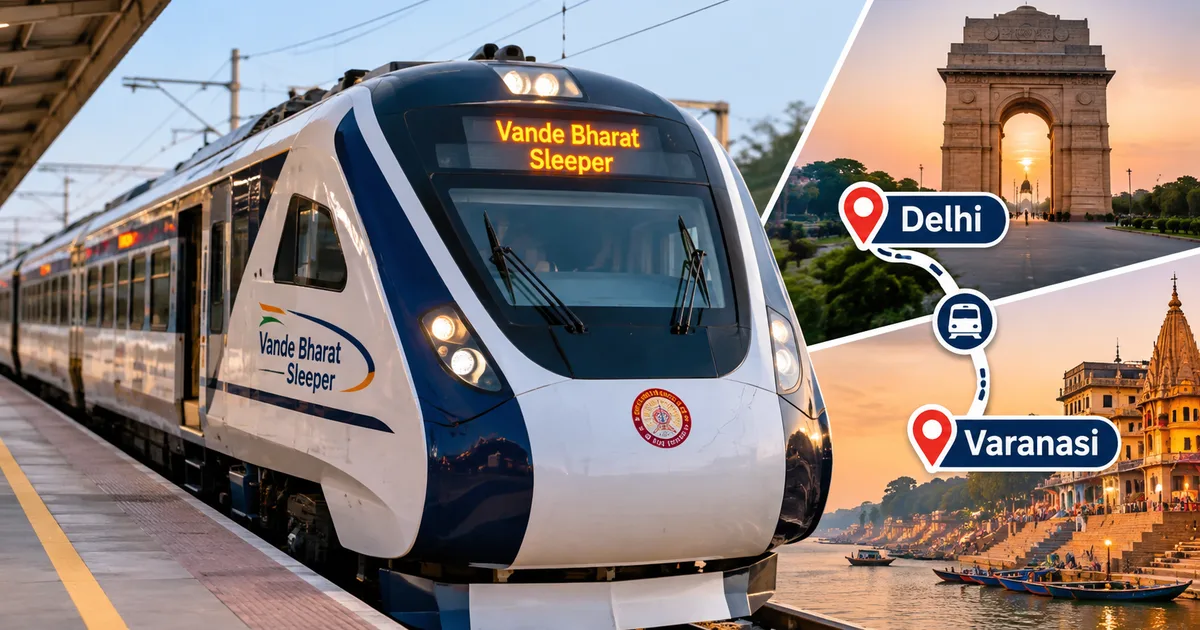
If you've ever boarded the Shiv Ganga Express or the regular overnight mail to Varanasi from New Delhi, you already know the drill. You shove your bags under the lower berth and brace for those sudden mechanical jerks at every signal halt. Then you just pray the air conditioning doesn't turn the coach into a freezer by 3 AM. The newly flagged off Delhi-Varanasi Vande Bharat Sleeper aims to overhaul that entire experience. It's India's second semi-high-speed sleeper trainset, and it's a massive shift in how overnight rail journeys work across north India.
In my experience, getting actual sleep on an Indian train is pure luck. Most coaches shake and rattle with enough violence to wake you every two hours. But this new trainset changes the basic mechanics of how Indian coaches move. Completely.
Railway Minister Ashwini Vaishnaw and Uttar Pradesh Chief Minister Yogi Adityanath flagged off the rake from Varanasi ahead of regular commercial operations, which start on Monday, November 2, 2026. Northern Railway handles maintenance, while North Central Railway manages transit across the busy Kanpur and Prayagraj corridor.
"From 2nd November, regular run will commence," confirmed Dr. Shivam Sharma, Chief Public Relations Officer for the North Central Railway zone.
So whether you're planning a weekend temple trip to Kashi or heading to Delhi for meetings, here's the full breakdown of how the train works and what tickets actually cost.
What makes the Delhi-Varanasi Vande Bharat Sleeper different from regular trains
The biggest change is something you'll probably never see from the platform. There's no locomotive upfront. Traditional setups like the Rajdhani Express or Prayagraj Express rely on a massive WAP-7 electric engine hauling 20 to 24 unpowered coaches from the head. When that engine speeds up or brakes, force ripples through the couplers. That's where you get that violent clunk that spills your morning chai.
Instead, this sleeper runs on distributed traction. Electric motors sit right under alternate coaches across the 16-coach rake. Power is spread across the whole train. So it speeds up smoothly. And it brakes without throwing you off your berth (which makes sense, honestly, once you see how EMUs operate). If you want a deeper look at how modern train technology compares across routes, read our explainer on the Bengaluru-Mumbai Vande Bharat Sleeper route.
Look, the cabin insulation is the other big upgrade. If you ask me, conventional ICF and even newer LHB coaches let in far too much track noise and outside honking. The Vande Bharat sleeper has sealed gangways, double-glazed panoramic windows, heavy door seals, and specialized acoustic padding under the floor. It's quiet. Step inside and the silence feels more like a commercial flight than an old mail train.
Route and stoppages between New Delhi and Varanasi
The train covers around 760 kilometers between New Delhi (NDLS) and Varanasi Junction (BSB). That's a brutal, packed rail corridor with some of the heaviest passenger traffic in India.
Indian Railways skipped smaller junctions here to protect overnight speeds. Between New Delhi and Varanasi, the train stops at only four commercial stations:
- Ghaziabad Junction, serving commuters from eastern Delhi and western Uttar Pradesh.
- Aligarh Junction, serving the educational and industrial belt of western UP.
- Kanpur Central, one of the busiest railway transit points in northern India.
- Prayagraj Junction, connecting passengers headed toward the Sangam city.
Skipping minor stops pays off. The entire 760 km trip takes 9 hours and 30 minutes. That matches or beats other premium trains on this line, but the ride is vastly more stable. I think most passengers will pick that stability over raw speed any day.
Train timings and schedule for 27421 and 27422
The schedule is built for overnight trips. You board after dinner and sleep the whole way. By morning, you're already there, ready for work or temple darshan.
Train number 27421 runs from Varanasi to New Delhi. It leaves Varanasi Junction at 8:50 PM. It gets to Prayagraj around 10:35 PM for a quick five-minute halt, then pushes on to Kanpur Central by 12:20 AM. After another brief stop, it runs through the dark and pulls into New Delhi at 6:10 AM. You can book this six days a week, though Friday departures are off for maintenance.
On the return leg, train number 27422 heads from New Delhi to Varanasi. Departure from New Delhi is at 9:40 PM, so you don't have to rush through evening traffic to catch it. It hits Kanpur Central late at night and pulls into Prayagraj by 4:45 AM. Final stop is Varanasi Junction at 7:10 AM. Just like the northbound train, it operates six days a week, with Saturday runs cancelled.
Honestly, the timing is brilliant for anyone sick of wasting half a day at airport security checkpoints. You can browse more transit breakdowns in our dedicated rail and tech explainers section.
Expected ticket fares and booking process on IRCTC
The Railway Board always drops the official tariff notifications right before bookings open, so the exact numbers here are a bit fuzzy until that circular goes live. But early pricing models match what you see on Tejas and Rajdhani express trains, just with a small markup for the new hardware.
Here's what you can expect to pay for a one-way ticket between Delhi and Varanasi, with standard meals included:
- Third AC (3A) berths: expected between ₹1,900 and ₹2,200.
- Second AC (2A) berths: expected between ₹2,800 and ₹3,200.
- First AC (1A) berths: expected between ₹3,800 and ₹4,500.
Catering is bundled into the ticket price. That said, Indian Railways lets you opt out during booking if you'd rather save around ₹300 to ₹500. The IRCTC-contracted kitchens handle everything, serving hot regional north Indian breakfast items and packed dinners.
Getting a ticket is the usual drill. You can buy seats on the official IRCTC portal, or grab them on your phone through the IRCTC Rail Connect and RailOne apps. Prefer paper? Physical PRS counters at local railway stations still hand out counter slips.
One tip: get your IRCTC account Aadhaar-verified before ticket booking opens. Verified profiles can book up to 24 tickets every month, whereas unverified ones get capped at just 12. You can pay instantly using UPI or net banking without convenience fees on select government gateways. For a step-by-step walkthrough of seat selection, read our guide to booking Vande Bharat sleeper tickets.
Remember, the Ministry of Railways recently cut down advance reservation windows. To avoid getting stuck in waitlist limbo, check the latest railway ticket reservation rules before you finalize travel dates.
Berth layouts and coach design across classes
If you've ever whacked your head trying to climb onto an upper berth in an old coach, you'll love what the Integral Coach Factory (ICF) built here. Those nasty, razor-sharp iron ladders are finally gone.
The 16-coach rake divides passenger capacity across three classes:
- Third AC (3A) occupies eleven coaches, accommodating the largest share of passengers with improved 3-tier transverse berth configurations.
- Second AC (2A) spans four coaches, offering 2-tier arrangements with wider berths, private reading lamps, and privacy curtains.
- First AC (1A) consists of a single premium coach, providing lockable 2-berth and 4-berth coupes along with hot water shower cubicles.
Berths use high-density foam cushioning covered in fire-retardant fabric. In my experience, the middle berth in Third AC has always been a pain to set up, but here the latching system is much smoother. It doesn't sag in the center. And it won't crush your fingers when you fold it away in the morning (annoying, I know, on older rakes).
Under-berth storage is noticeably taller too. Standard trolley bags slide in easily without scraping against steel support brackets. Every berth has USB-A and USB-C fast charging ports alongside a phone holder. You also get an angled reading light that won't blind the person sleeping right across from you.
The washrooms deserve a callout. The train has pressurized bio-vacuum toilets just like modern passenger planes. They use roughly 500 milliliters of water per flush instead of the 10 to 15 liters wasted by older gravity chutes. The whole setup is hands-free, fitted with infrared sensor taps and foot-operated trash bins.
The technology inside the new sleeper trainset
Beneath the passenger comforts, the train has serious engineering upgrades built directly into the chassis.
First on that list is the indigenous Kavach anti-collision system. Kavach works through RFID tags laid between the rails and computer modules inside the driving cabs. If a loco pilot accidentally runs a red signal, or if another train enters the identical track block, Kavach slams on the brakes automatically. It also controls speeds during thick winter fog, which blinds the Delhi-Kanpur-Prayagraj stretch every year from November through January.
Coaches also have automatic plug doors. The train simply won't budge until every single outer door is sealed shut. As soon as you arrive at a platform, an automatic footstep slides out to bridge that awkward gap between the train floor and the concrete edge. That makes getting on with heavy strollers or suitcases a whole lot safer.
Basically, the internal climate control is fully automated. Dozens of sensors track air quality and temperatures across the coach. Air conditioning units have micro-filters for fine dust, while an automated controller tweaks cooling output based on cabin headcount and outside humidity.
Why this matters for travelers on the Delhi-Varanasi route
The route between Delhi and Varanasi is packed year-round. Flights along this corridor regularly spike to ₹4,500 or ₹7,000 one-way during wedding seasons and winter festivals. Once you factor in cab rides to the terminal and airport security lines, flying doesn't actually save you much time compared to a clean overnight sleeper.
Thing is, regular mail trains on this line are notoriously unpredictable with delays and rattling coaches. This sleeper plugs that gap. You sleep in genuine comfort and step onto the platform without an aching back.
If you travel between Purvanchal and the capital on a regular basis, I think this service is well worth booking. You can find more transit advice and trip planning tips in our step-by-step travel guides.