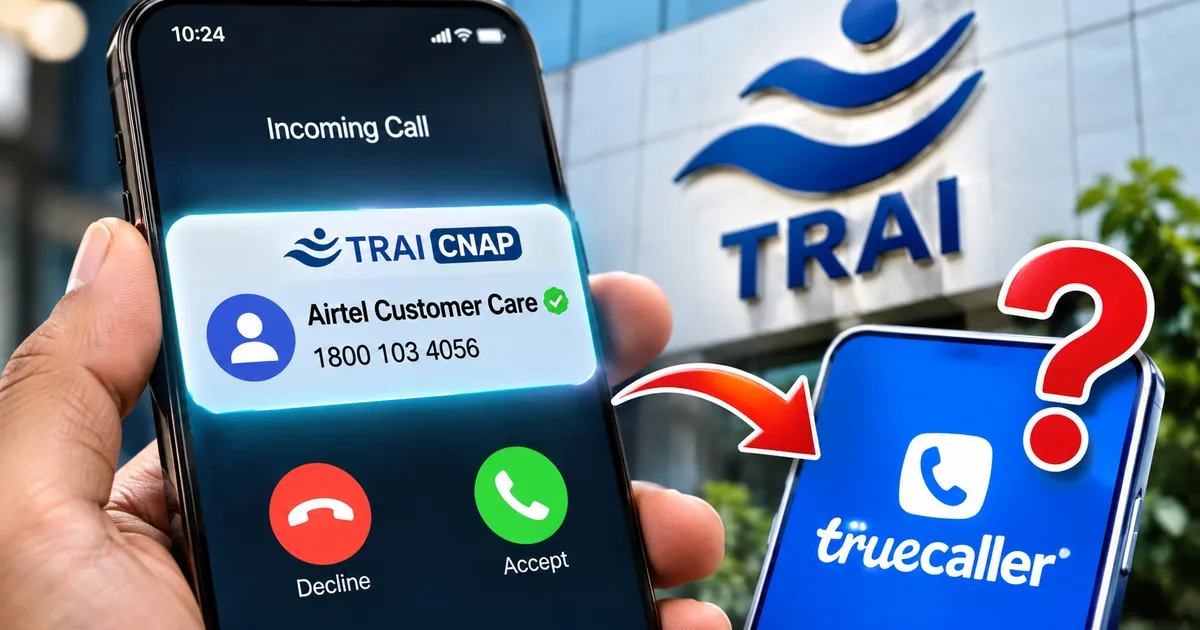
Picture this: your phone rings right in the middle of an afternoon meeting. The screen flashes an unknown ten-digit number starting with +91-98. You hesitate. Is it your courier delivery boy trying to find your building gate, or another loan agent offering a pre-approved credit card you never asked for? Today, that guesswork begins to fade. With the official rollout of TRAI CNAP caller ID across Indian telecom networks, your phone will start displaying the registered name of whoever is calling you.
No app installation needed. No battery drain running quietly in the background. Basically, it's just the actual identity tied to the SIM card showing up on your screen before you pick up.
The Department of Telecommunications (DoT) set a firm timeline telling operators like Reliance Jio and Bharti Airtel, alongside Vodafone Idea (Vi), to turn this on across 4G and 5G networks starting November 1. The target deadline for the whole country is March 2026. In my experience, almost everyone in India has stopped answering unknown numbers because the spam got completely out of hand (and honestly, who hasn't been interrupted during lunch by a loan pitch?). Having verified names pop up is a huge relief for anyone trying to get through a workday.
If you've read our telecom tech guides, you know Indian networks moved fast over the last decade. But voice calling stayed stuck in the 2000s with plain digits on a screen. CNAP fixes that mess.
What is calling name presentation and how does it reach your screen?
CNAP stands for Calling Name Presentation. Sounds like bureaucratic jargon, but it's really simple.
Whenever you buy a SIM in India, you verify your identity with Aadhaar or DigiLocker records. Telcos keep that information saved inside their Customer Application Form (CAF) database. When someone calls you on a CNAP-ready network, their operator grabs that verified KYC name, matches it to the number, and sends it straight across the voice signaling channel to your phone display.
Look, the whole lookup takes mere milliseconds before the phone even rings. You don't need mobile data on. You don't need an active internet connection. The name travels right over the telecom signaling layer, right alongside the number itself (which makes sense, actually, given how regular caller ID has worked for decades). If you ask me, baking identity directly into the carrier network is the only way this ever works reliably.
The step-by-step path from cell tower to your handset
Here is how a typical call journey works under the hood:
- A caller initiates a call from their mobile handset or fixed line.
- The originating telecom switch queries its internal database for the verified KYC name attached to that active SIM card.
- The network bundles the verified name into the SIP signaling header alongside the standard caller number.
- Your local operator receives the packet and passes the caller name directly to your phone display.
- Your smartphone screen lights up with both the caller name and their mobile number.
And that's the big difference. The name doesn't come from a random internet database. It comes straight from core telecom routing switches.
How CNAP differs from Truecaller and crowd-sourced apps
For more than a decade, Truecaller was pretty much the default caller ID app across India. Everyone installed it on their new phones without thinking twice. But Truecaller and CNAP operate on fundamentally opposite principles.
Here's the deal: Truecaller depends on crowdsourcing. When someone installs the app, they upload their entire contact book. So if four colleagues save Ramesh as Ramesh Office Guy, Truecaller serves that crowdsourced tag to everyone else. In my experience, that backfires all the time. I've seen reputable doctors labelled Do Not Pick simply because a few patients got mad about clinic delays.
Thing is, scammers figured out how to game crowdsourced lists years ago. A fraudster buys a cheap SIM, gets twenty friends to save the number as HDFC Bank Official Helpdesk, and the app dutifully flashes that fake name to targets.
The primary flaw of crowdsourced caller ID has always been accountability. Anyone could manipulate contact tags. CNAP ties caller display strictly to government-mandated KYC records, making deliberate identity masking far harder for opportunistic fraudsters.
Does this kill Truecaller? Not right away. But it destroys their main moat. Truecaller reps argue that CNAP lacks community spam scores, call recording, auto-blocking, and quick search. That's fair. CNAP won't tell you if fifty people reported a number for selling sketchy mutual funds (annoying, I know). But when it comes to answering who actually owns a phone number, KYC records beat crowdsourced guesses every day of the week.
Honestly, Truecaller has turned into a bloated mess over the years. Between the popup ads and the constant battery drain, it's exhausting. A lot of people who only put up with the app to avoid mystery calls will just delete it once carrier caller ID runs smoothly.
Why the Department of Telecommunications pushed for KYC verification
Money is the real driver here. More specifically, the sheer amount of cash ordinary Indians lose to digital fraud every day. The numbers here are a bit fuzzy because so many cases go unreported, but official estimates run into thousands of crores each year. If you ask me, that financial bleeding is what finally forced the government's hand.
Over the last two years, scam crews moved far beyond cheap lottery texts. Today they run elaborate digital arrest and fake delivery scams where callers pretend to be police officers or customs officials. Targets get frantic calls claiming an illegal package was confiscated at Mumbai airport, or that their bank account helped move cartel money. Terrified victims (often older folks who don't follow tech news) end up wiring ₹5 lakh to ₹50 lakh of their life savings into sketchy mule bank accounts before figuring out they got robbed.
Scams like this work because of caller ambiguity. If someone claims they're calling from the Delhi Police Cyber Cell or the State Bank of India, you've got no clean way to verify them on the spot. With CNAP running, if that fraudster uses a SIM registered to Suresh Kumar, your screen shows Suresh Kumar. Not SBI. That alone breaks the spell.
The DoT also wants to combat relentless telemarketing calls that torment mobile users who already signed up for the National Do Not Disturb (DND) registry. Shady telemarketing agencies buy bulk prepaid SIMs to dodge commercial headers like VK-HDFCBK. Under CNAP, every single one of those personal SIMs displays the buyer's real name on your screen instead.
What happens to enterprise callers and delivery executives
What about legitimate companies? What happens when Swiggy, Zomato, Amazon, or your local ICICI Bank branch gives you a ring?
TRAI laid out clear rules for enterprise lines. Companies with corporate connections or enterprise SIP trunks have to link their numbers to their registered business name. So when an airline calls about a delayed flight, you'll see IndiGo Airlines on screen. You won't see the name of an agent working out of Gurugram.
There's still friction on the ground, though. A lot of local kirana shopkeepers, cab drivers, plumbers, and delivery partners use personal prepaid SIMs for work. That means a courier delivering medicine might show up under their personal village name instead of Delhivery or Blue Dart (annoying when you're waiting on a package). I think sorting out enterprise trunks for millions of gig workers will take a while, but the framework is heading there.
Technical hurdles, device compatibility, and privacy questions
So why did this take until late 2026? Building this wasn't trivial. Indian telecom infrastructure is a massive beast dealing with over a billion active connections day in and day out.
Telcos like Reliance Jio and Bharti Airtel, alongside Vi, had to overhaul their core IP Multimedia Subsystem setups. As Jio pushed its standalone network during its rapid 5G network rollout, setting up cross-network lookups meant syncing databases for hundreds of millions of call handshakes every hour. If a query adds even 300 milliseconds of lag, calls drop or take forever to connect. I'm not sure exactly why the testing phase dragged on so long in certain states, but metro circles are getting caller names first while smaller towns wait their turn.
Phone compatibility is another headache. Current 4G and 5G smartphones running modern Android or iOS versions handle CNAP packets easily. Older 2G and 3G feature phones simply lack the software code to display name strings. DoT rules tell manufacturers that every new phone sold in India must support CNAP out of the box, but older handsets across rural markets will stay blind to names until users upgrade.
Then there's the privacy debate. This got heated during TRAI consultations. Women's safety advocates raised serious red flags about broadcasting legal KYC names by default. Think about a woman booking a cab or taking a delivery; the driver instantly sees her full legal name just by calling her phone (which is a valid worry, if you ask me). TRAI originally suggested an opt-out choice for regular citizens, but DoT wanted mandatory display on 4G and 5G to clamp down hard on fraud. The final rules strike a compromise: people with documented safety concerns can request name masking via customer care, though business lines don't get that option.
How to protect yourself from sophisticated spoofing scams
CNAP makes everyday calls far safer, but it isn't an impenetrable shield. Criminals adapt fast. You still have to stay sharp.
Here are several practical rules to protect your money and identity:
- Never trust a caller solely because their displayed name sounds official. Criminals can still buy SIM cards using stolen Aadhaar credentials or forged documents.
- Remember that government agencies, police departments, and the Reserve Bank of India never demand money transfers or UPI PINs over a voice call to resolve an investigation.
- Treat unexpected requests for OTPs, ATM PINs, or screen-sharing app installations as immediate red flags.
- Verify suspicious business calls independently by opening the official company app or dialling customer care numbers listed on official websites.
- Report any fraudulent or suspicious call to the National Cyber Crime Reporting Portal at cybercrime.gov.in or call the national cyber helpline at 1930 immediately.
Reporting fraudulent numbers when verified names turn out fake
If you get a sketchy call and the name on screen obviously belongs to some poor identity theft victim, don't just hang up and brush it off. You can report that number in under two minutes using the government's Chakshu portal on the Sanchar Saathi website (sancharsaathi.gov.in).
When you file a report on Chakshu, telecom security teams review the SIM details immediately. If multiple people flag the same connection for extortion or phishing scams, DoT can kill the connection and blacklist the phone's IMEI across every Indian network within hours. That quick report stops the scammer from harassing someone else's parents later that night.
CNAP is a huge step forward for telephone security in India. It tears down the anonymity that phone scammers hid behind for over a decade. It won't wipe out every scam overnight, but it finally gives regular people a fighting chance when their phone starts buzzing.