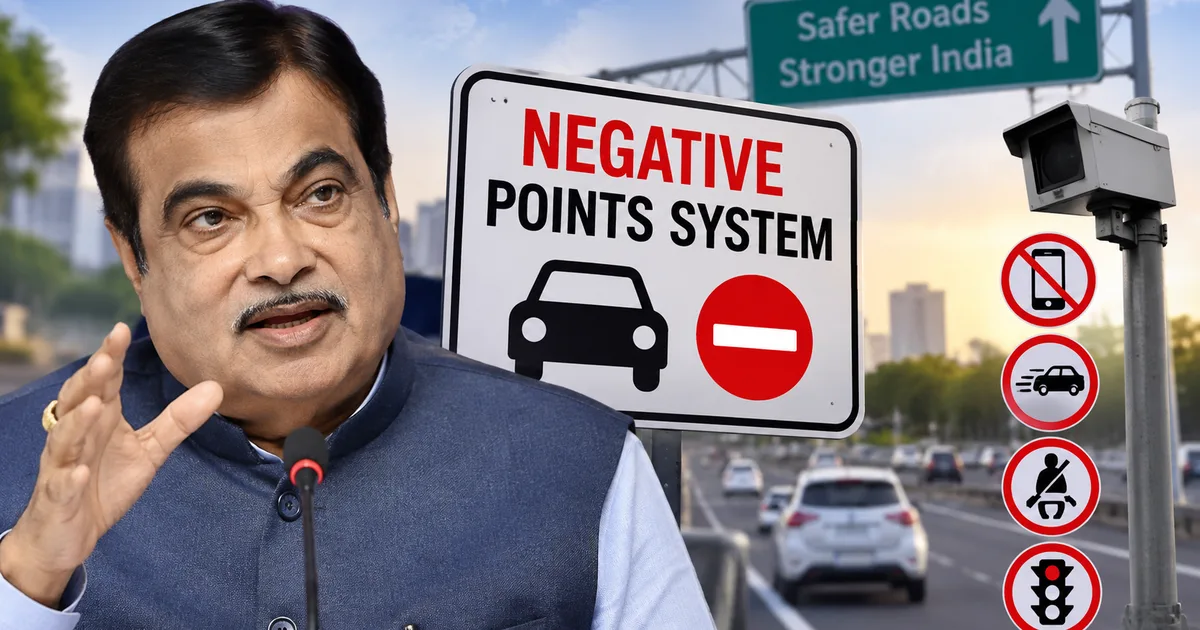
You're driving down the Outer Ring Road in Bengaluru. Maybe you're running late. You speed up just a bit to beat a yellow light, and the camera flashes. A few days later, you get an SMS. You have a challan. You open the mParivahan app, pay the fine via UPI, and move on with your life. The mistake cost you a thousand rupees. But that is the end of the story. This is exactly how traffic enforcement is in India today. It's entirely financial. If you have the money, you can afford to break the rules repeatedly. You just keep paying the fines. Union Minister Nitin Gadkari wants to stop this. So this is why the Nitin Gadkari negative points system 2026 is being introduced for Indian driving licences and vehicle registration certificates (RCs).
Honestly, this is a massive shift for anyone who drives in India.
We're going to look at exactly what this means and how the point deductions will work. It changes your daily commute. We also see similar regulatory shifts happening elsewhere, like the New Railway Ticket Reservation Rules 2026 Explained: What Changes for Passengers, where the government is tightening the noose on system abuse. I'm not sure exactly why all these changes are happening at once, but they are here.
How the driving licence suspension rules will work
The concept is straightforward. The government assigns a point balance to your driving licence. Think of it like a credit score for driving.
Every time you commit a traffic offence, points get deducted. Different offences have different point weights. For example:
- Parking in a no-parking zone might cost you a single point.
- Jumping a red light might cost two or three points.
- Dangerous driving or driving under the influence could instantly strip away a massive chunk of your balance.
Once your point balance drops below a certain threshold, the transport department takes action. Your licence is suspended for a few months. If you keep losing points, they cancel your licence entirely. This means you're legally banned from driving. You'd likely have to go through the entire process of getting a learner's licence and passing a driving test all over again to get it back. In my experience, nobody wants to deal with the RTO twice.
This system also applies to the vehicle's RC. This is really important for people who own multiple vehicles or run transport businesses. If your car has a lot of traffic violations, the RC itself faces suspension, regardless of who is driving it at the time. This puts the responsibility firmly on vehicle owners to ensure their cars are driven safely. It's a mess for fleet owners (which makes sense, actually).
The problem with traffic fines today
To understand why the ministry is doing this, we have to look at the limitations of our current challan system. E-challans are incredibly efficient at collecting fines. Cameras catch you and software identifies your number plate. Then a text message goes to the registered phone number.
Thing is, a fine is just a flat penalty. A thousand-rupee fine is a major financial hit for a college student riding a scooter. But for a wealthy person driving a luxury SUV, it's barely pocket change. This creates a scenario where rich people can effectively buy the right to break traffic rules. They pay the challan. Then they continue driving recklessly.
The negative points system levels the playing field. It doesn't matter how much money is in your bank account. If you lose your points, you lose your right to drive. Simple as that.
Gadkari addressed this directly at the 66th SIAM Annual Convention. He pointed out that driver behaviour is a massive problem on Indian roads. The country has a tragically high number of road accidents and fatalities every year. If you ask me, the government clearly feels that financial penalties alone aren't changing how people drive. They need something stricter.
"My ministry is planning to introduce graded point system in driving licences and vehicle registration certificate. Every offense will cut points on the driving licence. And after a particular limit, the licence will get suspended or even cancelled." - Nitin Gadkari
Good drivers get actual benefits
This new policy has rewards for good drivers. It punishes mistakes, but it gives you something back for driving well.
If you follow the rules and maintain your points, you fall into a good driver category. Gadkari mentioned the government is working on ways to offer incentives for people who maintain a clean record.
The most obvious benefit is vehicle insurance. Currently, your car insurance premium depends mostly on the age and make of your car, or whether you claimed insurance in the previous year. Under the new system, insurance companies likely get access to your driving points. If you have a perfect score, you are a lower risk to the insurer. This translates into cheaper premiums when you renew your policy.
This creates a strong financial incentive to drive safely. And it's completely separate from the fear of getting a challan.
"This is exactly the people who have good points, they will get incentives from insurance or companies or whatever benefits will be there. But those who are habitually making mistakes, the penalty is there. That is the principle behind this policy." - Nitin Gadkari
Tracking your points and driving history
You'll probably track all of this through the same government apps you already use. The mParivahan app and DigiLocker will almost certainly integrate the points system. You'll be able to open the app and see your current point balance right next to your digital driving licence.
If you get a challan, the app shows you both the fine amount and the points deducted. We regularly cover updates to these platforms in our Tech Explainers section. We expect a major app update to launch alongside this new policy.
This transparency is important. You need to know exactly how close you are to losing your licence. It gives you a chance to correct your behaviour before it's too late.
Vehicle RC cancellation and commercial drivers
This new system is going to be incredibly stressful for gig workers. If you deliver food for Zomato or Swiggy, or drive an Ola or Uber, you spend all day on the road. The pressure to complete trips quickly is immense. I think it's going to cause a lot of friction.
Currently, gig workers factor traffic fines into their monthly expenses. It's a harsh reality of the job. But if they start losing points, the stakes are much higher. A suspended licence means they simply can't work at all.
We might see companies change their algorithms to stop pushing drivers to rush. If an entire fleet of delivery riders gets their licences suspended, the companies suffer massive operational losses. Fleet operators who rent out vehicles have to be very careful about who they hand the keys to. The vehicle RC gets suspended if the driver accumulates too many points (annoying, I know).
The push for better driving schools
The Ministry of Road Transport and Highways knows that punishing bad drivers is only half the battle. The other half is teaching people how to drive properly.
Historically, getting a driving licence in India was far too easy. Many people learned the absolute basics from a family member and passed a sketchy test. This is changing. Gadkari highlighted a massive push to build proper driving training centres across the country.
The government plans to set up 1,600 of these centres. Right now, 24 are fully operational. Another 112 are being built. These aren't small local driving schools. They are comprehensive training facilities designed to teach actual road safety and defensive driving.
Around 10 lakh drivers have already received training at these new centres, according to Gadkari. The numbers here are a bit fuzzy, but the goal is clear. They want to ensure that new drivers hitting the roads actually understand traffic rules and vehicle control before they get their licence.
Connecting the digital dots
This entire system relies heavily on India's digital public infrastructure. The transport department needs to connect the traffic cameras to the e-challan system. Then they link that directly to the Vahan and Sarathi databases that hold your RC and licence data.
We've seen the government successfully link massive databases before. Just look at how your PAN is linked to your Aadhaar and bank accounts. This causes headaches for some as seen in our coverage of Income Tax Refund Delays 2026: Why Taxpayers Are Waiting and New ITR Processing Rules Explained.
The transport database will be no different. The traffic police in Mumbai will be able to see a violation you committed in Delhi. It all follows your central digital identity. There is no escaping your driving history simply by crossing state lines.
Beware of fake news and WhatsApp rumours
Any time a major new government rule is announced, the rumour mill goes into overdrive. We're already seeing this with the negative points system.
You might receive WhatsApp forwards claiming that your licence is cancelled tomorrow if you don't wear a helmet. Or they claim three speeding tickets mean an automatic lifetime ban. Don't panic. These specific numbers are fake.
The government has announced the broad framework, but they haven't finalised the exact points table. We don't know yet how many points you start with, or how many points a specific offence costs you. We saw similar confusion around the Vishwas 2026 EPF Scheme: New Features and Withdrawal Rules Explained, where fake rules circulated for weeks before the official notification.
Wait for the official gazette notification from the Ministry of Road Transport and Highways. Until that document is published, all specific point numbers are just speculation. We'll post the real numbers in our Latest Tech News section as soon as they drop.
Bharat NCAP 2.0 and safer cars
Alongside the points system for drivers, the government is pushing car manufacturers to build safer vehicles.
Gadkari announced that Bharat NCAP 2.0 rolls out from October 2027. The New Car Assessment Programme tests cars for crash safety and gives them a star rating. The 2.0 version evaluates the entire safety chain of a vehicle.
This is a two-pronged approach. The points system forces drivers to be safer. Bharat NCAP 2.0 forces manufacturers to build cars that protect people better when accidents do happen. India is currently the third-largest passenger vehicle market in the world. Basically, the government is finally using that market power to demand better safety standards from companies selling cars here.
What you should do right now
You don't need to do anything differently today. The current challan system is still in effect. But this is the time to start fixing bad habits.
If you check your phone at traffic lights or drive on the wrong side to save five minutes, stop. When the negative points system goes live, those small habits add up very quickly. You don't want to lose your driving licence just because you were too impatient to wait for a U-turn.
Make sure your vehicle registration is linked to your current phone number. Download the mParivahan app if you haven't already. The days of simply paying your way out of bad driving are coming to an end.
I'm actually glad this is happening. The chaos on our roads costs lives every single day. A financial penalty just isn't enough of a deterrent for many people. Threatening to take away their ability to drive entirely is the only way to force a real change in behaviour. Look, the challenge here is obviously enforcement. It takes time to implement, and there are definitely technical glitches in the beginning. But the logic behind the policy is solid.