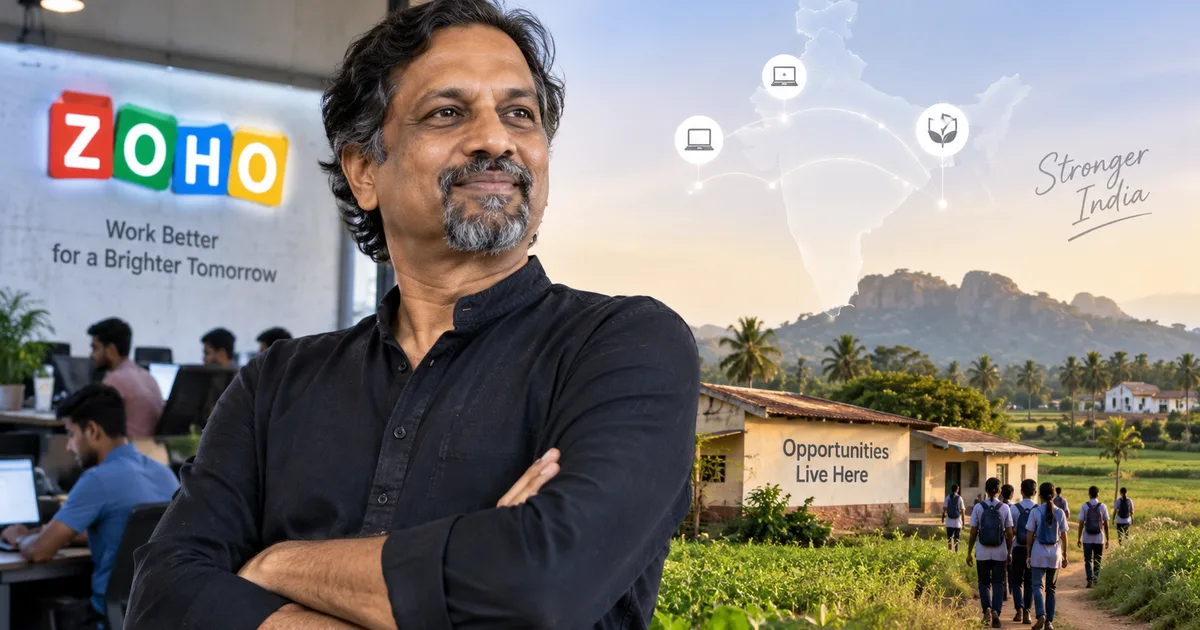
Look, the narrative around artificial intelligence in India right now is honestly out of control. Every single day, we hear about how generative models are going to solve all our problems and boost our national GDP by trillions of rupees. People think it'll make everyone a highly paid engineer overnight. But the reality on the ground is completely different. The Zoho CEO Sridhar Vembu 2026 warnings about the current state of the tech industry should be a wake-up call for everyone. He's been sounding the alarm on what he calls an AI bubble, and frankly, we need to listen.
Most tech leaders in Bengaluru and Hyderabad are busy hyping up their next funding round. Vembu is doing the exact opposite. He recently pointed out that valuations of these artificial intelligence companies have exceeded the insane levels we saw during the 1999 dot-com crash. That's a massive statement coming from someone who runs one of India's most successful software product companies entirely bootstrapped.
Thing is, when the guy who built a billion-dollar empire from Chennai and Tenkasi tells you that the basic math doesn't add up, you pay attention. We track a lot of these industry shifts over at our Latest Tech News section. But this particular situation feels vastly different from the usual technology hype cycles we've seen over the past decade.
The harsh reality of AI and Indian tech jobs
Here's the deal. For the past twenty years, the formula for a middle-class Indian youth was simple and predictable. You get an engineering degree from a local college and learn some Java or Python. Then you join an IT services giant and you're set for life. That formula is now completely broken.
Vembu recently stated that the Indian IT industry is no longer creating jobs the way it used to. He specifically mentioned that automated tools have boosted coding output. This sounds great on paper. But it also weakens the need for fresh hiring across the board. If a senior developer can use an assistant to do the work of three junior developers, why would a company hire those three juniors in the first place? They simply won't. I've talked to engineering grads this year and the panic is real.
And he didn't stop there. He raised a very uncomfortable question about whether the global market even needs that much more software. This directly challenges the business model of massive firms like TCS, Infosys, Wipro, or HCL. (I know, questioning the IT sector in India is almost blasphemous, but someone had to say it out loud.)
"We need to find answers if it can be as Sam Altman suggests, universal basic income or something else. AI is wiping jobs and we have a massive youth workforce."
This isn't just empty talk. We're already seeing companies quiet-firing workers across Pune, NCR, Chennai, and Bengaluru. Vembu claims that tech companies are laying people off for no real reason. At the same time, they aren't seeing actual productivity gains from their massive investments. It's a lose-lose situation for the workers. If you want a deeper dive into the employment numbers, you should check out our analysis on the Zoho CEO Sridhar Vembu 2026 Statement: AI's Impact on the Indian Tech Job Market Explained.
Why coding is no longer enough to survive
So what do you do if you're a 22-year-old fresh out of college looking for a job? Vembu has an answer. You probably won't like it at all.
More code doesn't equal more productivity. That's his core argument. It's a strong one. He argues that coding is essentially just translation. You're taking a business problem and translating it into a language a machine understands. Computers are now really good at translation. What they're terrible at is actually understanding the business problem in the first place.
This means the days of being a heads-down programmer are over. You can't just take a ticket and write the code anymore. You need domain knowledge. You need to understand how a retail business works or how a bank processes a UPI transaction. That's the one skill engineers need to beat automation.
Think about a typical banking application. A machine can easily write the code to create a database table for user accounts. It can write the API endpoints to fetch the balance. But the machine doesn't understand the regulatory compliance required by the Reserve Bank of India. I'm not sure exactly why so many people ignore this part. The machine doesn't understand why certain transactions need multi-factor authentication while others don't. That's where human judgment comes in. You need to be the person who understands the RBI guidelines and translates them into system requirements. That makes you irreplaceable.
Honestly, this makes a lot of sense. Think about how the Infosys CEO Salil Parekh 2026 Announcement: AI Suite Explained focuses heavily on enterprise solutions rather than just raw code generation. The actual value is in solving the business problem. Writing the loops and functions that execute the solution is just the easy part now.
The real cost of running these models
We need to talk about the money. Everyone thinks these new technologies are just some magical cloud software that runs on pure innovation. It's actually just thousands of extremely expensive computers. They run very hot. They consume massive amounts of electricity.
Vembu recently flagged something that most startups refuse to admit publicly. The rising costs of computer memory and processing tokens are making business very difficult. When you use a generative tool to write a script or draft an email, it costs money per token. As these models get larger, the compute required scales up massively.
He explicitly said he doesn't want to chase the cash burn. He'd rather bet on things like metallurgy. Yes, metallurgy. Building real physical things in rural areas instead of burning millions of dollars in a data center to generate a slightly better marketing email template. (Which is a wild pivot, actually.)
This is a refreshing take. I'm tired of seeing Indian startups raise massive amounts of capital just to build a thin wrapper around an external API. It's a sketchy business model. It isn't sustainable in the long run. The infrastructure costs will eat them alive the moment their venture capital funding dries up.
Bringing Japanese tech to rural India
This brings us to the most interesting part of Zoho's strategy this year. While everyone else is fighting over office space in Koramangala or setting up expensive hubs in Hitec City, Vembu is looking at villages.
He recently announced he was heading to Japan to bring Japanese companies into rural India. This is completely different from the standard foreign direct investment playbook we're used to seeing. Usually, a foreign company sets up a massive Global Capability Center in Gurugram and hires five thousand people. Then they just call it a day.
Vembu wants these companies to invest in smaller towns. He believes that rural education can be transformed by technology. Interestingly, he did call these new tools a massive learning booster at the India AI Impact Summit. So he isn't anti-technology at all. He just thinks we're applying it to the wrong problems.
Using technology as a personalized tutor for a kid in a Tamil Nadu village is an excellent use case. But using it to replace a junior developer in Chennai so a massive corporation can save five percent on their quarterly expenses? That's a bad use case. In my experience, chasing small margin improvements usually ruins the company culture anyway.
The infrastructure in these smaller towns is actually improving rapidly. We now have reliable broadband internet reaching villages that didn't even have proper roads ten years ago. When you combine that with the Unified Payments Interface handling digital transactions instantly, the geographical barriers to doing business disappear. You don't need a physical office in Mumbai to run a global software company anymore. Zoho proved this years ago. Now they're pushing the boundaries even further.
There's also a massive cultural shift happening here. For decades, the goal for any smart kid in a village was to move to a big city and get a corporate job. This led to a massive brain drain from rural areas. It also created overcrowded cities that lack basic infrastructure. If Vembu's vision succeeds, we could see a reverse migration. People could stay in their hometowns and still work on world-class software projects. That's true economic development. It isn't just inflating stock prices on Dalal Street.
How this affects small businesses and shops
Let's look at the broader economy. India runs on small and medium businesses. The local kirana store, the small manufacturing plant in Coimbatore, the textile shop in Surat, and the transport company in Kochi. These businesses don't need a hundred-billion-dollar language model.
They need basic digitization. They need inventory management that syncs with their GST filings. They need payroll systems that handle EPF deductions automatically without requiring an accountant on retainer. This is where Zoho has traditionally excelled. It's where they continue to focus their efforts.
At the recent MSME Growth Summit 2026, the Andhra Pradesh government forged major tie-ups to boost startups and small businesses. This is the kind of practical tech expansion that actually moves the needle for the Indian economy. You can find more about these practical business applications in our AI Tools & Software section.
Basically, a small business owner in India is already struggling with compliance and intense competition. Selling them an expensive suite they don't understand is a total mess. Giving them simple, affordable software that saves them three hours of paperwork a week is invaluable.
What this means for the average Indian techie
So what should you do with all this information? If you're working in the tech sector today, you need a reality check.
Here are the steps you should take right now to protect your career:
- Stop relying solely on your coding skills. If your entire identity is built around knowing React or Node.js, you're vulnerable. Start learning the business side of whatever product you're building.
- Ask your product manager why a feature is being built, not just how to build it. Understanding the business logic is your safety net.
- Be very skeptical of companies that claim to be tech-first without a clear path to profitability. If a company is subsidizing its compute costs with venture capital, that money will eventually run out.
- Look beyond the massive metropolitan areas. The cost of living in Mumbai or Bengaluru is astronomical and rising every year.
If companies like Zoho successfully build hubs in Tier 3 and Tier 4 cities, it could completely change the dynamics of wealth distribution in India. Imagine earning a solid salary while paying a fraction of the rent. You'd actually have clean air to breathe.
The industry is going through a massive correction right now. We saw this in 2001. We saw it again in 2008. The companies that survive are the ones that build real products for real people with sustainable unit economics. Sridhar Vembu seems to understand this perfectly. But the numbers here are a bit fuzzy for other companies. I guess we'll see who actually survives the crunch in the next couple of years.