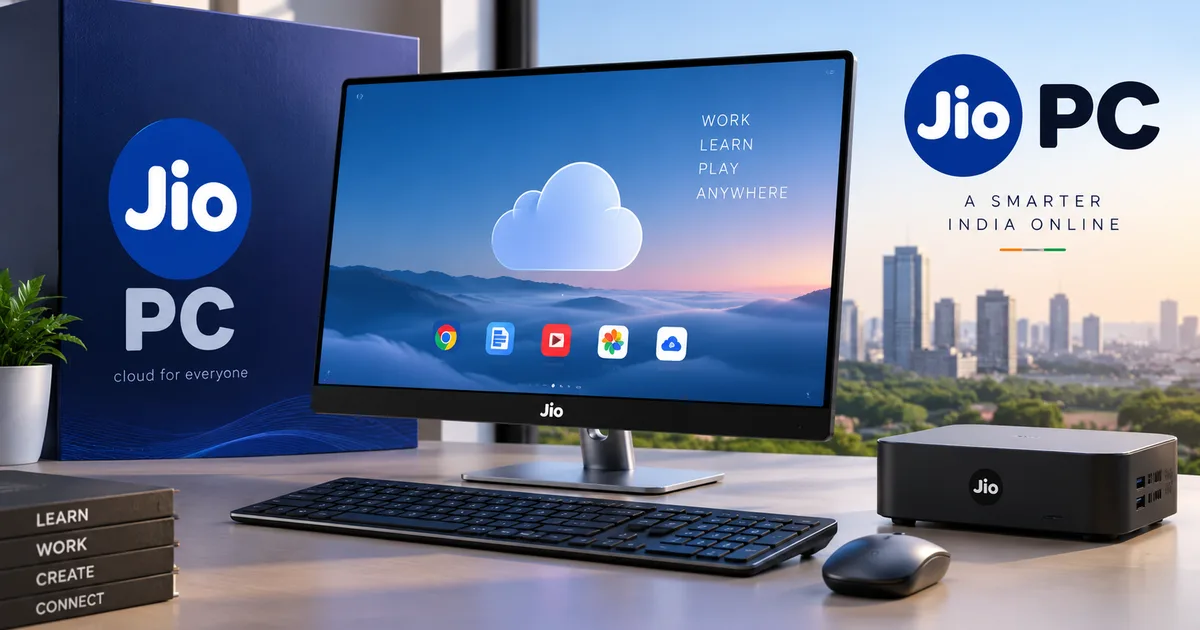
So Mukesh Ambani wants to put AI in every home, every call, and every app. That's the big vision. But hardware is expensive. And most of us are still using laptops that take five minutes just to boot up Chrome. This is where the Jio PC 2026 India launch comes in. Reliance is planning to release a cloud PC that completely bypasses the need for high-end local hardware. Instead of selling you a Rs 50,000 laptop with a powerful processor, they want to sell you a much cheaper device. It streams your operating system directly from their servers.
Honestly, I think this is a smart move. I've been tracking the Latest Tech News for a while. The biggest problem with budget laptops in India is they become useless after two years. Windows updates slow them down. The battery dies. The hard drive fills up. Jio is trying to fix this by moving the heavy lifting to the cloud.
What exactly is a cloud PC?
Before we talk about the price, we need to understand what this thing actually is. A standard laptop runs everything locally. When you open a spreadsheet, your laptop's processor does the work. When you save a photo, it goes on your local SSD.
The Jio PC works differently. It's basically a thin client. The physical device just handles your screen and keyboard. The actual computing happens on Reliance's servers. Your operating system and your files are all running in a data center somewhere in Mumbai or Pune. The Jio PC just streams the video output of that desktop to your screen.
Think of it like watching a YouTube video. But the video is your computer desktop. And you can interact with it in real time (which makes sense, actually).
And yes, this means you need a constant, fast internet connection. Which, of course, is exactly what Jio sells. They're building the hardware to sell you the subscription. It's the classic printer and ink business model, just updated for 2026. If you ask me, it's a solid plan.
Jio PC 2026 expected price in India
Pricing is always the main hook with Reliance products. They disrupted telecom by giving data away for free. They disrupted feature phones with the JioPhone. Now they want to do it with computers.
Reports from India Today and other outlets suggest the Jio PC will be priced around Rs 15,000. That puts it lower than entry-level Windows laptops from HP or Dell. Those usually start around Rs 30,000 and offer a terrible user experience anyway.
But that Rs 15,000 is just for the physical hardware.
The real cost will be the subscription. Because the Jio PC relies on cloud servers to function, you'll almost certainly have to pay a monthly fee for the JioCloud PC service. We don't have official pricing for that yet. I expect they'll bundle it with JioFiber or Jio AirFiber plans. If you're already paying Rs 999 a month for broadband, they might just throw the cloud PC access in for free. Or they might charge a nominal Rs 199 extra.
This is a clever strategy. It locks you into their ecosystem. If you stop paying for your Jio internet, your computer stops working. (I know, sounds a bit dystopian, but it's the reality of cloud computing.) In my experience, lock-in is the whole point.
Cloud OS and AI features
Mukesh Ambani recently mentioned he wants aging computers to become AI-ready PCs. This is the main selling point of the Jio OS that will run on these machines.
We already have a good idea of how the software experience will work.
- It will be heavily customized. Jio OS is based on Android, but built to look and act like a desktop operating system. You get a taskbar and a start menu.
- Everything is tied to your Jio account. Your login and your storage all run through the same ecosystem. You'll likely use the Jio app on your phone to authenticate logins.
- AI is baked in. Expect a heavy integration of voice commands and generative AI tools for writing documents or creating images. They're pushing hard on this angle to compete with Microsoft Copilot.
"We want to democratize AI and make it accessible to every Indian, regardless of the device they own."
That's the corporate line. What it means for you is you won't need to buy a Rs 1 Lakh laptop to run heavy AI models. The cloud servers do the processing. And your Rs 15,000 Jio PC just shows you the results. I think that's a huge deal.
If you're looking at other upcoming devices, like the Poco X8 5G India Launch 2026: Expected Price & Features, you can see how mobile processors are getting better. But for proper desktop work, offloading to the cloud still makes sense for cheap hardware.
Will it actually work in India?
This is the million-rupee question. Cloud gaming and cloud computing have struggled globally because of latency. If you click a button and it takes half a second for the screen to react, the computer feels broken.
For the Jio PC to succeed, the latency has to be imperceptible. If you're typing a Word document and the letters lag behind your keystrokes, you'll throw the machine out the window.
I have my doubts.
India's internet infrastructure has improved massively. But it isn't flawless. JioFiber is fast. Still, it has routing hiccups. If you're on a 5G connection that drops to 4G inside your bedroom, your entire computer will freeze (annoying, I know).
They're targeting this at students and small business owners who just need basic web browsing and spreadsheet work. For that, it might just be good enough. You can run Tally in the cloud. You can use Google Docs.
But don't expect to run heavy local apps. This isn't a machine for video editing or playing intensive local games. It's a Chromebook on steroids, completely dependent on the Reliance network.
The hardware specs
We don't have the final spec sheet yet. But we can make some educated guesses based on the previous JioBook and current leaks. The numbers here are a bit fuzzy.
The device itself doesn't need much power. It'll probably have an entry-level ARM processor, just enough to decode 1080p or 4K video streams efficiently. Expect 4GB of RAM. Again, because the cloud server has the real RAM. Local storage will be minimal. Maybe 64GB eMMC, just enough to hold the bootloader and local cache.
The screen will likely be an 11-inch or 13-inch basic LCD. Don't expect OLED at this price point. They'll cut corners on the keyboard and trackpad too. That's how you hit a Rs 15,000 price tag.
Interestingly, Reliance is also talking about turning your old computer or TV into a cloud desktop. This implies they might sell a standalone dongle or software client. If you have an old Intel Celeron laptop from 2015 that can barely open Windows 10, you might be able to install the Jio Cloud OS on it. You can give it a new lease on life.
If they pull that off, it could be huge.
Millions of Indian homes have dead laptops sitting in cupboards. Reviving them with a cloud OS subscription is a massive business opportunity.
By the way, if you're looking for Tech Explainers on how cloud architecture works, we've covered that extensively. But the short version is you rent the computer instead of buying it.
Privacy and data security in the cloud
One thing nobody is talking about yet is privacy. When you use a traditional Windows laptop, your files sit on your hard drive. If you don't connect to the internet, nobody can see them.
With a cloud PC, literally every single thing you do happens on a server owned by Reliance.
Every keystroke and every downloaded file is in the cloud. Reliance says they have strict encryption protocols. And they have to comply with the DPDP Act. But you have to trust their infrastructure.
I expect the Jio PC will come deeply integrated with Indian government services. You'll probably see native support for DigiLocker built right into the file manager. Aadhaar authentication could be required to set up the device, just like buying a SIM card. UPI integration will be seamless. If you need to make a payment on a website, a notification will pop up on your Jio phone instantly.
This deep integration is incredibly convenient. But it also means you're giving one company access to your entire digital life. If you're dealing with sketchy business documents, you might want to think twice before moving your entire workflow to a cloud-hosted machine.
Battery life: The hidden advantage
There is one massive benefit to the thin-client model that gets overlooked. Battery life. When a laptop is doing heavy processing, the processor draws a lot of power and generates heat. That kills your battery.
Because the Jio PC offloads all that work to the cloud, the local processor is basically just decoding a video stream. It barely breaks a sweat. This means the battery life should be exceptional.
We're seeing similar efficiency in new smartphones like the Moto G Max 2026 India Launch: Expected Specs, Battery Features, and Price Explained, where optimized chips sip power. But on a 13-inch laptop, a low-power ARM chip could easily give you 15 to 18 hours of real-world usage.
You could realistically leave the charger at home. You can take the Jio PC to the office and use it all day without worrying about finding a plug point. For power-cut prone areas in India, that's a huge selling point.
What about gamers and power users?
Let me be very clear. This is not a gaming laptop. If you want to play Valorant or GTA 5 natively, look elsewhere.
But Jio has been experimenting with JioGamesCloud for a while now. Because the Jio PC is already built to stream a desktop with low latency, it's the perfect vehicle for cloud gaming. You might not be able to install heavy games locally. But you could theoretically stream major titles through their gaming service.
This all comes down to latency.
Gamers notice a 20-millisecond delay. If the cloud servers are in Mumbai and you're playing from a small town in Bihar, the physics of fiber optics dictate that you'll experience some lag. It's fine for casual single-player games. But competitive multiplayer is going to be a mess.
If you're a coder or developer, you might actually like this setup. You can run a Linux terminal in the cloud and compile code on Reliance's fast servers. Then you push it to GitHub without your local machine ever getting warm. It's how a lot of professional developers work anyway using AWS or Azure virtual machines. Honestly, it makes sense.
Release date and availability
So when can you actually buy one? The Jio PC 2026 release date is expected to be around the festive season. Reliance loves launching hardware right before Diwali. It gives them maximum visibility. It also lines up with when Indians actually spend money.
Expect an announcement at their Annual General Meeting in August, with retail availability in October 2026. You'll be able to buy it through Reliance Digital stores and JioMart.
I suspect they'll do a soft launch first. They might offer it exclusively to existing JioFiber customers to test the server load before opening it up to everyone. I'm not sure exactly why they wouldn't just launch it everywhere, but it fits their pattern.
Should you wait for it?
Look, if you need a computer today for college or work, go buy a standard Windows laptop or a Chromebook. Don't wait for a product that hasn't been officially detailed yet.
But if you have a tight budget of under Rs 20,000 and you only need a machine for very basic tasks, the Jio PC could be worth keeping an eye on. It completely changes the economics of owning a computer. Instead of paying a large upfront cost, you pay a small amount and then rent the performance monthly.
Just be aware of the lock-in.
Once your data and your workflow are tied to the JioCloud, leaving that ecosystem becomes very difficult. If they hike the subscription price a year later, you either pay up or lose access to your virtual computer.
It's a fascinating experiment. And honestly, if anyone has the scale and the capital to force cloud computing into the Indian mainstream, it's Reliance. I'll be testing one the second it hits the market to see if the latency is actually manageable over a standard home Wi-Fi connection.
For now, we wait and see what they reveal at the AGM.