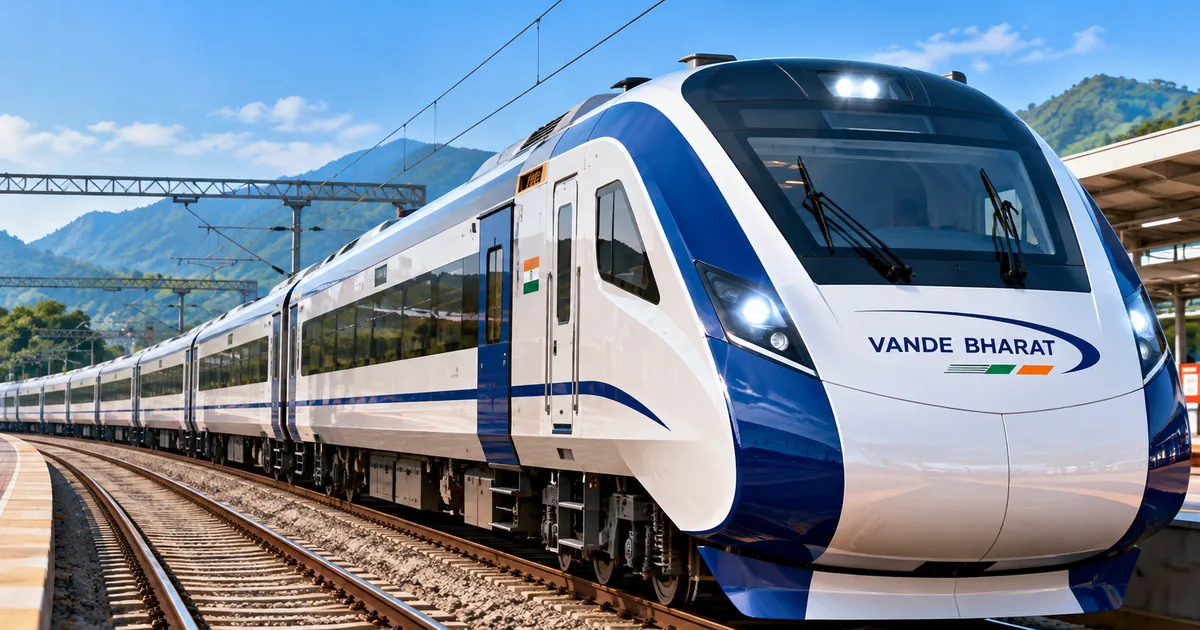
If you've ever tried booking a train ticket on IRCTC during festival season, you know the frustration of seeing a waiting list in the triple digits within two minutes of the Tatkal window opening. That exact crunch is why Indian Railways is pushing ahead with a 24-coach Vande Bharat Express sleeper train for long-distance routes. Adding coaches sounds simple on paper. But stretching a high-speed trainset across 24 cars involves serious mechanical changes, electrical rebalancing, fresh braking dynamics, and upgraded passenger facilities.
Three minutes flat. That's all it takes for an entire train to sell out completely.
Most of us know the Vande Bharat as the sleek daytime train zooming between cities in six or seven hours. It's got comfortable chair cars, automatic doors, clean vestibules, and decent snacks. But daytime travel barely scratches the surface of how people actually travel across India. If you ask me, the real backbone of our transit has always been the long overnight journey, whether you're heading from Delhi to Patna or Mumbai to Varanasi.
When the first 16-coach Vande Bharat sleeper prototype rolled out from the Bharat Earth Movers Limited (BEML) facility in Bengaluru with help from Chennai's Integral Coach Factory (ICF), excitement was huge. Then reality hit. Rail planners ran straight into a practical wall because sixteen coaches just can't carry enough passengers on packed trunk routes. So, that kicked off plans for a longer 24-coach version designed to move heavy passenger crowds without losing any speed.
Why Indian Railways needs a 24-coach train
To see why this upgrade matters, you have to look at track capacity. Indian Railways can't simply double departures on packed lines like New Delhi to Mumbai or New Delhi to Howrah. Tracks are already packed with express trains and heavy freight rakes. That makes every departure slot pure gold.
Here's the deal: if you can't add departures during peak evening hours, your only realistic choice is to make every train carry more people. Traditional Rajdhani and superfast expresses handle this by running 22 to 24 coaches pulled by electric locomotives. When engineers designed the initial 16-coach Vande Bharat sleeper, capacity was around 823 berths. That's a big drop compared to a standard 24-coach train, which often carries between 1,200 and 1,500 travellers (annoying for waitlisted passengers, I know). In my experience, taking away seats on busy routes always backfires.
If the railways swapped a 24-coach Rajdhani for a 16-coach Vande Bharat, seat capacity on that route would shrink. Confirmed tickets would get even harder to find. Waiting lists would shoot up fast. But by stretching the design to 24 coaches, capacity jumps from 823 to 1,224 berths. That's an extra 400 berths on every departure, bridging the gap between fast travel and mass transit.
The leap from 16 to 24 coaches adds over 400 berths to every run, allowing the train to match traditional Rajdhani passenger volumes while maintaining modern speed.
Inside the 24-coach Vande Bharat layout and passenger capacity
So, what does this new setup look like? The standard 16-coach prototype had 11 AC 3-tier coaches and 4 AC 2-tier cars, plus a single AC First Class coach. The new 24-coach version adds eight more coaches onto that base.
While ICF engineers are still finalizing the exact coach breakdown, most extra coaches are going to AC 3-tier and AC 2-tier travel. That makes total sense, since those two classes get the heaviest booking rush. Honestly, if you ask me, packing more AC 3-tier berths is the only way to help regular passengers. If you want a deeper look at booking rules and coach classes across the network, check out our Vande Bharat sleeper guide.
Here's how the 16-coach prototype and the upcoming 24-coach production model stack up against each other:
- The prototype ran with 16 coaches, whereas the new production rake expands to 24 coaches.
- Passenger capacity jumps from 823 berths on the 16-coach model to 1,224 berths on the 24-coach trainset.
- ICF Chennai is building the 50 planned 24-coach trainsets, while BEML produced the earlier 16-coach demonstrator.
- A dedicated full-sized pantry car joins the train alongside coach mini-pantries for hot meal service.
- Operational top speed remains designed for 160 km/h where tracks and signals permit.
Fitting 1,224 passengers into one trainset brings practical headaches you won't see in brochures. Take the morning rush before arrival. On an overnight train pulling in at 7:30 AM, dozens of people try to wash up and use the toilet at the exact same time. ICF designers caught this problem early. They're adding extra bio-vacuum toilets across the rake so passengers don't get stuck waiting in long hallway queues.
The berths themselves get some much-needed ergonomic fixes. Anyone who's scraped their shins on the sharp metal ladders of older coaches will love the redesigned footpegs. Cushioning uses polyurethane foam that doesn't sag into a wooden board after three hours. Plus, each berth has its own reading light, charging socket, bottle holder, and storage rack for fresh linens.
The dedicated pantry car fix for overnight routes
Meal management was easily one of the loudest complaints about early sleeper proposals. Daytime Vande Bharat trains don't carry a full kitchen car. Instead, they rely on mini-pantries in each coach equipped with bottle coolers and water boilers. Catering staff pick up pre-cooked food trays at junction stations and hand them out to passengers at their seats.
That setup works fine for a five-hour run from Chennai to Mysuru. It falls apart completely on an 18-hour haul from New Delhi to Mumbai Central. Passengers expect dinner along with hot morning breakfast. Relying purely on station pickups means meals turn lukewarm, and any track delay turns dinner service into a mess.
The 24-coach Vande Bharat sleeper fixes this with a dedicated pantry car that's fully air-conditioned. It gives kitchen crews real space to warm meals properly while managing supplies across all 24 coaches. Coach mini-pantries stay in place as local distribution points. Staff won't have to drag heavy food trolleys through twelve coaches at a stretch. Honestly, I think having a proper pantry car is long overdue, especially since nobody likes lukewarm dinner after paying premium fares.
Upgrades to suspension, couplers, and passenger safety
Building a 24-coach semi-high-speed train isn't as simple as hooking eight extra bogies onto the back. Unlike older trains pulled by a detached locomotive, the Vande Bharat is an electric multiple-unit trainset with distributed traction power. Motors are mounted beneath coaches along the whole length of the train.
When you lengthen a distributed-power train from 16 to 24 coaches, you completely change weight distribution and braking dynamics. ICF engineers in Chennai had to re-engineer power distribution and recalibrate the computerized control system so all motor coaches accelerate and brake in sync. If one end brakes even a fraction of a second late, you get terrible jarring between coaches.
To keep the ride smooth, the 24-coach rakes have shock-free suspension with secondary air springs and semi-permanent tightlock couplers. These wipe out the sudden jerks and metallic clanging that wake you up whenever a traditional train halts or starts moving. In my experience, those violent midnight jerks are the worst part of Indian train travel. First AC passengers also get hot showers, which is a rare treat outside luxury tourist trains like the Palace on Wheels.
Safety gets just as much focus. Every 24-coach rake comes factory-fitted with crash buffers, fire-detection units, smoke alarms, and the indigenous Kavach anti-collision safety system. Kavach 4.0 uses trackside radio frequency tags and onboard gear to track signals and train separation. If a loco pilot accidentally jumps a red signal, or if another train enters the same track block, Kavach slams on the brakes automatically.
Who is manufacturing these trains and what is the timeline?
Indian Railways has laid out a massive production plan. The target is to roll out over 200 Vande Bharat sleeper trains over the next few years. Multiple production plants and joint ventures are splitting the workload:
- Integral Coach Factory (ICF) in Chennai is handling the design and production of 50 sets of the 24-coach variant.
- BEML in Bengaluru, working with ICF technical support, is manufacturing an initial batch of 10 sleeper trainsets.
- Kinet Railway Solutions, an Indo-Russian joint venture, has been assigned contracts to manufacture 120 sleeper trainsets.
- A domestic consortium of Titagarh Rail Systems and BHEL is scheduled to produce 80 sleeper trainsets.
Right now, ICF Chennai is finalizing blueprints for the 24-coach sleeper. Officials want the first prototype ready by late 2026, with commercial runs planned for June 2027 (though railway timelines can be a bit fuzzy, if you ask me). That gap gives testing teams enough time. They need to run oscillation trials, emergency braking tests, track stability checks, and high-speed runs up to 180 km/h before letting paying passengers onboard. You can read more about how this rolling stock fits into modern transit over at our railway tech explainers hub.
Expected Vande Bharat sleeper routes and ticket pricing
So where will you actually see these 24-coach trains running? Indian Railways plans to prioritize high-demand Golden Quadrilateral trunk routes where ticket demand consistently beats available berths. Early candidates include:
- New Delhi to Mumbai Central, competing directly with the August Kranti and Mumbai Rajdhani.
- New Delhi to Howrah, serving the heavily congested eastern rail corridor.
- New Delhi to Patna and Varanasi, addressing massive regional passenger traffic.
- Bengaluru to New Delhi, offering a premium north-south overnight link.
When it comes to fares, expect prices slightly higher than current Rajdhani tickets. A 3-tier AC berth between Delhi and Mumbai on a Rajdhani typically costs around ₹2,200 to ₹2,800 depending on dynamic pricing. Early tariff estimates put 24-coach Vande Bharat 3-tier fares around 10% to 15% higher, justified by better suspension, cleaner bio-vacuum washrooms, faster acceleration, and modern onboard dining. Booking will link directly into the IRCTC app and website alongside standard Tatkal and premium Tatkal quotas.
For travellers fed up with endless waiting lists and dated coaches, moving to 24 coaches is simply a smart move. I think it shows that railway officials are finally listening to everyday commuters who want modern train tech without losing their shot at a confirmed berth. Makes sense, really. If you want to track daily developments across the Indian rail network, check our daily transport updates section regularly.