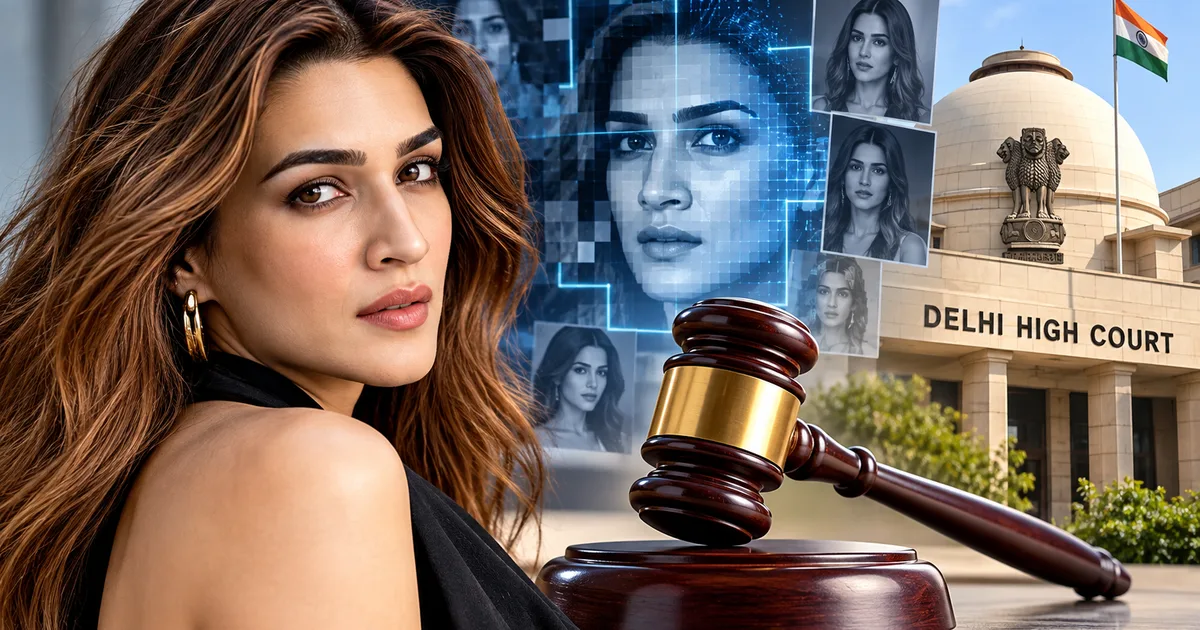
Picture scrolling through your Instagram feed or a Telegram channel and seeing a familiar Bollywood star promoting a shady betting app or an unverified crypto scheme. The face looks real. The mouth moves in sync, and even the voice sounds exact. That's the reality behind the Kriti Sanon personality rights case currently unfolding in the Delhi High Court. The actor approached the court in October 2026 after discovering unauthorized artificial intelligence tools cloning her voice and face across multiple online platforms without her consent.
Celebrities file civil suits because their faces carry millions of rupees in commercial value. Makes sense. But the precedent set in these courtrooms affects every single person using a smartphone in India today. If an algorithm can mimic a national film award winner to sell bogus financial schemes, nobody is safe from digital impersonation. In my experience, most people don't realize how quickly this tech is spreading.
What personality rights actually mean in Indian law
Basically, personality rights are just an individual's legal power to control how their name, image, voice, signature, and likeness get used commercially. If a consumer brand wants to put a celebrity on a billboard along the Western Express Highway in Mumbai, or run sponsored video ads on YouTube, they have to pay a hefty endorsement fee. That's serious money. Depending on the star, those contracts run anywhere from ₹50 lakh to several crores (wild, if you think about it).
When an unauthorized website or automated app uses generative algorithms to manufacture an endorsement without permission, they take that commercial value for free. Pure theft, really. But here's the problem: unlike our Copyright Act of 1957 or the Patents Act, India doesn't have an explicit statute specifically called a Personality Rights Act.
Instead, Indian judges protect a person's likeness by combining two legal concepts:
- The right to publicity, which shields the commercial value of a person's identity and prevents unauthorized commercial exploitation under common law principles of passing off.
- The right to privacy, recognized under Article 21 of the Constitution and further strengthened under the Digital Personal Data Protection Act.
Thing is, Indian courts have often stepped in fast when famous personalities approached them for help. If you want to see how the judiciary dealt with similar digital exploitation recently, take a look at our breakdown of the Aaradhya Bachchan personality rights case, where the high court cracked down on rogue websites fabricating defamatory content.
I checked recent filings in Delhi, and the pattern is unmistakable. Celebrities don't worry about physical counterfeit merchandise in Palika Bazaar like they used to. Today, they're fighting intangible code hosted on overseas servers (which makes sense, actually, given how cheap cloud tools are now). It's a completely different battlefield.
Why Kriti Sanon moved the Delhi High Court
Sanon's decision to approach the court follows months of widespread digital misuse. Shady operators have been using generative tools to plaster her face on promotional clips for unauthorized beauty products and sketchy financial schemes. In several instances, scam accounts circulated clips where her likeness appeared to recommend unverified stock-trading tips to unsuspecting users. Straight up fraud.
Worse, advances in voice cloning software have made audio replication cheap and accessible. Anyone with a clean 30-second audio clip from an interview or an award show can generate speech that mimics her pitch and distinct vocal mannerisms. It takes almost no effort. Her counsel pointed out that these clips were created and shared across social platforms without authorization. That misled regular consumers and hurt her professional standing.
In her petition, Sanon asked for an interim injunction to restrain defendants, including unidentified John Doe entities, from creating or hosting content that exploits her persona. She also requested directions to internet service providers and tech intermediaries to block access to offending URLs and take down AI models trained specifically on her likeness.
The law cannot be a silent spectator while digital technology allows anonymous operators to hijack a person's face, voice, and commercial reputation without consequence.
Look, think about the real-world harm here. When ordinary people in cities like Jaipur, Lucknow, Pune, or Indore watch a beloved actor appear to endorse some financial scheme, they assume it's legit. In my view, that's where this becomes predatory. The numbers here are a bit fuzzy, but many end up transferring ₹5,000 or ₹25,000 through UPI directly to fraudsters before realizing the video was entirely fake.
How AI deepfakes and voice cloning complicate the law
Earlier celebrity personality rights orders in India dealt with simpler violations. When Amitabh Bachchan secured an injunction back in 2022, or when Anil Kapoor protected his voice and the catchphrase jhakaas in 2023, the infringements were pretty straightforward: unauthorized posters, printed merchandise, fake lottery promotions, and mobile ringtones. Physical stuff, mostly.
Generative AI has changed the game completely. Today, modern voice AI models like ChatGPT Astra and open-source video synthesizers allow anyone with a basic graphics card to produce a high-definition deepfake in minutes. It's wild how fast it happened. That creates three distinct legal headaches that traditional copyright laws never anticipated.
First, anonymity is baked right into the internet. Rogue creators use burner Telegram channels, throwaway domain registrations, proxy networks, and offshore hosting providers located outside Indian jurisdiction. Good luck tracking them down. Even if a court orders an ISP to block ten specific URLs, twenty new mirror links pop up within forty-eight hours.
Second, there's the tricky boundary between commercial theft and artistic expression. Indian law protects freedom of speech and expression under Article 19(1)(a) of the Constitution. So where do you draw the line between an illegal commercial clone and legitimate satire, parody, caricature, or news reporting? (which, for the record, I think is an essential distinction we have to defend). It's a messy gray area.
Third, who is actually liable here? Is it the person who types the prompt, the developer who built the tool, the platform hosting the video, or the company that trained the foundation model on images scraped from the web? Our current legal framework doesn't have clean, ready-made answers for that mess.
What the Delhi High Court asked the lawyers to do
When the petition came up for hearing, the bench did something sensible. Instead of rushing to pass a blanket restraining order that could set an overly restrictive precedent (a real danger in fast-moving tech cases), the Delhi High Court directed Sanon's counsel to submit detailed legal research on the scope and limits of personality rights in India.
The court scheduled the next detailed hearing for October 29. By asking for thorough research, the bench is looking at how far judicial protection can stretch without stifling new technology or trampling on free speech. It's a delicate balancing act.
The judges are taking a closer look at several technical and legal questions:
- Whether personality rights can be used to stop AI models from being trained on publicly accessible celebrity media.
- What legal tests should distinguish actionable commercial exploitation from constitutionally protected parody and criticism.
- How intermediary liability rules under the IT Rules 2021 should apply when automated platforms fail to detect synthetic clones.
Honestly, taking time to examine the legal research is the right move. As we often discuss in our tech explainers hub, courts that rush out broad bans often create unintended headaches for independent researchers, startups, digital creators, and everyday software developers.
I'm not sure exactly how the court will balance training datasets with individual rights, but this October 29 hearing is definitely going to shape future AI disputes across the country. We'll have to see how it plays out.
Can everyday Indians protect their digital likeness?
You might wonder why a dispute involving a film star matters to someone sitting in Bengaluru or Ahmedabad working a regular 9-to-5 job. Here's the deal: the exact same technology used to forge celebrity endorsements is now targeting everyday citizens in synthetic identity scams. It's happening right now.
Criminals scrape short audio clips from family reels on Instagram to build synthetic voice clones of young college students. Then they call the parents. They claim the kid was arrested or in an accident, and they demand an immediate ₹30,000 or ₹50,000 transfer via UPI. In that moment of pure panic (and who wouldn't panic?), parents hear their child's voice on the line and send the cash before checking if it's true.
If someone clones your voice or likeness without your consent, you don't need to hire expensive senior lawyers to file a suit in the high court. If you ask me, knowing these basic legal remedies gives regular folks real peace of mind. Indian law already has clear criminal and regulatory remedies for this stuff:
- Section 66D of the Information Technology Act punishes cheating by personation using a computer resource with up to three years imprisonment and fines up to ₹1 lakh.
- Section 66E of the IT Act makes it a punishable offense to capture, publish, or transmit images of a person's private areas without consent.
- Section 318 of the Bharatiya Nyaya Sanhita penalizes criminal cheating and fraud committed through deception.
- The Information Technology Rules 2021 mandate that social media intermediaries must remove impersonating or non-consensual synthetic content within 24 to 36 hours of an official complaint.
If you run into unauthorized voice clones or deepfake scams, check our online scam protection guides for practical safety steps. And don't wait around if you get targeted. Report the incident immediately on the National Cyber Crime Reporting Portal at cybercrime.gov.in, or call the 1930 helpline right away.
At its core, the Kriti Sanon case is a major reality check for Indian cyberspace. The Delhi High Court is finally tackling how our legal system defines personal identity in an age of automated cloning tools. When hearings resume on October 29, the outcome won't just matter for Bollywood stars protecting their brand value. It's going to dictate how much control any of us actually have over our own faces and voices online.