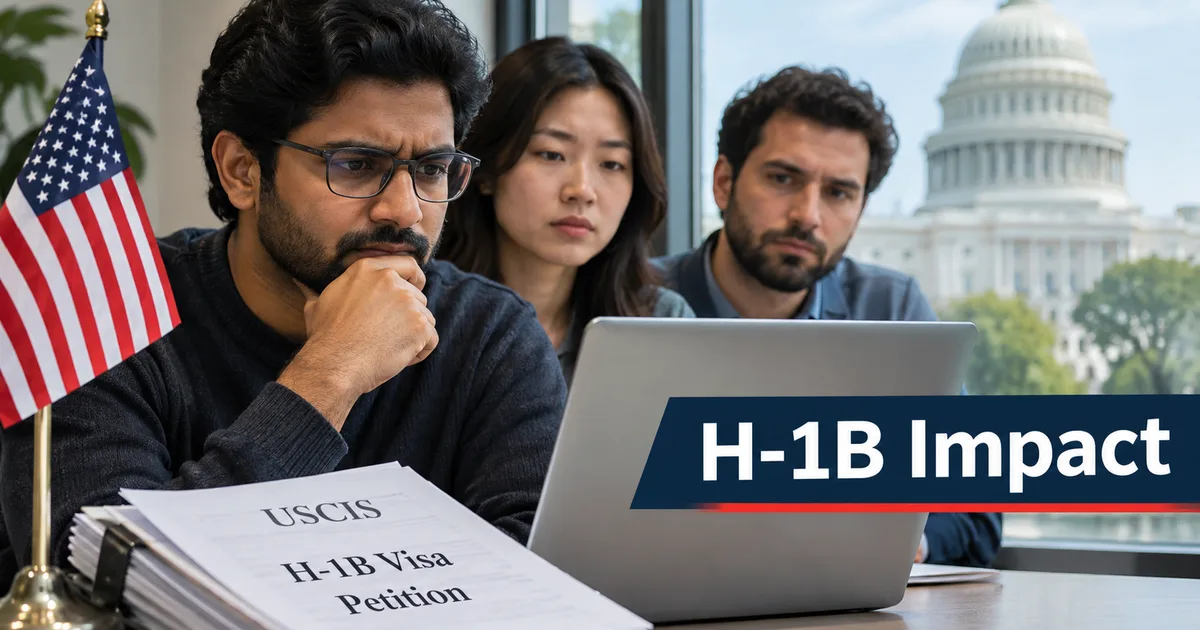
Imagine sitting at your desk in Sunnyvale or Hyderabad. You've been doing the exact same Senior Systems Engineer job for three years. Your employer files your standard H-1B extension. In the past, the H-1B extension deference rule made this mostly routine paperwork. The immigration officer checked your previous approval to verify nothing had changed, then stamped the renewal.
That safety net is going away.
On October 14, 2026, the US Department of Homeland Security published a proposed regulation titled "Removing Deference to Prior USCIS Determinations of Eligibility" (docket number USCIS-2026-0529). Public comments closed on November 13, 2026. It's still a proposal right now, sure, but it targets one specific paragraph in federal law. If they delete Section 8 CFR 214.1(c)(5), USCIS officers don't have to care about your past approvals anymore.
Look, if this becomes final law, every extension starts from zero. Same company, same job title. Same paycheck and same desk, with zero benefit of the doubt.
What the H-1B extension deference rule actually means
Under the current 8 CFR 214.1(c)(5) rule, USCIS starts with a pretty simple assumption. An officer already checked your degree and your job duties three years ago, along with your employer's financials, and decided the role is a specialty occupation. So why argue over those exact same facts again? Honestly, it's basic common sense (which is rare enough in immigration paperwork).
Under deference, an officer could only overturn a past approval in three situations:
- There was a material error in the previous approval.
- There was a significant change in job responsibilities or visa eligibility rules.
- New adverse information about the worker or employer came to light.
And if an officer still wanted to deny an extension despite that old approval, they couldn't just do it. They needed a supervisor's sign-off. Plus a real explanation for why deference didn't apply.
Removing this rule doesn't cancel your current visa. Let's get that straight right now, because panic spreads fast on WhatsApp groups. Existing H-1B or L-1 approvals stay valid until they expire. What changes is what happens when your employer files the next extension. Without deference, an officer treats your fourth-year extension just like a brand-new petition for a fresh grad, which is a mess if you ask me.
Why ending the USCIS deference policy hits Indian techies hardest
DHS estimates around 208,429 petitions each year will lose deference. Over 75% of all Form I-129 worker filings are for H-1B visas. And who holds those visas?
Official USCIS data cited by immigration law firm Reddy Neumann Brown PC shows Indian-born professionals made up 77.6% of all H-1B approvals for continuing employment in fiscal year 2025.
That one number explains why this hits Indian families so hard. The employment-based green card backlog stretches across decades for Indian nationals (nobody really knows when those dates will move fast again, honestly). So people routinely renew their H-1B visas five or six times while waiting for an adjustment of status. But if every extension is a coin toss, living in the US is just constant stress.
Thing is, Indian IT giants like TCS, Infosys, Wipro, and US tech firms are facing a massive paperwork headache. Mix this with corporate pullbacks like IBM H-1B Visa Sponsorship Ends for Consulting Roles, and sponsoring onshore staff gets tricky fast. In my experience, companies hate unpredictable legal timelines almost as much as workers do.
A lot of folks are already looking at Plan B. Senior engineers are walking away from the green card queue altogether, something we broke down in Disha Lamba H-1B Visa: Why Indian Techies Are Leaving the US.
How removing deference increases RFEs and legal costs
When an officer reviews an extension de novo, meaning from scratch, they can reopen basic questions settled years ago.
Does your Computer Science degree actually fit your software developer role? In 2023, USCIS said yes. In 2026, a stricter officer might send a Request for Evidence (RFE) asking for detailed course syllabi just to prove your degree matches the job (annoying, I know).
Even DHS admits ending deference will trigger thousands of extra RFEs every year. Answering an RFE isn't cheap or quick either. You need fresh wage surveys, long employer support letters, updated client letters for third-party placements, and hundreds of pages of backup paperwork.
Here's what that means in real life:
- Higher legal fees for employers, often adding thousands of dollars per filing.
- Extended processing times that leave workers stuck in employment authorization limbo.
- Increased risk of outright denials based on subjective officer interpretations.
- Higher stress for dependents on H-4 visas whose work permits rely on the primary H-1B approval.
H-1B workers aren't alone in this. Managers and executives on L-1A visas, plus specialized knowledge staff on L-1B visas, get the exact same scrutiny during renewals. I think L-1 renewals could get pretty sketchy for smaller consulting shops, though how hard this hits L-1 approval rates is still a bit fuzzy.
The flip-flop history of USCIS prior approval rules
If this feels like deja vu, well, we've seen this political ping-pong before.
USCIS first set up the deference policy in 2004 through a memo under the Bush administration. The goal was simple. They wanted to cut backlogs and stop officers from doing the exact same work twice.
Then in 2017, the first Trump administration scrapped that memo and told officers to make fresh calls on every extension. That move caused RFEs and denial rates to jump between 2017 and 2020.
In 2021, the Biden administration brought deference back. Later, they locked it into the Code of Federal Regulations at 8 CFR 214.1(c)(5).
Now in late 2026, DHS wants to erase that rule completely. This time it's harder to undo, though. Scrapping a memo only takes a signature, whereas deleting a federal regulation requires formal rulemaking under the Administrative Procedure Act. If you ask me, that's why DHS kept public comments open until November 13, 2026 (which makes sense, actually, even if it slows things down).
Practical steps for Indian workers preparing for visa renewals
Public comments are closed now, and immigration lawyers are waiting for the final rule to drop. But if your visa expires in late 2026 or 2027, you can't just sit around and wait.
For more on what else is shifting in US immigration, read our piece on how the US Visa Bond Programme Made Permanent in 2026 affects visitors and techies. You can also check our Tech Explainers section for simple breakdowns of digital rules.
Here are a few practical things every H-1B and L-1 worker should do right now:
- File as early as possible. USCIS allows Form I-129 extensions to be submitted up to 180 days (6 months) before your current status expires. Do not wait until the final month.
- Treat every extension like an initial petition. Gather full academic transcripts, detailed job duty lists, organizational charts, and evidence of specialized skill requirements. Do not rely on your previous approval notice as proof of eligibility.
- Keep paystubs and W-2s immaculate. Officers will check maintenance of status rigorously. Any gaps in payroll or unauthorized location changes can trigger instant denials.
- Ensure job titles and SOC codes match reality. If your role changed from programmer analyst to solution architect without an amended petition, an extension audit will catch it.
- Budget for premium processing and legal costs. Employers may face higher expenses, so discuss filing strategies with your company's immigration counsel well in advance.
Deference never guaranteed an automatic approval, but it prevented USCIS from asking the exact same questions twice. Without it, predictability disappears.
Basically, this proposed rule is a clear warning that easy renewals are over. If you're in the US on a work visa, I think keeping your paperwork airtight is your best defence, at least until we see how DHS handles the final rollout.