Bakrid is here and so are the fraudsters. Every year around Eid ul Adha, UPI payment scams spike across India, targeting both the people buying sacrificial animals and the traders selling them. In 2026, Hyderabad Police issued a formal warning to traders ahead of the festival, specifically calling out fake digital payment frauds at cattle markets and shops. If you're buying a goat, cow, or camel this Bakrid, or selling one, read this before you tap that green UPI button.
The timing isn't accidental. Bakrid is a festival of fast, large transactions, usually between people who don't know each other. Cattle can cost anywhere from ₹8,000 for a small goat to ₹80,000 or more for a good qurbani cow. Sellers are busy. Buyers are eager. And everyone's trying to close deals before the good animals are gone. That urgency is exactly what scammers count on.
The scams targeting sellers: fake payment confirmations
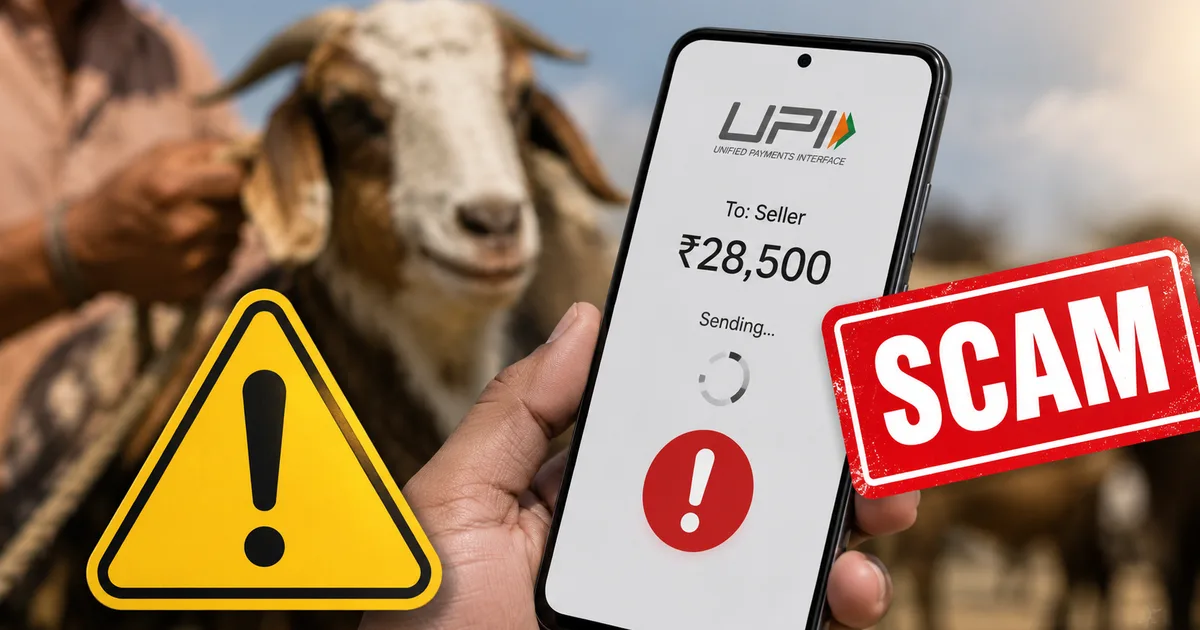
This is probably the most common Bakrid scam, and it's devastatingly simple. A buyer agrees on a price, say ₹25,000 for a goat, then shows the seller a WhatsApp screenshot or a doctored UPI app screen that "confirms" payment was sent. The seller is busy, trusting, and lets the animal go. The money never arrives.
These fake screenshots look very convincing now. Fraudsters use template apps that replicate Google Pay, PhonePe, Paytm, or BHIM UPI confirmation screens pixel-perfectly. The transaction ID looks real. The timestamp looks recent. The amount matches. But it's all fake. Nothing ever happened on the bank's end.
There's a variation that's even sneakier. The scammer initiates a genuine UPI "collect request" and shows that pending screen to the seller. The seller sees what looks like incoming money. It never processes, or the scammer cancels it the moment they walk away with the animal.
The scams targeting buyers: advance payment disappearances
If you're buying a sacrificial animal through WhatsApp groups, Facebook Marketplace, or online cattle portals, be very careful about advance payments. Here's how this typically plays out:
- You find a listing for a qurbani cow or goat priced 20-30% below local market rates.
- The "seller" (often claiming to be from another city) asks for an advance of ₹2,000 to ₹10,000 to reserve the animal and cover transport.
- You pay via UPI. The seller confirms receipt and promises delivery before Eid.
- They stop responding. The animal never arrives.
Some scammers keep stringing buyers along for days. They ask for more money for "transport delays" or "municipal clearance fees", squeezing ₹20,000 to ₹30,000 out of victims before going quiet. The whole thing can feel completely legitimate for a surprisingly long time. I think the reason people stay convinced is that the amounts start small and the story stays consistent just long enough.
QR code fraud at physical cattle markets
Physical mandis are being targeted too. Fraudsters approach buyers in crowded markets, offering to "help" with UPI payments. They show a QR code claiming it belongs to the actual seller. It doesn't. It's their own.
The subtler version is worse. They show a collect money QR code, which is a UPI payment request, not a payment send. You scan it, enter your UPI PIN thinking you're paying the seller, and you've just authorised the scammer to pull money from your account. This one catches a lot of people because the UPI flow looks completely normal from your end (annoying, I know).
You should never enter your UPI PIN to receive money. If anyone says "scan this code to get your refund" or "scan this to confirm the deal", stop. Just stop. That's not how UPI works. If you want to understand how UPI payment flows actually work, spending ten minutes on that will make this trick obvious forever.
Deepfake video call fraud on high-value deals
This is newer and mostly relevant for bigger transactions. CERT-In has flagged AI-powered deepfake calls as a growing threat in 2026. In the Bakrid context: you're selling a premium qurbani cow for ₹70,000 online, a buyer video-calls you and seems completely legitimate, face, voice and all. You feel reassured and go ahead. The face was AI-generated.
Honestly, this is still rare at the average local mandi level. But for transactions in the ₹50,000 to ₹1 lakh range happening entirely over phone or video, it's worth knowing this exists. Ask for something spontaneous during the call, like holding up today's newspaper or making a specific hand gesture you describe mid-call. Real-time deepfakes still struggle with that.
Warning signs that something is off
- A buyer shows you a payment screenshot instead of waiting for you to check your own UPI app.
- Any pressure to release goods before you see a credit notification on your own phone.
- Online sellers asking for a UPI advance from buyers they've never met, especially from another city or state.
- QR codes being shown by third parties or "helpers" at the market rather than the actual trader.
- Prices significantly below going market rates for sacrificial animals in your region.
- Requests to scan a QR code to "verify" your account or "receive" a payment.
- Sellers citing endless sequential delays after receiving your advance payment.
How to protect yourself as a seller
One rule covers almost everything. Don't release any animal or goods until you see the credit in your own bank account or UPI app. Not a screenshot. Not a "pending" transaction. Actual credit. Open your UPI app notification history, check your bank balance. This takes 30 seconds. Do it every time, no matter how busy the market gets.
UPI credits are instant in India. There's no legitimate reason a real buyer would say it'll show up in 10 minutes. That's a lie designed to get goods out of your hands before you can verify anything.
Also consider keeping a separate, low-balance account linked to the UPI ID you use at markets. Even if something goes wrong, your primary savings account stays untouched. Good general UPI hygiene, honestly, not just a Bakrid tip.
How to protect yourself as a buyer
Don't pay an advance to someone you haven't verified. If buying online, ask for a video call where the seller shows you the animal and their Aadhaar card, and is standing somewhere you can place geographically. Then search the seller's phone number on Google with the word "fraud" added. Takes two minutes and filters out most scammers immediately.
Before confirming any UPI transaction, your app shows the registered name against that UPI ID. Make sure it matches the person you think you're paying. If you're buying from "Qureshi Livestock" but the UPI name shows "Ramesh Kumar Personal", ask why before you confirm anything.
And it's worth reading about common advance payment scams targeting Indian buyers. Cattle market fraud follows nearly identical playbooks to other online advance-payment scams, just with a different product attached.
A relevant RBI proposal worth knowing about
RBI recently proposed a mandatory 1-hour delay on first-time UPI transfers above ₹10,000 to new payees, specifically as an anti-fraud measure. Bankers have pushed back because it'd slow transaction volumes, and as of now it's not in effect. But if it passes, it'd give buyers and sellers a window to reconsider before money moves irreversibly (which makes sense, actually). Worth watching as a policy development.
Where to report if you've been scammed
Act fast. UPI fraud recovery depends heavily on how quickly you report.
- National Cyber Crime Helpline: 1930 (24/7, free to call from any Indian network)
- Online portal: cybercrime.gov.in — file with transaction ID, UPI IDs involved, screenshots, and a clear timeline
- Your bank's fraud helpline — ask them to flag the destination account and explore a chargeback
- NPCI dispute resolution via your UPI app — under Help or Raise Dispute in Google Pay, PhonePe, or Paytm
Have these ready when you report: the UPI transaction ID from your app's history, the fraudster's UPI ID or phone number, screenshots of conversations, and the exact amount and time. The more specific you are, the faster the response.
If you want to understand what happens after you file, here's how UPI fraud recovery works in India, including the timelines and what your bank is actually required to do. Missing the first 24 hours makes recovery significantly harder, so don't sit on this.