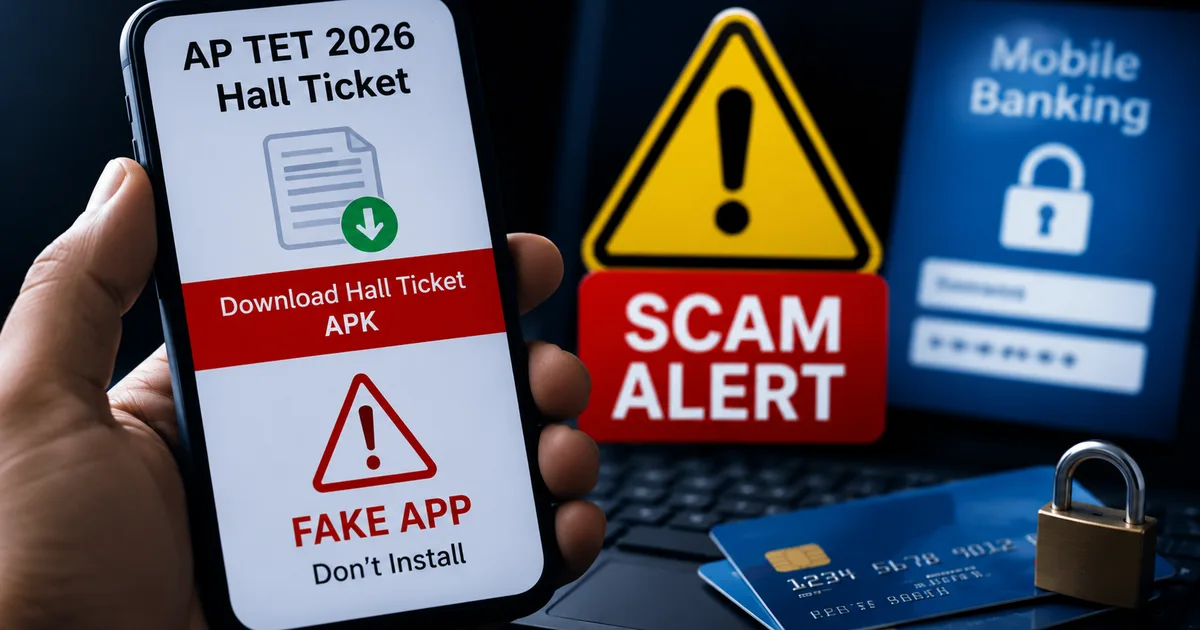
If you are seeing WhatsApp forwards pushing a Fake AP TET 2026 Hall Ticket Download APK Scam right now, stop everything. I need to talk to you about this before you tap on anything on your phone screen.
So the AP TET 2026 exams are kicking off on August 5. Lakhs of candidates across Andhra Pradesh are scrambling to get their admit cards right now. And whenever there is mass panic to download something quickly, scammers get to work. Honestly, it's a total mess. I think this might be one of the worst ones we've seen this year.
This is a nasty scam. We are looking at a coordinated fraud operation designed to steal your mobile banking details under the guise of an exam admit card. It preys on the anxiety students feel right before a major test. You just want your hall ticket. So you click the link your uncle sent on a family WhatsApp group. But you end up giving cybercriminals full control over your smartphone and your hard-earned money.
Let me break down exactly what is happening here.
What this scam actually is
Right off the bat, you need to understand that the government doesn't distribute hall tickets via APK files. Never have, never will. The official AP TET 2026 admit cards are only available on the official website at tet2dsc.apcfss.in. That's it.
There is no other way to get it.
But scammers know that government website servers often slow down when millions try to access them at once. People get impatient. The site throws an error. They refresh, and it fails again. So fraudsters are mass-forwarding messages on WhatsApp and Telegram claiming you can bypass the heavy website traffic by downloading a direct Android app. They call it the official AP TET hall ticket downloader or something sketchy like that.
It's completely fake. The file you are downloading is actually a piece of malicious software. Security researchers call it a banking trojan. Once installed, it hides in your phone's background and goes straight for your SMS inbox and banking apps like YONO SBI, Paytm, Google Pay, or PhonePe.
How the fraud works step by step
These guys have a very specific playbook. I've seen this exact tactic used for electricity bill scams, fake traffic challans, loan frauds, and even courier delivery frauds earlier this year. You can read more about those patterns in our latest scam alerts section.
Here's the exact sequence of how they empty your bank account.
- First, you get a message on WhatsApp. It looks urgent. It usually says something like "AP TET Server Down! Download admit card via fast link here" attached with an APK file named APTET_2026_AdmitCard.apk. Sometimes they even use the official government logos as the thumbnail for the file to make it look legitimate.
- Second, you click to install it. Your Android phone will probably throw up a warning about installing apps from unknown sources. But because you are stressed about your exam and desperate to know your exam center, you ignore the warning and hit install anyway.
- Third, the fake app asks for permissions. It will ask to read your SMS messages, access your contacts, track your location, and sometimes even ask for accessibility controls. This is the fatal mistake. When you grant these permissions, you hand over the keys to the castle.
- Fourth, the app opens and asks you to enter your registration number and date of birth to generate your hall ticket. It might even show a fake loading screen. While you are typing that in and waiting, the malware is quietly intercepting your OTPs in the background.
- Finally, the scammers use your phone number to log into your UPI or mobile banking apps on their own devices. When your bank sends an OTP to verify the login, the malware intercepts it, sends it directly to the scammers, and deletes the SMS from your phone so you never even see it.
Before you realize what happened, your money is gone. They route it through mule accounts faster than you can call customer care.
Why UPI makes this extremely dangerous
We need to talk about UPI for a second. UPI is fantastic. It changed how India transacts. But it's also tied directly to your phone number and the device you use.
When you install a malicious APK and give it SMS permissions, you're basically breaking the core security feature of UPI (which is terrifying, honestly). The scammers don't need to steal your physical phone. They just need your phone to receive the SMS and quietly forward it to them.
I've spoken to people who lost fifty thousand rupees in minutes because they installed a fake app. They didn't share their PIN. They didn't click a payment link. They just installed an app that read their incoming bank OTPs. That's how dangerous this fake APK scam really is.
If you want to understand more about how these financial frauds operate in India, take a look at our detailed explainer pieces on the subject.
Why students are specifically targeted
Cybercriminals aren't randomly picking targets here. They know that the AP TET is a massive deal. Millions apply, and the pressure is immense.
Many candidates come from rural areas where internet connectivity might be spotty. When the official website takes a long time to load on a slow 4G connection, frustration builds up. Scammers exploit this exact frustration by offering a fast track solution.
Basically, when you're stressed about an exam that dictates your career as a teacher, your critical thinking skills take a back seat. You aren't thinking about cybersecurity. You're thinking about whether your exam center is in your home district or three hours away. If you ask me, this vulnerability makes students the perfect targets for these organized fraud syndicates.
They also know that students often share information rapidly in large WhatsApp groups. If one person falls for the fake link and forwards it to a study group of two hundred people, the scammers just hit the jackpot. The viral nature of how we share information in India is weaponized against us.
The role of fake news and social media
We can't ignore how these fake links spread. It's rarely a direct message from a stranger. The scammers rely on social engineering. I'm not sure exactly why it works so well, but people fall for it constantly.
They might create fake social media profiles mimicking official education boards. Or they drop these APK links in the comments section of YouTube videos discussing the AP TET exam dates. Desperate candidates scrolling through comments looking for updates click on them.
This is why I always tell people to trust zero information on social media when it comes to official government exams. If the Board of Secondary Education in Andhra Pradesh has an update, they'll put it on their official portal or issue a formal press release to newspapers. They won't post a download link in a random Telegram channel.
Always verify. If you see a news clipping circulating on WhatsApp about the hall tickets being released, open a new tab and check a reliable news site yourself. Don't trust the screenshot. Screenshots can be edited in two minutes on a phone.
Warning signs you should never ignore
You can spot this scam from a mile away if you know what to look for.
The biggest red flag is the file format itself. Any exam admit card is always a PDF document.
If someone sends you an .apk file for a hall ticket, it is a scam. Never install APK files sent over WhatsApp or Telegram.
Another major warning sign is the language in the messages. They always create a false sense of urgency. They tell you the servers are crashing or that today is the last day to download it. Real government notifications don't sound like spammy sales pitches.
Look at the permissions too. If a simple hall ticket app asks to read your text messages, why would it need that? It makes zero sense. Always question why an app needs a specific permission. Why does a PDF reader need access to your microphone? It doesn't.
How to protect yourself right now
Look, the best defense is just knowing how the system actually works. You have to be paranoid about links on WhatsApp.
Always go directly to the source. Open your browser and type in tet2dsc.apcfss.in yourself. Don't click links forwarded to you, even if they come from close friends or family. People forward things without checking them all the time. It's a bad habit we all have.
Check your Android settings. Go to your security settings and make sure Install Unknown Apps is turned off for your browser and WhatsApp. This simple step blocks malicious APKs from installing automatically.
If you have elderly parents or younger siblings giving the exam, talk to them. Explain that hall tickets are only downloaded from the website. Education is your best tool here. The Indian Computer Emergency Response Team, known as CERT-In, constantly issues warnings about these APK scams, but the message doesn't always reach the people who need it most (which is frustrating, frankly).
If you're unsure about basic internet safety rules, you might want to check out our detailed privacy guides for some essential tips to lock down your devices.
What to do if you already installed the fake app
If you're reading this and realizing you just installed that APK yesterday, don't panic. But you need to act fast.
First, disconnect your phone from the internet immediately. Turn off Wi-Fi and mobile data. Turn on Airplane mode. This stops the malware from sending your OTPs to the hackers sitting somewhere far away.
Second, uninstall the suspicious app immediately. Go to your settings, find the apps list, locate the fake AP TET app, and delete it.
Third, call your bank. Use another phone if you have to. Tell them your phone was compromised and ask them to temporarily freeze your online banking and UPI access. Don't wait to see if money is missing. Freeze it first.
Fourth, you need to report this. The government has actually made this part easier. Call the national cybercrime helpline at 1930 immediately. You can also file a complaint online at cybercrime.gov.in. The sooner you report it, the higher the chance of the authorities freezing the scammers accounts before your money is withdrawn entirely.
I strongly recommend doing a factory reset on your phone if you installed the malware. It's a massive headache to set up your phone again, copy all your photos, sync your accounts, and download your apps. I get it. But it's the only way to be absolutely certain the trojan is gone from your system.
These scams aren't going away anytime soon. As long as there are massive entrance exams in India, there will be criminals trying to exploit the stress of the candidates. The numbers here are a bit fuzzy, but the financial losses are definitely huge. The only way we beat them is by slowing down, thinking critically, questioning urgency, and refusing to click on suspicious links.
Stay safe out there. Get your hall ticket from the official site only. Focus on your exam preparation instead of worrying about your bank account. And please, warn your study groups about this APK scam circulating right now.