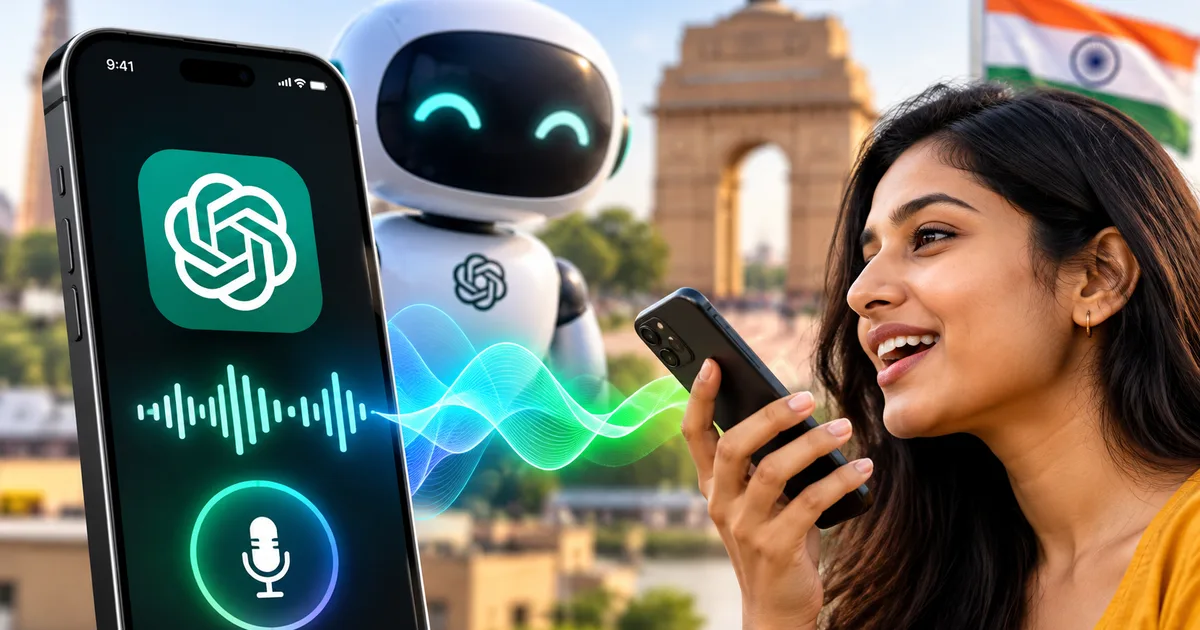
Look, we've been waiting for this one for a while. Ever since OpenAI teased it earlier this year, the hype around the ChatGPT Advanced Voice Mode 2026 India rollout has been somewhat exhausting. Every single week, someone online claimed they had early access or found a workaround to get it. But it's finally here. It's officially rolling out across Indian accounts right now. It runs on what they're calling GPT-Live (which is basically powered by the GPT-5.5 model behind the scenes). And honestly, it's pretty impressive. You can actually interrupt it, and it talks back like a normal person instead of a robotic customer service agent reading from a stale script.
I spent the entire weekend testing it out. Is it perfect? No. Does it sometimes get a regional accent completely wrong or misunderstand a local slang term? Yes, absolutely. But if you're a student prepping for tough interviews or just someone who wants to talk to a smart piece of software while stuck in agonizing Bengaluru traffic, this update changes things. I think the traffic use case alone is worth it. Read on for exactly what you're getting, which Indian languages actually work, how it compares to local options, and whether you actually need to spend ₹1,950 a month for a Plus subscription.
What exactly is GPT-Live and Advanced Voice Mode?
OpenAI recently launched GPT-Live globally. They're aggressively pushing it as their absolute best voice model. And honestly, they aren't wrong. Previous voice features on the ChatGPT app basically operated in clunky stages. They transcribed your speech to text, and then a standard text-to-speech engine read the AI's answer back to you. That process caused that weird two-second delay that made conversations feel completely unnatural.
GPT-Live changes the architecture entirely. It processes audio natively. This means it doesn't just read your words. It actually hears your tone and your pauses. You can interrupt it mid-sentence if it starts giving you a long, boring answer (which is weirdly accurate, actually). You can ask it to talk faster or sound sarcastic. It picks up on the emotion in your voice. If you sound frustrated, it actually softens its tone and tries to be more helpful. It's wildly fast. You can find more of these kinds of updates in our AI Tools & Software section. But if you ask me, this one feels like an actual product improvement. It isn't just a marketing gimmick.
The Indian language reality: Hindi, Hinglish, and beyond
Here's the deal for Indian users. For a long time, these global AI voice tools sounded completely clueless when trying to speak Hindi. They had this bizarre, forced American twang. It made them impossible to take seriously. The 2026 update fixes a massive chunk of that problem.
OpenAI has heavily focused on multilingual support. The new model handles Hindi naturally. It captures conversational nuances and actually understands Hinglish without getting confused mid-sentence. You can start a sentence in English and throw in a Hindi phrase. It replies seamlessly in the same mixed context. And they didn't stop at Hindi. I'm not sure exactly how many dialects they nailed, but early testing shows much better comprehension for Bengali, Marathi, Telugu, and Tamil. If you've been following the ChatGPT 5.6 Sol Voice Mode India: Features and Languages updates, you know this has been a major priority for AI companies trying to capture the massive Indian user base.
I tested it by asking it to explain complex financial concepts in conversational Hindi. It did it without sounding like a textbook. Is it flawless? No. Sometimes a fast-spoken Marathi phrase confuses it. Or it might mispronounce a specific South Indian city name.
But the progress is obvious. This is huge for local businesses who want to use AI but don't operate entirely in English.
Free tier vs. Plus: Do you need to pay?
This is what everyone wants to know. Right now, access to the Advanced Voice Mode is gated. But the gates are slowly opening. As is standard with OpenAI's playbook, Plus and Team users got the feature first. They pay roughly ₹1,950 a month in India. They get higher usage limits and priority access to the GPT-Live models during peak hours.
But there's a catch for free users. OpenAI is gradually rolling out limited access to the free tier with strict time caps. You might only get 10 to 15 minutes of Advanced Voice interaction before the app cuts you off. Then it defaults back to the older standard voice mode. If you rely on this heavily for daily tasks, the free tier will frustrate you very quickly.
So if you're a student trying to decide if the subscription is worth your pocket money, the pricing is steep. I recommend checking out the ChatGPT Astra 2026 India Rollout: Voice AI Access Guide to see how OpenAI's offerings compare with Google's latest updates. Google often has better integrations for Android users in India and more generous free tiers for everyday use.
How Indians are actually using Advanced Voice
We're seeing some wild and genuinely useful applications pop up. ChatGPT voice conversations are exploding across the country. People are finding uses OpenAI probably didn't even anticipate.
- Hardcore interview prep: People are using it to simulate high-pressure job interviews. You can tell it, "Act like a strict HR manager from an Indian IT service firm and ask me about my Java experience." It actually does a decent job. It challenges your answers and gives real-time feedback on your tone.
- Live translation on the go: While travelling across states, you can have the app open and ask it to translate conversations on the fly. It's much faster than typing into Google Translate. The spoken output sounds more natural to the locals.
- Storytelling for kids: Parents are using it to generate interactive bedtime stories. You can ask it to "tell a story about a space explorer from Mumbai," and it handles the pacing and character voices perfectly.
- Coding help while commuting: Developers are talking through logic problems while walking away from their keyboards. Sometimes just explaining the bug out loud to the AI helps you find the fix. It's like having a rubber duck that talks back.
The impact on Indian customer service
We need to talk about the elephant in the room. BPO and customer service jobs. India is the global hub for call centers. With a voice model that sounds this natural and handles regional accents without a script, corporate executives are definitely paying attention.
Some companies are already piloting these advanced voice agents for first-line customer support. Will it replace human agents entirely tomorrow? Probably not. The AI still hallucinates occasionally. You really don't want a bot confidently giving a customer the wrong refund information. But for routine queries like checking order status or resetting passwords, this technology is more than capable.
The local competition: Sarvam AI and Google
OpenAI isn't the only player targeting the Indian voice market. We can't talk about this without mentioning local alternatives. Companies like Sarvam AI are building models specifically trained on our regional languages from the ground up. Their OCR and voice agents are designed explicitly for Indian enterprise use cases.
Then you have Google's Astra, which is deeply integrated into the Android ecosystem. For a lot of Indian smartphone users, jumping through hoops to use a standalone app like ChatGPT might feel less intuitive than just pressing a button on their phone to summon Google's built-in assistant (which makes sense, actually). You can read more about these shifts in our Latest Tech News hub.
Privacy: Should you be worried?
Whenever an app asks for microphone access and processes your raw audio in the cloud, privacy becomes a real concern. OpenAI claims they don't use your voice clips to train their audio models without explicit permission. They've also built in guardrails to prevent the AI from impersonating real people or generating deepfakes of public figures.
But you should still be smart about what you share. If you're discussing confidential client information or your bank details, maybe don't do it over a live voice chat with a cloud-based AI. The Indian government is also closely watching how these companies handle user data. Regulations are tightening. Always check your app settings and opt out of data sharing if you want to be safe.
The verdict: Worth the hype?
Honestly, yes. We cover a lot of AI features that turn out to be completely useless in the real world. This isn't one of them. The ChatGPT Advanced Voice Mode is a genuinely good product.
The lack of delay and the ability to detect emotion make it feel like an actual assistant. The regional language support for India is finally hitting a standard where it's actually usable for daily tasks. If you have the Plus subscription, you should absolutely be using this right now. If you're on the free tier, give it a spin when you get access. Just be prepared for the annoying time limits.