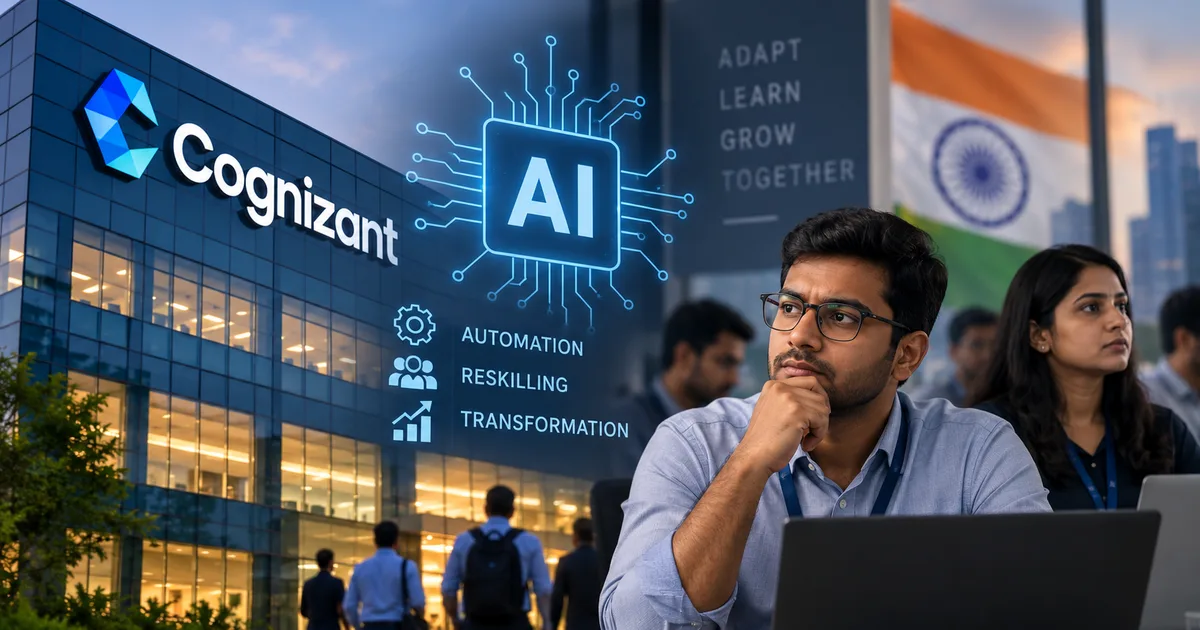
Look, the Indian IT sector is going through something messy right now. You can't open LinkedIn without seeing someone panicking about generative AI taking their job. And honestly, they have a reason to be worried. I want to talk about the Cognizant AI strategy and restructuring 2026, and its impact on Indian IT employees. It is complicated. I've been tracking their announcements over the last few months. Some of it sounds incredibly scary for the average developer in Pune or Chennai. But then you look at their actual hiring numbers, and the story gets weird.
If you've spent any time working for an IT services giant, you know the drill. You get hired, go through a long training period, and eventually land a project doing maintenance or writing simple code. That entire pipeline is getting ripped apart in real-time. Cognizant is at the front of this massive shift. What they're doing right now is going to be copied by every other major player next year.
The elephant in the room: Project Leap and layoffs
We have to start with the bad news. Reports are swirling about something called "Project Leap" internally at Cognizant. The rumors say up to 15,000 jobs might be at risk globally. The company is accelerating its AI transformation (which makes sense, actually). If you've been following the Latest Tech News, this isn't exactly an isolated incident. We've seen similar tremors across the industry. Just read up on the Infosys Generative AI Strategy: Impact on Indian IT Jobs to see how widespread this is.
But what does a restructuring of this scale actually mean for the folks sitting in Cognizant's massive Indian delivery centers?
Basically, it means the end of the traditional bench. IT services companies used to hire thousands of freshers and train them for six months. They'd keep them on standby. That model is dead. If an AI agent powered by Anthropic's Claude can do the routine maintenance work, clients won't pay for humans to sit around waiting for tickets.
The layoffs are about cutting a specific type of capability that the market no longer values. It goes beyond simple cost cutting. Clients are pushing back on the old model of "give me fifty junior developers for a year." They want five senior engineers and a suite of AI tools. This is terrifying if you're currently one of those fifty junior developers. I think it's the biggest shock to the system we've seen in a decade.
You have to look at the jobs being targeted. It's mostly middle management and basic system administrators. If your job involves taking data from one system and putting it into another system, you're directly in the crosshairs. The company simply can't justify billing a client for that work. An API and a large language model can do it instantly.
Claude AI is everywhere now
Speaking of Claude, Cognizant just massively expanded its partnership with Anthropic. They're embedding Claude AI across their enterprise platforms. They even launched a dedicated EMEA AI Unit in July to help companies scale what they call "agentic AI adoption."
Agentic AI isn't just a chatbot that answers questions. It's software that can plan and execute multi-step processes on its own. It writes code and tests it. When Cognizant starts selling this capability to banks and healthcare companies, the billing model changes entirely.
"The billing model is shifting from headcount to outcomes. Clients want to pay for a solved problem, not 40 hours of a junior developer's time."
This outcome-based pricing is the real disruption here. Indian IT grew up on time-and-materials billing. You charge $25 an hour for a developer. Then you pay them the equivalent of $5 an hour in INR and keep the difference. But when a client says, "We will pay you $100,000 to migrate this database, we don't care how many hours it takes," the incentive changes. Now, Cognizant wants to use AI to do that migration in a week with two people. Not three months with twenty people.
The fresher paradox: AI does the work, but hiring continues
Here's the deal: a recent study by Cognizant and Pearson found that 37% of entry-level tasks in India are already done by AI. That number is staggering. If you're a fresh engineering graduate, over a third of the work you used to do in your first year is gone.
So you'd think Cognizant stopped hiring freshers, right? Wrong.
They actually hired 20,000 graduates recently. They plan to hire more throughout 2026. This confused a lot of people. Why hire 20,000 kids if AI is doing their job?
I looked into this. The answer is that the nature of the entry-level job has changed completely. You aren't being hired to write basic boilerplate code anymore. You're being hired to be an "AI Builder." You review what the AI outputs and fix the hallucinations. You stitch different AI agents together.
The CEO, Ravi Kumar S, was just named to the TIME100 AI list for 2026 specifically because of how he is retraining the workforce for this exact shift. He's a former nuclear scientist who seems to understand you can't just fire everyone and replace them with servers. You need humans in the loop. The loop just looks completely different now.
These new hires are being put through rapid training programs. They focus entirely on prompt engineering and understanding business context. They're expected to be productive in weeks, not months. The grace period of sitting in a massive training facility in Mysore or Chennai learning Java basics is over. You're expected to use AI to write the Java for you. Your job is to make sure it doesn't break the client's production environment.
What this means for salaries and promotions
When a company talks about "restructuring" and "AI transformation" in the same breath, the first thing employees worry about is their paycheck. The days of guaranteed double-digit annual appraisals in Indian IT are long gone. What we are seeing now is a massive widening of the salary gap based on AI proficiency. I'm not sure exactly why it happened so fast, but it did.
If you're a legacy skills developer maintaining older Java or .NET applications without using any AI assistance, your salary is likely going to stagnate. You might survive the Project Leap cuts. Your compensation won't grow, though. Companies know they can replace this work easily.
On the other hand, the engineers who are actively building these new AI pipelines are seeing massive premiums. If you know how to fine-tune an open-source language model on a client's proprietary dataset, you can practically name your price right now. Cognizant is aggressively trying to build a cohort of these "AI Builders" internally. Hiring them from the outside is simply too expensive. They know they'll lose out to smaller AI boutiques if they don't train their own people.
This creates a weird dynamic on the floor. You have project managers who've been with the company for fifteen years terrified of being let go. Meanwhile, a twenty-three-year-old who understands vector databases is getting fast-tracked for promotions. Experience used to be the most valuable currency in Indian IT. Now, adaptability is.
The Q2 numbers and the stock market reaction
Let's look at the actual numbers, because the financials tell a completely different story than the layoff rumors. In the second quarter of 2026, Cognizant reported revenue of $5.48 billion. That's a 4.5% increase year-on-year. They saw a solid 12% growth in their financial services sector. That's massive considering how cautious banks usually are with new technology.
Because of this performance, they actually raised their full-year revenue and profit forecasts. Wall Street loved it. The stock jumped 11% right after the announcement. But if you look closer at the report, there is a catch. The growth masks some weaker bookings and uneven demand in other areas. Clients aren't just handing over blank checks anymore. They're taking money away from traditional IT maintenance budgets. They dump it into AI pilot programs instead. If your project is on the maintenance side of that equation, your funding is drying up.
This explains the disconnect. The company is healthy and growing. It's just growing in a completely new direction. They have to shed the weight of the old business model to fund the new one. Unfortunately, that "weight" is often thousands of employees who were never trained for the new reality (annoying, I know).
The shift to GCCs and consulting
Another massive part of Cognizant's strategy is their focus on Global Capability Centers (GCCs). Recently, they were named a leader across four different GCC services assessments by firms like ISG and NelsonHall.
What does this mean for you? It means multinational companies are setting up their own tech hubs in India rather than outsourcing everything. Cognizant is helping them build and run these centers. This is a very different type of consulting work compared to traditional IT support. It requires better communication skills and a deeper understanding of the client's core business. You have to consult on AI strategy rather than just take tickets from Jira.
We also saw Avanade appoint former Cognizant leader Achal Kataria as their India CEO recently. This shows how competitive the market for senior leadership with AI transformation experience has become. The talent war at the top is fierce. The bottom of the pyramid faces restructuring.
How to prepare your career for the new reality
If you're sitting in a cubicle right now wondering about your job security, you need to be proactive. Waiting for HR to assign you a training module is a bad strategy.
Here are the practical steps you need to take right now:
- Stop fighting the tools. If your company gives you access to enterprise AI assistants, use them for every single task. You need to become the person who can do the work of three developers by prompting correctly. If you don't know where to start, spend some time exploring new AI Tools & Software.
- Learn about outcome-based delivery. Understand how your project actually makes money for the client. The closer you are to the business value, the harder you are to replace. Technical skills are becoming commoditized. Domain knowledge is not.
- Upskill in cloud security and data governance. AI models need clean, secure data. Companies are desperate for people who can build safe data pipelines for these models to consume. Everyone wants to build chatbots, but very few people know how to secure the data feeding them.
- Start looking at alternative tech roles. The service sector is shifting. Sometimes working directly for product companies offers more stability. See the Zoho CEO Sridhar Vembu 2026 Statement: AI's Impact on the Indian Tech Job Market Explained for an interesting contrast in how product companies view this transition.
- Improve your soft skills immediately. When the AI writes the code, your primary job becomes communicating with the client to figure out what code actually needs to be written. English fluency and stakeholder management are suddenly more important than knowing the syntax for a React hook.
The bottom line for Indian IT
The reality of the Cognizant situation is that the company is adapting to survive. The IT services industry in India built its foundation on labor arbitrage: doing the same work cheaper than someone in the US or Europe. But AI is cheaper than anyone. The new arbitrage is intelligence. It's about who can use these tools most effectively to deliver a finished product.
You don't need to panic. The IT sector in India is massive and resilient. But you do need to wake up. The job you were hired to do three years ago is probably gone. The job you'll have next year is being invented right now. The people who get laid off will be the ones who refuse to learn how to manage AI agents. The people who get promoted will be the ones who figure out how to automate their entire team's workload.
It's a harsh reality, but it's the only one we have. Keep your skills sharp and keep watching the market. Don't assume your current project will last forever. Things are moving too fast for that kind of comfort.