You know what's annoying about modern smartwatches? They do way too much. Sure, it's cool that your watch can tell you your Zomato order is outside. Or let you read a WhatsApp message while you're driving (which you absolutely shouldn't do). But when you're trying to sleep, you don't want a glowing screen blinding you. Or when you're working out, you just want to focus on breathing. Not swiping through endless menus. That's exactly why the concept of the Google Fitbit Air is suddenly making a lot of sense for a lot of people.
Google has officially confirmed that the Fitbit Air is finally launching in India this October 2026. This is their screenless fitness tracker. And honestly, it's about time we got some decent hardware in this category. We've seen minimalist products like the Whoop strap get popular globally with athletes. But they're a mess to buy here. The subscription costs are insane, and importing them is a headache. I think the Fitbit Air is a much more practical alternative for everyday Indian users who just want to understand their bodies better.
So, what exactly is this thing? Why are people hyped? And why should you care about a fitness band that doesn't even have a tiny screen to show you the time?
Why a screenless fitness tracker actually makes sense
Let's get the obvious question out of the way first. Why pay good money for a wearable device that lacks a display? I thought the exact same thing when I first heard about these devices. A watch without a face feels broken by design. But think about it. Think about how many times a day your wrist vibrates for a group chat message that you don't even need to read.
Most of us already stare at our phones for six to eight hours a day. Then we have laptops for work. Maybe a tablet or a TV at night.
Adding yet another screen to our wrists is overkill.
A screenless tracker like the Google Fitbit Air is designed to do one thing well. It tracks your health in the background. It doesn't fight for your attention.
You put it on and completely forget about it. It tracks your steps and your sleep stages silently. Then, when you actually want to see your data, you just open the app on your phone. You don't get constant buzzes on your wrist during a meeting. No bright screens light up the dark room when you turn over in bed.
Removing the screen has a massive benefit for battery life. Most smartwatches need a charge every day or two. The Fitbit Air will last up to seven days on a single charge, according to recent leaks and BIS certifications. That means you can track a whole week of sleep without taking it off to charge it.
Google Fitbit Air specs and hardware details
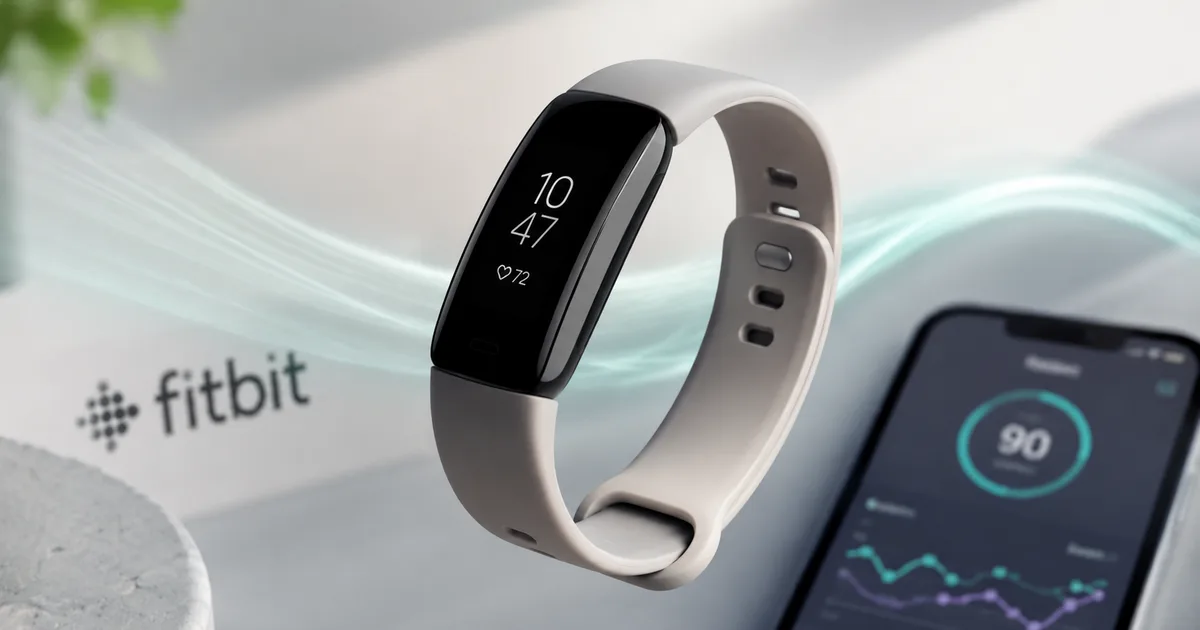
Basically, the design of the Fitbit Air is minimalist. It's a sleek silicone or fabric band. It has a tiny sensor module. It looks more like a modern bracelet than a piece of consumer electronics.
Here's what we know about the hardware and specs based on recent certifications and early previews:
- It packs a 24/7 continuous heart-rate monitor, an SpO2 sensor for tracking blood oxygen levels while you sleep, and high-precision motion sensors for activity tracking.
- You can expect up to seven days of continuous use. This alone is a huge upgrade over something like an Apple Watch or even a Pixel Watch if you care deeply about uninterrupted sleep tracking.
- It's designed specifically to be comfortable enough to wear 24/7. This matters a lot. If a watch is too bulky or the strap is sweaty, you'll just take it off at night, which entirely defeats the purpose of buying a health tracker.
- It syncs directly with the Fitbit app on your smartphone via Bluetooth, and yes, it works perfectly fine whether you use an Android phone or an iPhone.
Thing is, the simplicity is the main selling point. It doesn't need a fast Snapdragon processor. Or a high-res OLED screen. It just needs accurate sensors and a rock-solid Bluetooth connection to offload the data.
AI health features in the new Fitbit app
Hardware is only half the story.
The real magic of the Google Fitbit Air is the software. Google has baked new AI health features directly into the Fitbit app.
Google has been pushing AI into everything lately. Honestly, I think health tracking is one of the few areas where it actually feels useful. The new Gemini-powered features inside the Fitbit app act like a personal coach. They don't just dump a spreadsheet of numbers on you.
Instead of giving you raw data, the new AI features try to explain what that data means for your day. It might notice that your resting heart rate is elevated compared to your baseline. Then it will suggest that you take a rest day instead of hitting the gym. Or it could connect your late-night food deliveries with poor sleep scores the next morning (which makes sense, actually).
The AI can even analyze patterns over months. If it sees that your sleep quality always tanks during the first week of the month, it points that out. Then you can manage your work stress better.
"The shift towards AI in health tech isn't about giving you more raw numbers. It's about giving you actionable advice based on the numbers your body is already generating."
You can even use natural language to interact with your data. You can open the app and ask, "Why was my sleep so bad last night?" The AI will look at your recent physical activity and your sleep stages. Then it gives you a personalized answer in plain English.
This is a big deal for people who aren't hardcore fitness nerds. You don't need to understand what HRV means. You don't need to read a sleep graph. The app just tells you if your body is recovered or stressed. And it tells you what you should do about it.
Expected price in India and launch date
So, how much is this minimalist piece of tech going to cost you?
Google has officially confirmed the October 2026 launch window for India. This happens right after their big Pixel 11 hardware event. They haven't announced the exact Indian retail pricing yet. We can make some educated guesses based on global pricing structures, though. The numbers here are a bit fuzzy, but we can figure it out.
The Whoop band is the closest competitor. It relies on a pricey monthly subscription model that turns off a lot of Indian buyers (annoying, I know). Google has historically offered Fitbit Premium. But they're moving towards including more of the core features for free to compete with Apple Health. We expect the Fitbit Air to have a standard upfront hardware cost. It shouldn't force you into a heavy monthly subscription just to see your own data.
Current estimates put the Google Fitbit Air price in India somewhere around INR 12,000 to INR 15,000. This places it in the premium fitness tracker segment. It's well above the budget bands from Xiaomi or Noise that you can buy for two thousand rupees. But it's way cheaper than a full-fledged Pixel Watch or an Apple Watch SE.
If Google can keep the price under INR 15,000 and bundle a few months of Fitbit Premium, I think it will sell well. The Indian market is flooded with cheap smartwatches. They are basically just notification screens with terrible health sensors. A lot of people have realized that those budget watches aren't helping them get healthier. There is a real demand for accurate health tracking from a reliable brand.
We expect the device to go on sale through Flipkart and Amazon shortly after the official October announcement. Offline retailers like Reliance Digital should get it too.
The privacy question: where does your data go?
We can't talk about a Google health device without addressing the elephant in the room. Privacy. When you strap a device to your wrist that monitors your heart rate 24/7, you hand over highly sensitive personal data.
Google says that Fitbit health and wellness data won't be used for Google ads. They have strict internal walls separating your health data from your search history. The data is processed securely. And you have the option to delete your entire history from the Fitbit app at any time.
The new AI features mean that your data is analyzed by machine learning models to generate personalized insights, though. In my experience, if you're highly sensitive about your health data, you might want to stick to a basic pedometer. But for most users, the trade-off of getting actionable health advice is worth the data exchange. That is, provided Google sticks to its privacy promises.
Who is the Google Fitbit Air actually for?
Let's be clear about one thing. This is not a device for everyone. If you love getting WhatsApp notifications on your wrist, this is not the product for you. If you like paying for your groceries with your watch via UPI, you should stick to a traditional smartwatch.
But there are a few specific types of people who will absolutely love the Fitbit Air:
- If your main goal is to improve your sleep hygiene, a bulky smartwatch is annoying. A slim, screenless band is way more comfortable to wear to bed and won't wake you up with accidental screen taps.
- I know a lot of people who love wearing classic analog watches but still want to track their daily steps and heart rate. You can wear a nice mechanical watch on your left wrist and the minimalist Fitbit Air on your right wrist without looking ridiculous.
- If you find yourself constantly checking your wrist just because the screen lit up with a spam email notification, this device removes that temptation completely. It forces you to be more intentional about when you check your phone.
It's a niche product. But it's a rapidly growing niche. People are finally starting to realize that constantly being connected isn't always a good thing. Especially when it comes to personal health.
What you need to know before buying
Before you get too excited and start saving up for the October launch, keep a few practical things in mind.
First, you'll need to rely heavily on your phone. You won't be able to check your step count mid-walk without pulling out your mobile device. If you're used to glancing at your wrist to see how close you are to your 10,000 steps, there will be an adjustment period.
Second, we still don't know exactly which AI features will be locked behind the Fitbit Premium paywall in India. Google has promised that all the basic tracking and core insights will be free. But they might reserve the advanced personalized coaching for paying subscribers. I'm not sure exactly why they haven't clarified this yet. Keep an eye out for those details closer to the launch date.
Finally, check out our other guides on choosing the right wearable if you're still on the fence. And if you're worried about data privacy with all these new AI health apps reading your vitals, we have a few detailed explainers covering exactly what Google does with your Fitbit data.
I'm genuinely excited to try the Fitbit Air when it lands in India. Sometimes taking a step back from screens is exactly the tech upgrade we actually need. I can't wait to test it out myself.