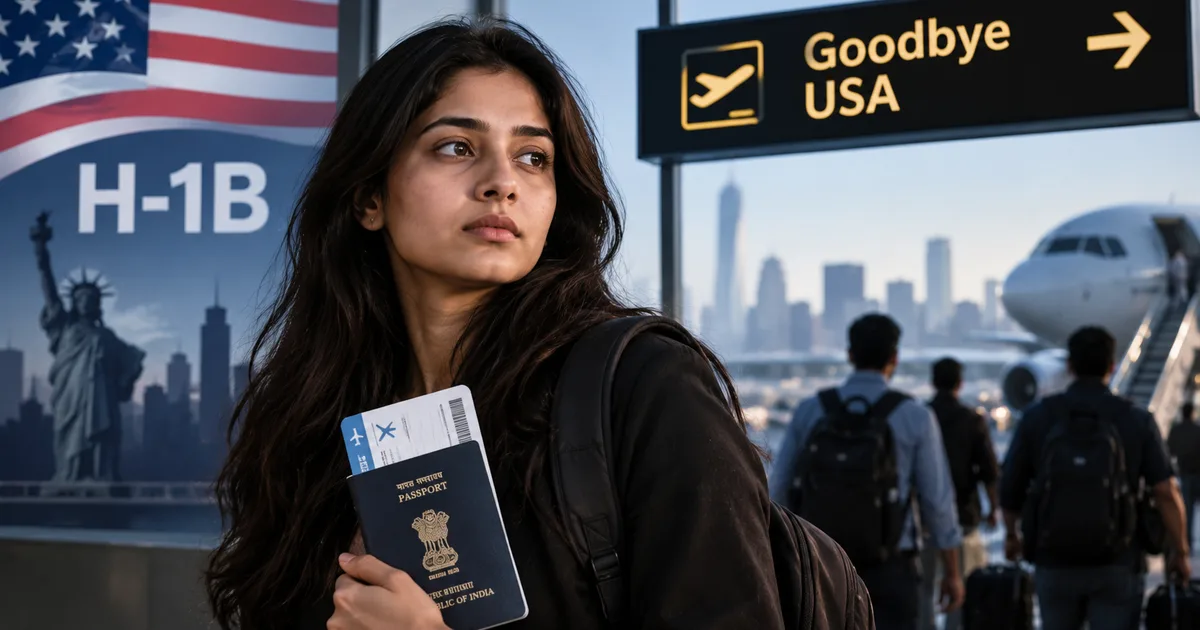
Disha Lamba had everything the typical Indian techie dreams about. A six-figure salary at CVS Health in New York and an H-1B visa her employer sponsored. She had built a life in one of the world's most expensive cities. But then, just two months after her H-1B was selected in the March 2026 lottery, she packed up and flew back to Gurugram. No job lined up. Just a decision.
Her story went viral across Hindustan Times, NDTV, Moneycontrol, and the Economic Times. It probably blew up because it hit something real. Thousands of Indian techies in the US are quietly doing the math on whether it's still worth it.
What actually happened with Disha Lamba
Disha was 28 and working as a data scientist. She had spent two years waiting for her H-1B to get picked in the lottery. When it finally happened in March 2026, she still chose to leave.
Look, her reasons were straightforward. She hated the loneliness and the restrictions the H-1B puts on your professional life. "The H-1B visa has its pros, but I wasn't okay with the cons," she told Moneycontrol. She also said she wanted to hug her parents. That's a massive deal when you're 9,500 km away and your parents are getting older (which makes sense, actually).
She didn't frame it as a failure. She framed it as a choice. And that choice signals a shift in how this generation of Indian tech workers thinks about the US.
What is the H-1B visa, and why does it feel like a trap?
Basically, the H-1B is a non-immigrant work visa that US companies use to hire skilled foreign workers. They mostly hire in tech and engineering. Indian nationals are by far the largest group of H-1B holders. In any given year, Indians make up over 70% of approved petitions.
Here's how it works in practice. Your employer sponsors you. If they stop sponsoring you through a layoff or your own decision to quit, you get 60 days to find a new H-1B sponsor. Otherwise you have to leave the country. You can't freelance or start a business. You can't even take a side client without risking your visa status. Your entire professional life is tied to one employer.
The lottery itself is a mess. USCIS got over 470,000 registrations for just 85,000 spots in the FY2026 cap. Most applicants wait years and apply multiple times without getting selected. I'm not sure exactly what the FY2027 lottery numbers are right now, but the demand definitely hasn't dropped.
And 2026 has made things worse. The policy environment around immigration in the US has tightened up a lot. We're seeing more scrutiny on H-1B applications and concerns about job displacement. If you ask me, things are getting pretty restrictive. You can read about how visa layoffs in 2026 are hitting Indian techies to see how this plays out in real life.
Why Andhra Pradesh's youth are already rethinking this
Disha's story isn't a one-off. A New Indian Express report from 2026 looked into why Andhra Pradesh's youth are rethinking the US dream. The state has historically sent huge numbers of students and workers to the US. Most of them take the H-1B route. But that pipeline is starting to look a bit sketchy.
Here are the reasons:
- H-1B restrictions mean you can't easily switch employers or explore entrepreneurship
- The cost of living in US tech hubs, particularly New York and the Bay Area, is genuinely brutal even on a six-figure salary
- Loneliness and distance from family hit harder than most people expect
- India's own tech sector has matured considerably, with Bengaluru, Hyderabad, Pune, and Gurugram offering competitive salaries and much lower costs of living
- The INR-to-USD gap matters less when your expenses in India are a fraction of what they'd be in New York
A Moneycontrol piece from around that time said more Indian techies are actively weighing these factors early on. They aren't waiting until they burn out in their US stints.
The math has changed
Let's talk rupees and reality for a second.
A senior data scientist at a mid-tier US company might earn $120,000 to $160,000 annually. You're taking home maybe $80,000 to $100,000 after federal and state taxes. New York has very high taxes (annoying, I know). Rent in Manhattan for a decent 1BHK can run $3,500 to $4,500 per month. Add health insurance and groceries, and the savings aren't nearly as dramatic as people assume.
In Gurugram or Bengaluru, a senior data scientist at a good company now earns anywhere from Rs 25 lakh to Rs 60 lakh per year. The cost of living is so much lower. You can actually build wealth.
You also have to factor in the emotional cost and the uncertainty of visa renewals. The political climate around immigration in the US is tough. You also can't do anything outside your job description without risking your visa status. Honestly, the calculus starts to shift when you add it all up.
The H-1B itself is becoming less stable
There's another factor that people rarely discuss. The US government in 2026 introduced a permanent visa bond programme. This adds financial and legal complexity to the whole immigration picture. You should really check out what the US Visa Bond Programme means for Indian students and H-1B techies if you are considering the US route.
The uncertainty applies to getting the visa and keeping it. Layoffs hit H-1B holders extremely hard because of that 60-day clock. In 2026, multiple rounds of tech layoffs hit companies that employ large numbers of Indian H-1B workers. A lot of people found themselves scrambling. Some found new sponsors. Others didn't. Our tech explainers section covers this broader landscape of immigration and job market shifts.
What's pulling people back to India
Disha mentioned wanting to hug her parents. That's real. It's probably the most honest thing said in all the coverage of her story.
But there are structural pull factors pushing this along:
- India's startup ecosystem has genuinely grown up. There are funded startups in every major city offering ESOPs and competitive compensation
- Remote work made the geographic barrier feel smaller during the pandemic, and a lot of people discovered they could do interesting work from home
- UPI and digital payments have made financial life in India much smoother than it was even five years ago, which matters when you're comparing the practical quality of daily life
- The ability to freelance, start a business, or consult without visa constraints is enormously freeing for people who are entrepreneurially inclined
- Family support, especially for those thinking about marriage or having children, is far more accessible in India
India has a massive advantage over the US because you can work for global companies remotely while living here. A data scientist at a Bengaluru office of a global firm can earn well and live comfortably. They don't have to worry about a 60-day window if their contract changes.
Is this a trend or just a few viral stories?
Honestly, it's both.
Individual stories like Disha's go viral purely because they're relatable. They aren't statistically representative. Most Indian techies who get H-1Bs don't leave voluntarily within two months. The visa is still super valuable to millions of applicants.
Thing is, there's a growing segment of younger workers in their late 20s and early 30s. They are more openly questioning whether the trade-offs are worth it. The Moneycontrol piece on why more Indian techies are leaving the US called this a structural shift in the industry.
And the broader context matters a lot. The US policy environment in 2026 has stricter immigration enforcement and concerns about AI replacing engineering roles that H-1B holders traditionally filled. The visa feels less like a golden ticket these days. In my experience, it feels more like a complicated contractual obligation. If you're wondering how AI job displacement is affecting H-1B holders specifically, check out the piece on H-1B AI engineer job losses and how Indian techies can upskill.
What this means if you're considering the US
This doesn't mean the US is a bad idea. It still makes sense for many people in specialised fields or early in their careers. The US has specific research opportunities that don't exist in India yet.
But you have to give the decision more honest scrutiny than it sometimes gets. Here are a few things to think through:
- What happens to your life and visa status if you get laid off?
- Are you okay with not being able to freelance or start something on the side for years?
- Have you actually done the savings math, accounting for US taxes and cost of living?
- What does your career look like in 5-10 years if you stay in India versus go to the US?
- How important is proximity to family to you, and how will that change as your parents age?
Disha Lamba answered these questions for herself and chose to come home. She's definitely not alone in making that call. People are going to keep talking about what success actually looks like for Indian tech professionals in 2026.
"The H-1B visa has its pros, but I wasn't okay with the cons" -- Disha Lamba, data scientist, speaking to Moneycontrol after returning to Gurugram in 2026.