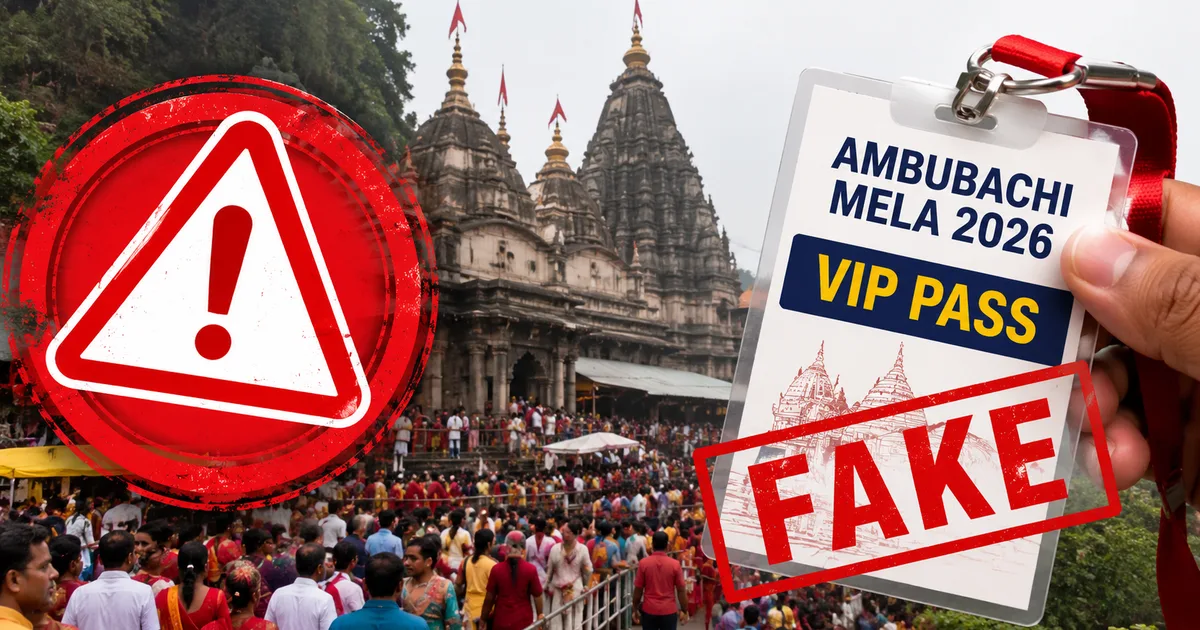
If someone has sent you a link to buy a VIP pass for Ambubachi Mela 2026 at Kamakhya Temple, stop. Don't click it. Don't pay anything. Because here's the thing, there are no VIP passes for Ambubachi Mela this year. Assam minister Jayanta Malla Baruah confirmed this publicly, and Kamrup Metro district administration has said the same. Yet scammers are out there selling "exclusive darshan passes" and "priority entry packages" to lakhs of devotees who are planning to visit Guwahati for one of the biggest Hindu festivals in the country.
Ambubachi Mela draws massive crowds. In recent years, over 8 lakh pilgrims showed up. If you ask me, it's just a prime target for online fraud. And this year, with the festival getting even more attention, these scams are already circulating on WhatsApp, Telegram, Facebook, and fake booking websites.
What the scam looks like
The setup's pretty straightforward. You get a text (usually forwarded on WhatsApp) saying something like: "Book your Kamakhya Temple VIP Darshan Pass for Ambubachi 2026. Skip the queue. Priority entry. Limited slots. Book now at ₹500, ₹1,000, ₹1,500, or ₹5,000."
In my experience, some versions are way more sophisticated. Sites like pikme.org have been offering "Ambubachi Mela VIP pass packages" with clean layouts, countdown timers, fancy graphics, and fake testimonials. The pricing is all over the place (which makes sense, actually). It ranges from a few hundred to a few thousand rupees depending on the tier of "VIP access" they're pretending to sell.
And the payment method? It's usually UPI. Or maybe a QR code. Sometimes they'll send a link to payment gateways that look totally real but aren't.
How the fraud actually works, step by step
- You get a WhatsApp forward or see a sponsored post on social media that sells VIP darshan passes for Ambubachi Mela 2026.
- The link leads to a site that looks semi-official, mostly with photos of the Kamakhya Temple and a convincing booking form.
- You fill in your name, phone number, email, and Aadhaar or DigiLocker details to verify.
- You pay via UPI, either by scanning a QR code or typing in a UPI ID.
- You get a PDF confirmation showing a fake QR code or a reference number.
- When you arrive at Nilachal Hill, they reject the pass. By then, the website is gone. The UPI number's dead. And your money is gone for good.
I've noticed some scams go even further. After getting your phone number and ID details, these fraudsters can call you back. They'll pretend to be temple staff or travel agents. They do this to get more money or bank details, using the excuse of fixing your booking issues.
What authorities have actually announced
If you ask me, this is the part that needs to be on every single devotee's phone screen before they start the journey.
There are no VIP passes for Ambubachi Mela 2026. Assam minister Jayanta Malla Baruah said this clearly. The Kamrup Metro administration has confirmed it. Right now, they're setting up 4 control rooms and planning massive crowd management. Entry to Kamakhya Temple during the festival is totally free. The administration manages everything, and no paid priority system exists at all.
Also, the administration says there won't be any food stalls or lodging on Nilachal Hill during the mela. None. So anyone trying to sell you a "VIP package" with food or accommodation on the hill is lying twice over.
No VIP passes are being issued for Ambubachi Mela 2026. Any website or individual selling such passes is engaged in fraud. (Kamrup Metro administration, official announcements, June 2026)
The Kamakhya Temple authorities have set up facilitation centres and guidance channels. Not a single one of them involves paid passes.
Warning signs to watch for
- Any message or website offering "VIP" or "priority" darshan at Ambubachi Mela 2026
- Payment requests via UPI, QR codes, bank accounts, or informal transfers for temple entry
- Websites with countdown timers and "limited slots" pressure tactics
- Forms asking for Aadhaar numbers, DigiLocker credentials, PAN cards, or bank details
- WhatsApp forwards with booking links, especially those asking you to share them further
- "Official-looking" PDFs with QR codes that promise temple entry
- Travel packages that claim to include guaranteed temple entry as part of a paid bundle
If you ask me, the tell is usually the urgency. Real temple entries don't run out. Also, real festivals don't ask for advance UPI payments to some random number. If someone's rushing you to pay now or lose your slot, that's just a scam.
How to protect yourself
First, verify everything through official channels only. The Kamakhya Temple doesn't have an official ticketing app or third-party booking partners for Ambubachi Mela. The Kamrup Metro district administration's official announcements are the only source of real info.
If you're planning a visit, check the official travel guides and government announcements instead of third-party travel sites. In my experience, several tour operators legitimately offer Guwahati travel packages, but none of them can guarantee priority darshan at Kamakhya. That's because no such system exists anyway.
Here are a few practical steps:
- Don't pay anyone for temple entry. Kamakhya Temple entry during Ambubachi is free. Full stop.
- Never share Aadhaar numbers, DigiLocker credentials, bank OTPs, or passwords with any website claiming to be a temple booking portal.
- If you've already clicked a sketchy link, change your UPI PIN immediately and check your bank statements.
- Screenshot and report any fake websites or WhatsApp messages.
- Warn family members, especially elders who might be planning their first visit, about this specific scam.
And if you're using a travel agent, ask them specifically: do they have an official tie-up with Kamakhya Temple administration? If they say yes, you should ask for proof. (They won't have any, because none exists.)
What to do if you've been scammed
If you've already paid for a fake Ambubachi Mela VIP pass, act fast. If you ask me, the sooner you report it, the better the chance of recovering your money (though I don't think the odds are great once UPI funds move).
- Call the National Cyber Crime Helpline: 1930 immediately
- File a complaint at cybercrime.gov.in with screenshots of the payment, the website, chat logs, and messages
- Contact your bank or UPI app (PhonePe, GPay, Paytm, or BHIM) to flag the transaction, since some platforms have fraud reversal processes
- File a local police complaint if the amount is significant
- Report the fraudulent website to CERT-In at cert-in.org.in, because they track and take down malicious Indian sites
Make sure you keep all evidence: screenshots of the booking page, payment confirmation, chat messages, and phone numbers involved. You'll need these when filing the complaint.
Why this scam works so well
I'm not sure exactly why, but Ambubachi Mela is one of those events where demand genuinely outstrips capacity. Hundreds of thousands of devotees head to Nilachal Hill. Queues can stretch for hours, and the emotional stakes are high, with people traveling from across India and waiting months for this. So when someone offers a quick shortcut, the temptation's very real.
Also, many pilgrims are first-time visitors who don't know the local temple administration structures and rely on WhatsApp forwards to plan their trip. Scammers know exactly who their targets are.
I think there's also a broader pattern here. We've seen similar fraud around IPL ticket scams, where fake passes circulate with celebrity endorsements and people pay ₹80,000 for complimentary passes that don't exist. The template is always the same. It's a high-demand event. There's fake scarcity. They demand urgent payment, and then they vanish.
You can read our explainer on how online ticket fraud works in India to get the full picture.
The bottom line
Ambubachi Mela 2026 at Kamakhya Temple is free to attend. There's no VIP passes, no priority darshan bookings, no special entry, and no official paid entry system. Anyone selling you one is just a fraud.
Share this with whoever in your family or friend circle's planning the visit. A two-minute talk now is worth way more than a 1930 helpline call from Guwahati after losing ₹2,000 to a fake QR code.
If you ask me, checking our latest news section is a good idea. We update it regularly as new fraud patterns emerge.