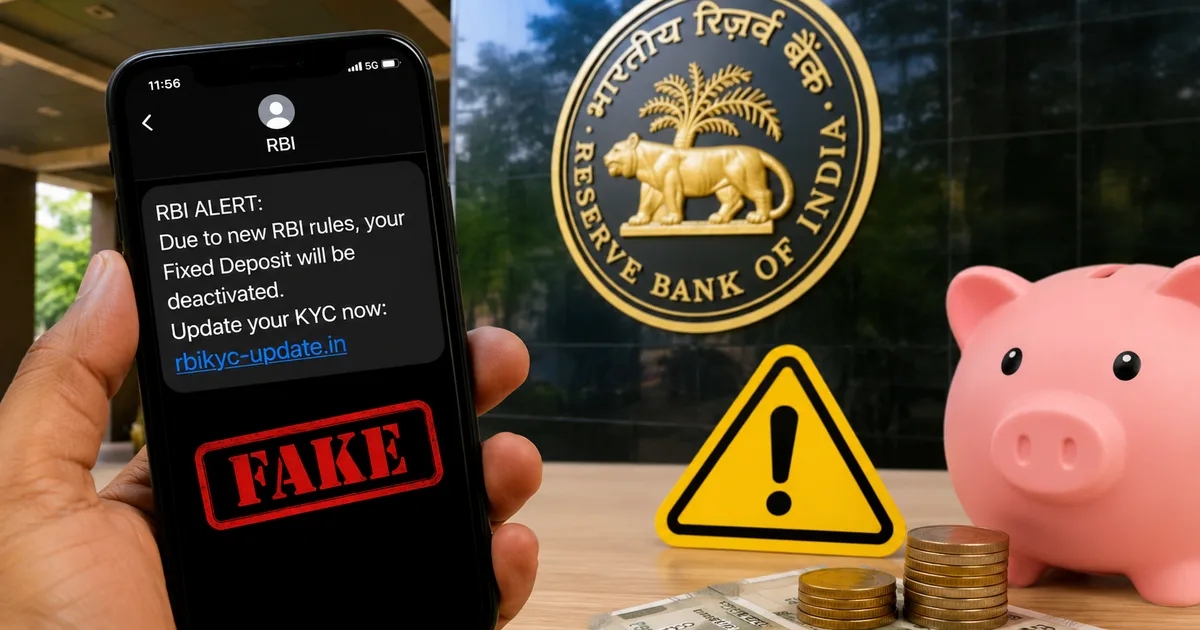
I got a message yesterday morning claiming my fixed deposit was going to be frozen. It looked official. It said the Reserve Bank of India had changed the rules and I needed to update my KYC immediately. Honestly, I panicked for a second. We all know how much of a nightmare dealing with blocked accounts can be in India. But then I looked closer. It was the Fake RBI Fixed Deposit Rule Changes KYC Update SMS Scam 2026. And it's spreading across India right now.
This scam is catching a lot of people off guard. You get an SMS. It looks urgent. It mentions new RBI guidelines for fixed deposits and dormant accounts.
The timing is pretty clever. People are already anxious about their money. Mostly because of recent news about the RBI returning unclaimed deposits and tightening rules on mule accounts.
Look, the RBI doesn't text you to update your KYC. That's just not how they operate. But scammers know exactly how to press our buttons. They use fear. And they use urgency. They basically weaponize our trust in institutions against us (which makes sense, actually, given how much we rely on the central bank).
Understanding the fake RBI KYC update SMS scam
This scam is built on a very simple premise. The fraudsters just want you to believe your savings are at risk. They send out thousands of SMS messages hoping a few people take the bait.
The message usually says something like: "Dear Customer, as per new RBI guidelines on Fixed Deposits, your account will be suspended today. Update your PAN/Aadhaar KYC immediately by clicking this link."
It sounds scary. And that's exactly what they want. You panic and stop thinking clearly. You just want to fix the problem fast so you can get on with your day.
Thing is, scammers pay attention to the news. The RBI recently pushed banks to return unclaimed deposits within three months. There was also news about the RBI taking action on fraud, stating customers could get up to Rs 25,000 compensation for small value frauds. Plus, there's a lot of chatter about the RBI tightening KYC checks because of a massive surge in mule accounts.
I'm not sure exactly why it works so well, but scammers take these real news events and twist them. They use the exact jargon. They mention the RBI. They make their fake messages seem like legitimate follow-ups to real policies. It's an effective tactic because the underlying news is totally real, even if the SMS is a complete mess.
I've seen similar scams before when we track these issues in our scam alerts section. The UPI fraud waves where people got tricked into sending money while trying to receive it. The fake electricity bill messages threatening to cut off power at 9 PM. This is just the latest variation. But in my experience, it's particularly dangerous because it targets fixed deposits. Those are often a family's primary safety net in India. Threatening that safety net makes people act impulsively.
How the 2026 fixed deposit KYC scam actually works
Understanding the exact mechanics of the scam is the best way to avoid falling for it. It follows a predictable pattern. I'll break it down so you know exactly what to watch out for.
First, you get the SMS. As I mentioned, it usually comes from a random 10-digit mobile number. It's almost never an official bank shortcode. But the sender name might be spoofed on older phones to look like a bank.
Next, the message tells you to click a link to update your KYC. This is the trap.
If you click the link, you end up on a fake website. This website is designed to look exactly like a real banking portal. Sometimes it looks like an official RBI page. They copy the logos perfectly. The colors match too. To the untrained eye, it looks completely convincing (annoying, I know).
Then, the fake website asks for your personal details. They might ask for your Aadhaar number or your PAN card details. They will definitely ask for your internet banking login credentials and your debit card number. They also want the expiry date and CVV.
Once you enter this information, the scammers have what they need to start a transaction. But they aren't done yet. They still need the final key.
The final step is the OTP. The scammers sit at their computers and use your details to start a transfer from your real bank account. Your bank then sends an OTP to your phone to authorize this transfer.
Meanwhile, the fake website prompts you to enter the OTP you just received. When you type that OTP on the fake site, the scammers grab it. They use it on the real banking portal. You're actually authorizing a transaction initiated by the scammers, thinking you're just verifying your KYC.
They drain your account before you even realize what happened.
It's a highly organized operation. They use the information you provide to bypass the security measures banks have in place. And since you handed over the OTP yourself, banks often argue that you authorized the transaction. That makes it incredibly difficult to get your money back. Fighting for a refund can take months. It involves endless paperwork.
Warning signs you should never ignore
You really need to know how to spot these fake messages instantly. There are always red flags if you know what to look for. Train yourself to recognize them. Here are the things to watch:
- The urgency trap: Real banks don't threaten to freeze your account in 24 hours via a random text message. They send formal letters, emails, and notifications within their secure apps. If an SMS creates a sudden sense of panic, it's almost certainly a scam.
- The sender ID: Official bank messages come from specific registered shortcodes, like VM-HDFCBK, AD-ICICIB, or similar formats mandated by TRAI. If the message comes from a standard 10-digit mobile number like +91 98765 43210, block it immediately. Banks don't use personal numbers for official communication.
- The sketchy link: Scammers use URL shorteners like bit.ly or slightly misspelled domain names to trick you. Instead of onlinesbi.com, it might be onlinesbi-update-kyc.in or rbi-kyc-verify.com. If the URL looks sketchy, complex, or doesn't exactly match your bank's known website, don't click it.
- The sloppy writing: Poor grammar and spelling are also common in these messages. Official communications are usually heavily proofread. If you spot glaring errors, weird capitalization, or unnatural phrasing, trust your instincts.
Also, just remember a fundamental fact. The RBI deals with banks. They don't deal with individual retail customers directly for KYC updates. The RBI will never send you an SMS asking you to update your details on a random website. Your specific bank handles your KYC. If you want to understand how banking regulations work, you can read our explainers on the topic.
I know it sounds obvious when you read it here in a calm environment. But when you're busy at work and suddenly get a message saying your savings are at risk, making a mistake is surprisingly easy. Scammers rely on you reacting before you think.
How to protect your hard-earned money
Taking a few basic everyday precautions can save you a massive amount of grief. Make these habits part of your digital life.
Never click on links in unsolicited SMS messages. Same goes for WhatsApp forwards. Just don't do it. If you get a message claiming there's an issue with your account, don't use the contact information or links provided in that message.
Instead, open your official banking app. The one you downloaded from the Google Play Store or Apple App Store. Or go directly to your bank's website by typing the address into your browser yourself. Check if there are any real notifications there. If you're still unsure, call your bank's official customer service number. You can find this authentic number on the back of your debit card, on your passbook, or on their official website.
Never share your OTP or PIN with anyone, not even someone claiming to be from your bank or the RBI. The Reserve Bank of India does not ask for personal details or OTPs over SMS or phone calls.
Keep your banking apps and your phone's operating system fully updated. Banks and phone manufacturers regularly release security patches to fix vulnerabilities. Make sure you use the latest versions to stay protected against known threats, as we often mention in our security guides.
Be careful about where you store your sensitive documents. Use verified platforms like DigiLocker for your Aadhaar and PAN cards. Don't keep unencrypted photos of them lying around in your phone's photo gallery. Any rogue app could potentially access them.
Honestly, the best defense is a healthy dose of skepticism. If something feels off, it probably is. Take a breath. Don't let anyone rush you into making a financial decision on your phone.
Where to report cyber fraud in India
If you realize you've been scammed, you need to act fast. Even if you just clicked the link and entered some details but stopped before the OTP, don't wait around. Time is literally money in these situations. The faster you act, the better your chances of stopping the fraud.
The absolute first thing you must do is contact your bank. Call their emergency hotline right away. Tell them exactly what happened. Ask them to freeze your account and block your internet banking access. They should also block any compromised debit or credit cards instantly. The sooner you report it, the better your chances of limiting the damage.
Then, you need to report the fraud to the authorities officially. The Indian government has a dedicated portal for exactly this purpose.
Go to cybercrime.gov.in and file a complaint immediately. This is the National Cyber Crime Reporting Portal. Provide all the details, including the SMS content, the phone number it came from, and the fake website URL if you have it.
You can also call the national cybercrime helpline at 1930. This number is active across India and is designed for reporting financial frauds. If you need help using the portal, you can find our reporting tools breakdown for more information.
Don't wait until the next morning. Don't wait until Monday. The faster you report the incident through these official channels, the higher the chance that the authorities and the banks can coordinate to freeze the fraudulent transaction. They need to catch it before the money is moved out of the banking system entirely.
It's also worth checking out the advisories from CERT-In. They regularly publish technical alerts and advice about new scams targeting Indian internet users. Staying informed is part of staying safe online.
Scammers are constantly adapting their tactics. They read the financial news just like we do. You can check our news coverage to see how quickly they adapt. When the RBI announces new rules or pushes banks to clean up dormant accounts, the scammers see a golden opportunity. They prey on our natural confusion about complex banking rules. And they feed on our fear of losing our money.
But you don't have to be a victim. By understanding how these scams actually work and knowing the specific warning signs, you can protect yourself. Talk to your parents about this. Talk to your friends too. Share this info. A lot of people in India are coming online for the first time and they're particularly vulnerable to these types of attacks.
We have to look out for each other and spread awareness. Because scammers certainly won't stop trying to steal our savings.