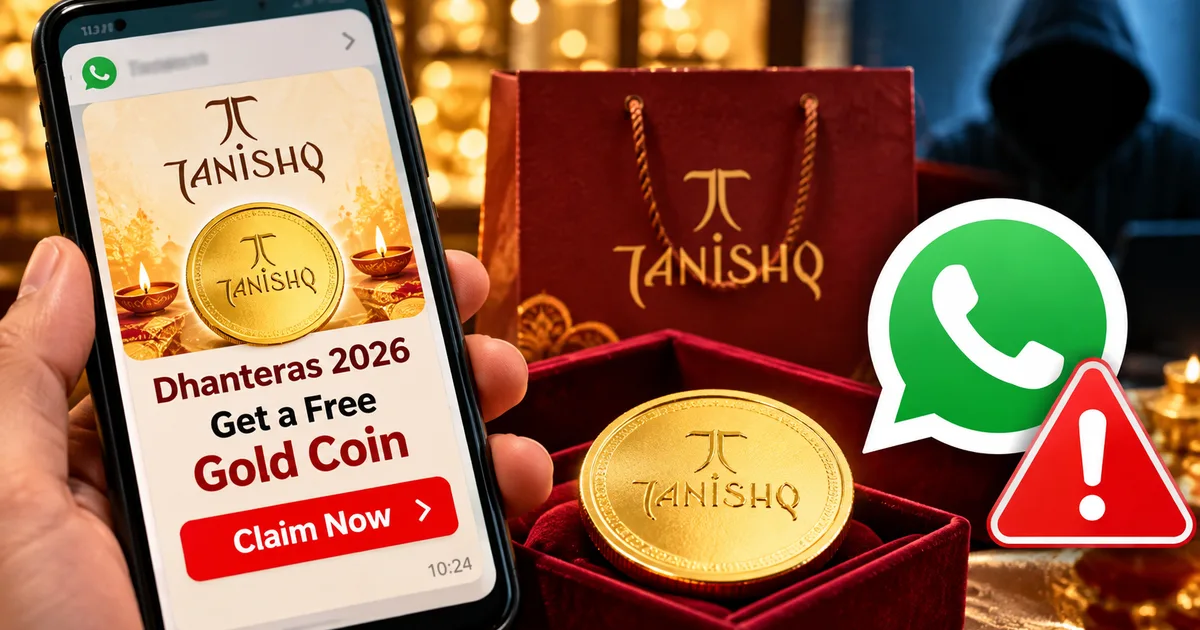
Every Dhanteras, my family WhatsApp group fills up with festival forwards and gold buying reminders. But this morning, an uncle sent something that made me drop my cup of tea: a message shouting that Tanishq is handing out a 1-gram 24K gold coin to celebrate the festival. It came with an urgent countdown timer and a sketchy web link. If you see this message landing on your phone, don't click it. The fake Tanishq Dhanteras 2026 free gold coin WhatsApp link scam is spreading across Indian chats, designed specifically to steal money from your bank account through fraudulent UPI requests and stolen phone data.
Gold prices in India are hovering near ₹80,000 for 10 grams this season. That puts a 1-gram coin at around ₹8,000 in cash. And honestly, nobody hands out ₹8,000 gifts to random strangers on the internet.
Thing is, people fall for it every single year. Festive shopping excitement clouds our judgment, and scammers know exactly which emotional buttons to press. If you ask me, trust is what scammers really exploit here. We saw similar tactics in our coverage of the fake LIC dividend cheque scam, where scammers used brand trust to fleece policyholders. Here, criminals borrow the name of Titan Company and its jewelry brand to pull off the exact same trick.
Vishvas News ran a fact-check on these viral Dhanteras giveaways and confirmed that Tanishq has zero connection to the WhatsApp links. Titan shares promotions only through official retail outlets and its main domain at tanishq.co.in (which makes sense, actually).
"Tanishq does not run WhatsApp viral chain giveaways or demand courier fees through third-party links. Any message promising free 24K gold coins for Dhanteras via unofficial web links is fraudulent." - Titan Company consumer advisory notice
What the fake Tanishq gold coin offer looks like
The message usually lands from someone you know, like a relative or a coworker. That's what makes it dangerous. When an aunt forwards a deal, your guard drops. You trust her. In my experience, most people don't even read the fine print before hitting forward.
Here's how the forwarded text usually reads:
"Tanishq Dhanteras Mahotsav 2026: Get a free 1-gram 24K gold coin on the auspicious occasion of Dhanteras! Titan is celebrating 30 years of trust with 10,000 free coins. Tap the link below to claim yours before stocks run out: tanishq-dhanteras-gift.top"
Notice that domain name. It says "tanishq-dhanteras-gift.top" or ends in something like ".xyz" or ".site". It's never tanishq.co.in. The message also includes a ticking clock or claims only 412 coins remain. I'm not sure why people still fall for this fake urgency, but that rush keeps you from taking two seconds to check Google and verify the claim.
How the fake Tanishq Dhanteras gold coin scam works
The trap unfolds in four distinct stages, each built to push you deeper into the con. I spent twenty minutes digging into the code on one of these spoofed pages (annoying work, honestly), and the setup is downright sneaky.
First, tapping the link opens a bright web page bathed in maroon and gold, complete with the Tanishq logo ripped straight from their advertising campaigns. You see a rotating wheel of fortune or three festive gift boxes waiting to be opened. You tap a box, and surprise: you win a 1-gram 24K gold coin on your second try. The site plays cheerful sounds and displays fake reviews from people in Pune and Jaipur claiming their gold arrived yesterday.
Next comes the viral loop. A pop-up informs you that your prize is reserved for exactly five minutes, but there's a catch. To unlock delivery, you have to share the link with 5 WhatsApp groups or 10 individual contacts. The page monitors your clicks. Every time you tap the green WhatsApp button, a progress bar creeps up from 20% to 100%. By the time you finish, you've turned into an unpaid promoter for cybercriminals and spammed your entire contact list.
Then comes the financial bite. Once the bar reaches 100%, the site asks for your shipping details, including your postal address and phone number. Then it hits you with another catch. The gold coin is free, but you have to pay a "mandatory courier insurance" or "Dhanteras GST handling charge" of ₹99 or ₹149.
That ₹99 feels harmless when you think you're getting an ₹8,000 coin. So you click to pay. The page redirects to a spoofed payment gateway mimicking PhonePe or Paytm, or prompts you to scan a dynamic QR code. That's where you hit a dangerous phishing link designed to capture your debit card details and net banking password. In other variants, the page sends a collect request on UPI. If you approve the request, money leaves your account instead of crediting anything.
Some nasty variants go even further. Instead of charging a small fee, the site prompts Android users to install an "exclusive delivery tracker" file ending in .apk. That file is malicious spyware. It reads your incoming SMS messages and steals your two-factor authentication codes, which lets fraudsters empty your savings account while you sleep.
Warning signs of a fake WhatsApp gold offer
Spotting these scams doesn't take a tech degree. Honestly, you just need to spot the common patterns that every festive phishing trick relies on.
- The link uses suspicious web domains ending in extensions like .xyz, .top, .live, or .buzz instead of the brand's verified website.
- The page forces you to forward the promotion to multiple WhatsApp chats before you can claim the reward.
- The promotion asks for upfront shipping fees, registration charges, or customs clearance payments via UPI.
- The message insists on immediate action with artificial timers showing only a few minutes or items remaining.
- The sender claims you won a contest or giveaway that you never entered in the first place.
- The website asks you to download an unknown application file or grant SMS permissions on your Android device.
Legitimate jewelry brands never ask you to spam your family members to get a discount or free gift. To be honest, if an offer forces you to chain-mail a link to five groups, it's a scam. Period.
What to do if you clicked the Tanishq Dhanteras fraud link
Look, if you tapped that link and realized the trap halfway through, don't panic. Your immediate steps depend on what you did on the scam page.
If you only opened the page and closed it without typing any information, you're safe. Just close the tab. Then open your browser settings and clear your cached cookies. Don't forward the message to anyone else. Delete the chat message from WhatsApp to prevent accidental clicks later.
If you shared your phone number and delivery address, expect a flood of spam calls and bogus courier delivery alerts over the coming weeks. Scammers sell these stolen databases on sketchy online forums. In my experience, the biggest headache is follow-up phishing. Stay on high alert for callers claiming to be from your bank or courier companies who ask you to install remote access tools.
If you made a payment or entered card details, act fast. Open your banking app right away and freeze your card. Call your bank's 24x7 support line to report unauthorized payment activity. If you approved a UPI request or suspect someone accessed your net banking, reset your UPI PIN and password from a secure phone immediately. We detailed similar recovery steps when examining the Bank of Baroda compensation link fraud earlier this month.
If you downloaded and installed an APK file, disconnect your phone from Wi-Fi and mobile data immediately. Restart your phone in safe mode. Find the downloaded file in your app settings and uninstall it. If the app refuses to delete or holds device administrator privileges, back up your photos and perform a complete factory reset (annoying, I know, but it beats letting malware siphon your bank balance).
How to report UPI cyber fraud in India
Speed is everything when money disappears from your bank account. In cybercrime investigations, the first two hours after a fraudulent transaction are known as the golden hour. If you report the incident during this window, banks and payment intermediaries can freeze the transferred funds before the scammer withdraws them at an ATM or converts them into crypto assets.
Here's how to report the incident step-by-step:
- Call the national cybercrime helpline at 1930 immediately. Keep your bank account number, transaction ID, and the scammer's UPI handle ready.
- File a formal complaint on the official National Cyber Crime Reporting Portal at cybercrime.gov.in. Upload screenshots of the WhatsApp chat, the fake web link, and your bank debit alert.
- Submit a written dispute form with your bank branch within 24 hours to secure protection under the Reserve Bank of India guidelines on unauthorized electronic banking transactions.
- Report the sender on WhatsApp by tapping their profile, scrolling to the bottom, and selecting Report Contact.
- Notify CERT-In through their official reporting channel at incident@cert-in.org.in if you encountered malicious Android software or coordinated phishing domains.
Indian cybersecurity agency CERT-In regularly issues advisories warning people against holiday phishing campaigns. I think scammers thrive on the festive rush simply because people are distracted and eager for seasonal discounts.
You can read more practical protection checklists across our scam alerts and safety guides to stay ahead of these festive traps. For broader device security, our step-by-step tech guides cover how to lock down your phone against malicious app installations.
Remember the golden rule of Indian digital payments: Never enter your UPI PIN to receive money or claim a reward. Entering your UPI PIN only ever does one thing: it takes money out of your account. Verify every forwarded offer directly on official brand websites. And tell your family groups to delete that fake Tanishq link immediately.