Yesterday, the National Testing Agency released the highly anticipated CUET UG 2026 scorecard for over 11.64 lakh students across India. While candidates rushed to the official NTA website, server lags quickly turned excitement into frustration. Unfortunately, online fraudsters were waiting for this exact moment. Within minutes of the announcement, WhatsApp groups and Telegram channels started filling up with fake CUET UG 2026 result links. If you clicked on one of these links expecting a quick score check, you might have compromised your phone or your bank balance. This isn't a drill. It's a coordinated phishing attack targeting anxious teenagers and their parents.
I saw three different messages in a single student group this morning. One promised a direct PDF download. Another offered a toppers list bypass. None of them were real. Students are desperate to know where they stand because college admissions depend on these marks. That panic makes you click first and think later. But doing that can lead to serious identity theft or UPI fraud.
According to official reports, the total number of candidates who appeared for the exam went up from 10,71,735 in 2025 to 11,64,098 in 2026. NTA released the scorecards on June 23, 2026. When over eleven lakh students try to load a single website, the server slows down. That's standard web traffic. But for a student whose college future is on the line, five minutes of a blank screen feels like a lifetime. Scammers exploit this window. They know you're stressed, and they know you'll click anything that looks like a shortcut.
The danger of WhatsApp and Telegram scams targeting students
Social media platforms are the main channels for these scams. WhatsApp and Telegram are particularly sketchy because of how they organize communities. A single Telegram channel can host tens of thousands of students. A WhatsApp community group can reach thousands. Scammers join these groups and drop messages that look highly official.
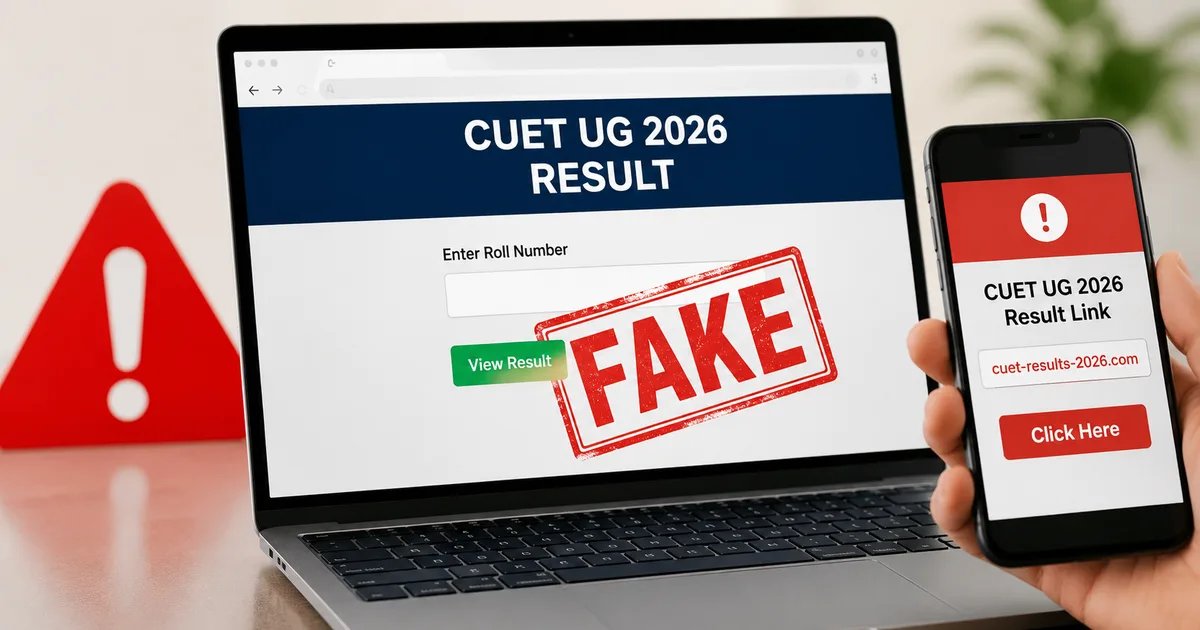
They use phrases that sound authentic. For example, they might post: 'CUET UG 2026 scorecard download link activated. Direct server 3 copy. Avoid the official site crash. Click here.' This message spreads fast. Students share it with classmates. Parents share it in family groups. Before you know it, a single malicious link has been clicked by thousands of people. Clicking these links can install malware on your phone or expose your private credentials.
How to spot fake CUET UG 2026 scorecard links
Spotting fake CUET UG 2026 result links isn't as hard as it seems. You just need to pay attention to the details. Scammers make mistakes, and if you know what to look for, you can spot the fraud in seconds.
First, look at the domain name. The official website for checking results is cuet.nta.nic.in. If the link you received points to cuet-nta-results.info, nta-scorecard-direct.com, or cuet-portal-2026.xyz, it's fake. Fraudsters buy cheap domain names that sound official. They use words like 'gov', 'nta', 'results', or 'exam' in the URL. But they can't buy a sub-domain on the official gov.in portal. If the URL doesn't end with .nic.in or .gov.in, stay away.
Second, check if they ask for money. The National Testing Agency doesn't charge any fee to view scorecards. If any site asks for a processing charge or a small fee of ten rupees via UPI, it's a scam. Scammers use tiny amounts because they know you won't hesitate. But when you pay, they capture your details or send you to a spoofed page that harvests your UPI PIN.
Third, look for download prompts. A real result is shown on screen, and you can save a standard PDF. You don't need to install an app. If a link prompts you to download an APK file or install a certificate, stop. These APKs run in the background and read your texts. This lets fraudsters intercept bank OTPs and drain your accounts.
Step-by-step breakdown of how the exam fraud works
To understand why this is dangerous, you need to understand how the scam actually works. It's a multi-step operation designed to exploit human psychology and technical loopholes.
Step 1: The initial broadcast
Scammers start by setting up fake profiles on Telegram and WhatsApp. They pretend to be teachers, coaching institute staff, or NTA officials. They join hundreds of student groups. The moment results are announced, they broadcast their messages. They use caps lock, bold text, and urgent warnings to grab attention. They claim the official site is permanently crashed and that their link is the only working alternative. This creates a false sense of urgency, pushing you to click without checking the URL.
Step 2: The copycat webpage
When you click the link, you're sent to a webpage on an anonymous server. The scammers have copied the exact code and layout of the official NTA portal. You see the logo of the National Testing Agency, the emblem of the Government of India, and links to other exam pages. It looks incredibly real (annoying, I know). The page asks you to input your application number, your password or date of birth, and your mobile number. Some advanced phishing pages even ask for your Aadhaar number for identity verification before showing the scorecard.
Step 3: The data harvest and the UPI trap
Once you submit your credentials, the site shows a loading screen. Then it demands a small fee of fifteen rupees to unlock the file. Fraudsters know you won't hesitate to pay such a tiny fee. But when you use their payment link, they capture your UPI PIN or send you to a spoofed page. In other cases, the page tells you to download an app to view the scorecard. This app is malware. Once installed, it reads your SMS messages and steals bank OTPs to drain your account.
Simple steps to protect your personal data and devices
Protecting yourself from these threats is about basic digital hygiene. You don't need to be a tech expert. You just need to follow a few simple rules.
First, always start from the official homepage. Never click a direct result link sent by someone on WhatsApp or Telegram. Instead, open your browser, type cuet.nta.nic.in in the address bar, and hit enter. Even if the page takes time to load, wait. It's better to wait an hour to see your marks than to lose your bank balance in minutes.
Second, use DigiLocker. The Government of India provides DigiLocker as a secure digital wallet for official documents. When NTA declares results, the scorecards are also uploaded there. Since DigiLocker is linked to your Aadhaar card and verified phone number, it's completely secure. You don't have to worry about phishing links or malicious portals. It's a safe and officially recognized way to get your academic documents.
Third, turn off automatic downloads in your messaging apps. Both Telegram and WhatsApp have settings that automatically download media and files. Go to your settings and turn this off. This prevents your phone from downloading malicious APK files in the background without your permission.
According to a recent cybersecurity advisory by CERT-In, students and parents should avoid downloading applications from third-party websites or untrusted links. Always use official app stores like Google Play Store or Apple App Store for downloading any software.
I'd recommend bookmarking the official National Testing Agency portal before results are declared. This way you always go to the correct URL. You can find more practical suggestions in our safety guides section.
Also, avoid forwarding unverified links in student groups. When you forward a link, other students trust it because it came from a classmate. If you see someone share a suspicious result link, warn the group immediately and report the message to the group administrator. You can find more updates on academic security in our latest exam updates.
What to do if you already entered details or paid money
If you've already fallen for a fake link, don't panic. First, if you installed an APK file or an app from a link, turn off your mobile data and Wi-Fi immediately to cut off the malware. Then go to settings, find your app list, and uninstall the suspicious software. Look for apps with generic names or no icons, as malware often hides this way. You can also restart your phone in safe mode or do a factory reset if you think the malware has deep system access.
If you entered your UPI PIN or banking details on a suspicious portal, call your bank's customer care immediately to block your accounts and UPI services. You can also block your UPI ID directly through your payment app. Change your UPI PIN on a secure device and check your transaction history for any unauthorized debits.
If you shared your CUET application number and password, log in to the official NTA website immediately and change your password. Check if your profile details, email address, or contact number have been changed. If you can't log in, contact the NTA helpdesk. You can learn about identifying other financial scams in our online frauds section.
Where to report online cyber fraud in India
Reporting these scams is important. It helps the police track down the fraudsters and stops other students from falling victim.
If you've lost money or faced identity theft, report the crime immediately on the National Cyber Crime Reporting Portal at cybercrime.gov.in. This portal is maintained by the Ministry of Home Affairs and lets you file a complaint online.
You can also dial the national cybercrime helpline number at 1930. This helpline is operational 24/7. If you call within the first few hours of a fraudulent transaction, the cyber cell can work with banks to freeze the funds before the scammers withdraw them.
For reporting fake government portals or malicious phishing links, you can email the Indian Computer Emergency Response Team at info@cert-in.org.in or visit their website at https://www.cert-in.org.in/. They have the authority to block fraudulent domains and take down phishing sites.
College admissions are stressful enough without worrying about online scams. Stick to official channels, protect your devices, and report anything suspicious. Stay safe.