Look, the Employees' Provident Fund Organisation (EPFO) has actually been doing some solid work lately. I don't say that often about government portals, but credit where it's due. They recently upgraded their systems so that advance withdrawals get settled in just three days. Fact is, about 71% of claims process that fast right now. The auto-claim limit even went up to Rs 5 lakh for certain withdrawals. They processed a record 11 lakh claims worth Rs 3,000 crore in a single day recently. That's incredible scale for an Indian government department.
But here's the deal. Scammers are watching whenever a government service gets faster and makes headlines. They read the exact same news we do. And they know millions of Indian employees are actively checking their claim status online. So they've launched a wave of fake EPFO auto processing claim status WhatsApp scams to steal your money.
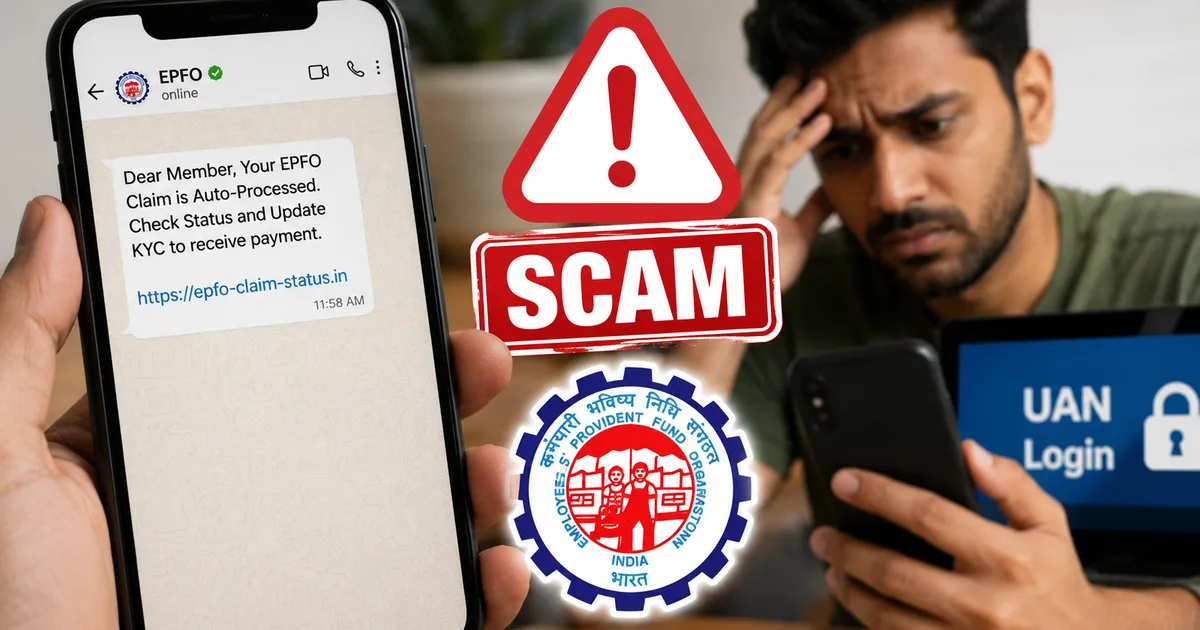
And honestly, it's pretty convincing. I saw one of these messages last week forwarded in a family group (which, for the record, is where half these scams spread). It looked incredibly official. It had the EPFO logo and government emblems. There was a message about a pending Rs 85,000 claim transfer.
I'll break down exactly how this fraud operates. You'll see why the new speed of the system actually works against you if you aren't careful. And you'll learn why you need to protect your UAN login at all costs.
The new EPFO 3-day claim settlement brings bad actors
Right now, the EPFO is moving serious money. The new system handles auto-settlements for things like medical emergencies or education advances without manual human checks for amounts up to Rs 5 lakh. They're also moving to a centralized database. They are even rolling out auto-settlements for inoperative accounts with balances up to Rs 1,000. All of these upgrades mean the system is more automated than ever before.
Many people face real delays because of the massive system upgrades. Scammers exploit this exact frustration. You are highly vulnerable when you wait desperately for a claim to clear and get a message offering a fast track solution. I'm not sure exactly why it works so well, but it does.
They weaponize this exact news. You'll get a WhatsApp message from an unknown number. It might even have a profile picture of the EPFO building in Delhi. Or maybe it has the G20 logo. The message usually says something like: "Dear Member, Your EPF auto claim of Rs 85,000 is on hold due to pending KYC. Please verify your UAN login details to process the 3-day settlement."
Thing is, the EPFO will never send you a WhatsApp message asking you to log in. They just don't do that. They send SMS alerts from official sender IDs like 'EPFOHO' when a claim is processed. They definitely aren't chatting with you on WhatsApp about pending approvals.
The scammers bet that desperation will make you click first and think later. This message feels like a godsend if you actually applied for a PF withdrawal. You think that's why the money hasn't hit your HDFC account yet. And you click.
How the fake EPFO WhatsApp scam works step by step
It starts with manufactured urgency. The message will tell you that your auto-processing claim will be cancelled in 24 hours if you don't act. Or they say your account will be frozen. They want you to panic. Panic stops you from looking at the URL.
Here's the exact playbook they run:
- You receive a message with a link that looks something like epfo-claim-status-gov.in or uan-kyc-update.com. Sometimes they skip the link and just send an APK file disguised as a "New EPFO Status Tracker" app.
- If you click the link, it takes you to a fake website. I mean a perfect clone. It looks exactly like the real Member e-Sewa portal. It has the same blue color scheme, the same fonts, and it asks for your UAN, password, and even has a fake CAPTCHA to make it look secure.
- Once you type those details in, you hit submit. The page might just load endlessly or show an error. The scammers now have your UAN and password on their end.
- They still need an OTP to actually log into the real EPFO portal and make changes. The fake site will prompt you for the OTP sent to your Aadhaar-linked mobile number, claiming it's for final verification.
- You enter the 6-digit OTP thinking you're verifying your claim. The scammers use it to access your real account on the actual EPFO portal. They immediately change your bank account details and initiate a massive withdrawal.
It's even worse if they send an APK file instead of a link. These fake apps install malware on your Android phone. The malware can read your SMS messages directly. You won't even know they intercepted your OTP. CERT-In has been warning about these sketchy Android apps for months. They hide in the background and read your bank OTPs before forwarding them to the scammers. Sometimes these apps disguise themselves as government utilities like DigiLocker.
The trap of stealing your UAN login and password
Your UAN is basically the master key to your provident fund. It is a big deal. If someone gets your UAN and password and manages to trick you out of an OTP, they have full control over the money you've saved for decades.
I've seen cases where people lost years of savings because they clicked a link while riding the metro in a hurry. The scammers log in and update the KYC details. They link their own dummy bank accounts. Then they submit a fake illness claim. Because the system is fast now, the money gets cleared and transferred out before the victim even realizes what happened.
The balance is zero by the time you check your real UMANG app next month.
Think about how devastating that is. You work for twenty years to build up a safety net. Some guy sitting in a cyber cafe in Jamtara drains it because of one fake WhatsApp message. Honestly, it's a mess.
Warning signs you're dealing with a scammer
You can spot this scam from a mile away if you know what to look for. Here are the biggest red flags you should never ignore:
- Official government communication happens via SMS from verified sender IDs. It doesn't come from personal 10-digit mobile numbers on WhatsApp. If you get a government alert from a number starting with +92 or some random international code, block it immediately.
- The real website is unifiedportal-mem.epfindia.gov.in. Anything else is a trap. That applies even if it sounds official or has "epf" or "uan" in the name.
- If someone sends you an Android app file over WhatsApp to check your claim faster, it's absolutely malware. The only official apps you should ever trust for government services are UMANG and DigiLocker. You download those directly from the Google Play Store or Apple App Store. Never install an APK from a chat. This will compromise your entire phone.
- Scammers always create a false sense of urgency. They say "Verify now or lose your money" or "Account suspended in 2 hours." The real EPFO doesn't work on 24-hour ultimatums for pending claims. Government processes might be slow, but they don't threaten you with instant cancellation via WhatsApp.
How to protect your PF money from WhatsApp fraud
Protecting yourself isn't actually that complicated. It just requires a healthy dose of suspicion whenever someone talks about your money online. You have to treat your UAN like your ATM PIN.
Never click on links you get on WhatsApp about your EPF or bank accounts. Just don't do it. Open your browser and type in the official EPFO website yourself if you want to check your balance. Or better yet, just use the official UMANG app.
Never share your UAN password or any OTP with anyone. Not on a phone call claiming to be from the EPFO Delhi Head Office. And definitely not on a random website you clicked through from a text message.
Keep your mobile number updated in your Aadhaar and EPF accounts. That way, you actually get the real SMS alerts if someone tries to log in. Your UAN is heavily linked with your Aadhaar (which makes sense, actually). A compromise here can lead to a mess. Your EPF balance might just be the start of your problems if a scammer intercepts your OTPs.
The Employees' Provident Fund Organisation never asks for UAN passwords, OTPs, or bank details over phone calls, SMS, or WhatsApp. Any message requesting these details is fraudulent and should be ignored.
Regularly check your PF balance and your KYC details. Raise an alarm immediately if you see a bank account linked to your UAN that you don't recognize.
What to do if you clicked the link
You need to move fast if you realize you accidentally clicked a fake link and entered your UAN details. Like, right now. Stop reading and act.
Go to the official EPFO member portal immediately and change your password. The scammers might've already changed it if you can't log in.
You need to report this immediately. Call the national cybercrime helpline at 1930 immediately. This is the fastest way to get authorities involved. It can help freeze any unauthorized transfers before the money hits the scammer's bank account.
Next, file a formal complaint on the official portal at cybercrime.gov.in. Give them screenshots of the WhatsApp message and the 10-digit number it came from. The more details you provide, the better chance the police have of tracking them down.
You should also alert your bank. Tell them your Aadhaar-linked number might be compromised. This is especially true if you downloaded an APK file. Turn on airplane mode immediately to cut off their connection if you installed an unknown app. Delete the app. Honestly, a factory reset of your phone is the safest bet to clear out any hidden malware. You don't want to mess around with apps that can read your OTPs.
We've got plenty of guides on how to secure your Android phone if you suspect it has malware. We also have other scam alerts to keep you updated on the latest threats targeting Indian users. You can also read our explainers about how the new EPFO auto-claims actually work.
Look, the faster claims process is genuinely a good thing for all of us. Getting your own money when you need it shouldn't take months. But we have to be smarter than the thieves trying to steal it. The scammers are getting better at faking official communication. Stay alert. Trust nothing on WhatsApp and keep your UAN details to yourself. Your retirement fund depends on it.