I need to talk to you about something that is blowing up my phone right now. Everyone wants to know when the new merged Reliance and Disney streaming platform is actually launching. We all saw the news, and honestly, the anticipation makes sense. But there is a massive problem happening while we wait for the official release. Criminals are running a fake JioHotstar early access APK scam across the country. If you get a WhatsApp message offering a link to download this app early, you need to delete it immediately. It is not a real app. It is a straight-up trap designed to wipe your bank account.
Look, I get it. We all love getting things before anyone else. But you have to be smarter than this. The official app is still in development. Reliance is actively hiring people to build it right now. They are not quietly handing out test versions through random Telegram groups or forwarded messages. This is a critical security threat that is stealing real money from regular people.
The context behind the chaos
To understand why this scam works so well, you have to look at the news. The merger between Reliance's Viacom18 and Disney's Star India is one of the biggest media events in Indian history. People are expecting a single app that combines cricket, HBO shows, Disney movies, and local daily soaps. That is a very attractive product.
On top of that, there is drama. A Delhi-based app developer bought the JioHotstar domain name and demanded Rs 1 crore from Reliance to hand it over. The developer even alleged they received legal threats from the company. All of this noise keeps the brand name in the news cycle. Scammers read the news too. They see a trending topic and they immediately build a trap around it. They know millions of Indian internet users are searching for cheap ways to access their favorite shows, so they give them exactly what they are looking for.
Why Indian users are prime targets
We have to talk about why this is happening here. India has seen a massive explosion in digital payments over the last few years. UPI is incredible. It makes life so much easier. But it also means that our phones are direct conduits to our bank accounts. In the past, a scammer had to convince you to go to a bank branch or an ATM. Now, they just need you to tap a screen a few times.
Furthermore, our mobile data is incredibly cheap. Everyone is online, and everyone consumes huge amounts of video content on their phones. We are a mobile-first country. So when a highly anticipated entertainment app is announced, the demand is off the charts. Scammers exploit this combination of high digital payment adoption and massive entertainment consumption. They cast a wide net on WhatsApp, knowing that even if only one percent of people click the link, they will still make a fortune.
What the early access scam actually is
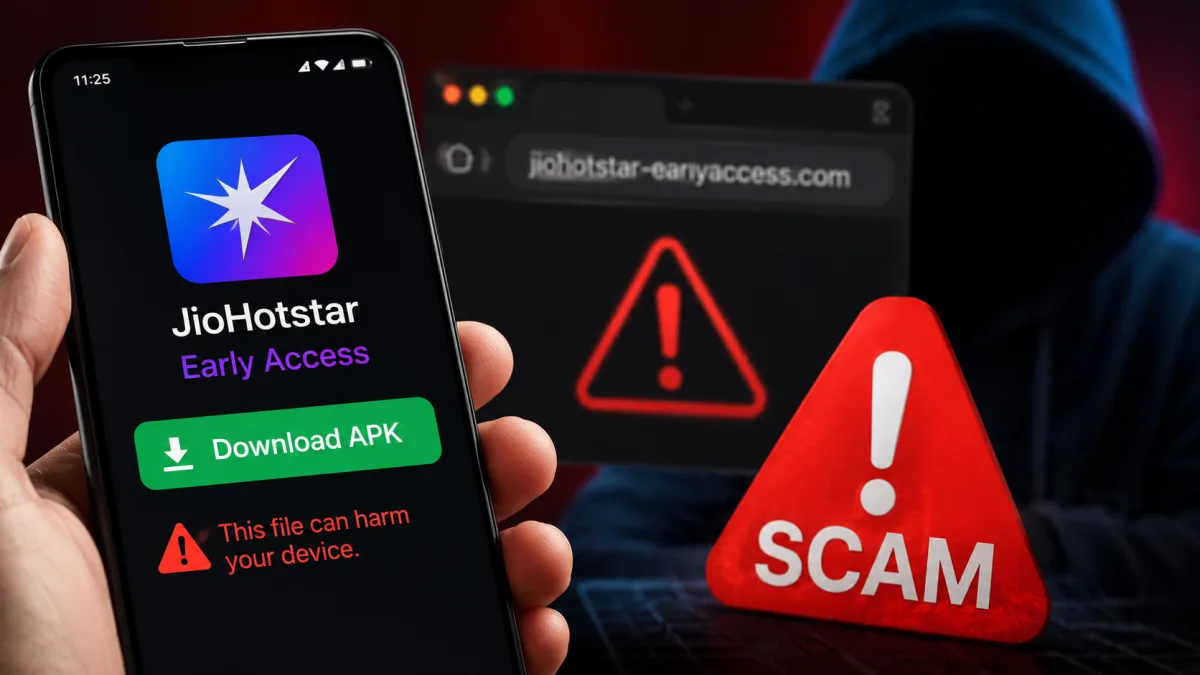
This is a classic bait-and-switch operation. Scammers know we are used to sideloading apps when something isn't available on the Google Play Store. So they create a package that looks incredibly tempting and spread it where you already spend your time.
Often, the bait involves a ridiculous price point. You might see messages offering a combo of Netflix, Prime Video, and JioHotstar for something like Rs 299. It sounds too good to be true. And obviously, it is. They send you a link to download an APK file. For anyone who doesn't know, an APK is just the installation file format for Android apps.
The scammers wrap their malicious code in a package that has the official logos. They might even use a name like "JioHotstar_Beta_V1.apk" to make it look legitimate. But this file has absolutely nothing to do with any official company. It is malware designed by professional thieves.
How this fraud works step by step
I want to walk you through exactly what happens if you actually click that link. This is the part where things go from bad to worse very quickly.
- The initial contact: You receive a message from an unknown number on WhatsApp, or maybe even from a friend whose account was compromised. The message hypes up the new app and includes a shortened link.
- The download page: If you click the link, it takes you to a webpage that looks surprisingly professional. It probably has fake reviews and convincing graphics. You tap the download button, and an APK file saves to your phone.
- The installation: Your Android phone will likely warn you about installing apps from unknown sources. This is a standard security feature. The scammers include instructions in their message telling you to ignore this warning and bypass your phone's security.
- The permission grab: This is the fatal mistake. When you open the fake app, it asks for a bunch of permissions. It wants access to your SMS messages, your contacts, and your phone calls. Most people just click "Allow" without reading.
- The quiet theft: The app might show you a fake login screen or just crash. You think it's just a buggy beta version. Meanwhile, it is silently reading your incoming SMS messages in the background. When you try to log into your actual bank app or use UPI, the scammers intercept your OTPs and empty your account.
The screen sharing trick
Another popular method scammers use involves convincing you to download a screen-sharing app like AnyDesk or TeamViewer. They will call you pretending to be customer support for the streaming service, claiming there is a problem with your account setup. They say they can fix it remotely if you just download a simple support app.
Once you install it and give them the access code, they can see everything on your screen. They will ask you to open your banking app to verify a small refund or a verification charge. They watch you type in your PIN. Then, while they still have control of your screen, they initiate a massive transfer and approve it themselves. Never install a screen-sharing app at the request of a stranger. Legitimate companies will never ask you to do this.
The fake customer care angle
Sometimes the scammers add another layer to this mess. The fake app might display an error saying your account is blocked. It provides a "customer care" number to call for help. When you dial that number, a very polite person speaking Hindi or English answers the phone.
They pretend to be a technical support agent. They tell you they need to verify your identity to unlock your account. They might ask for your Aadhaar number, your debit card details, or tell you to open an email. Once they have that access, they can authorize transactions directly from your device. It is a highly organized operation.
I have seen reports where victims lost upwards of fifty thousand rupees in a matter of minutes. The thieves work incredibly fast once they have access to your text messages. You can read our detailed guides on how banking trojans operate, but the short version is that they bypass the two-factor authentication that is supposed to keep you safe.
Warning signs you cannot ignore
You need to train yourself to spot these red flags. The government's cybersecurity agency, CERT-In, constantly warns about these exact tactics.
"Cybercriminals are constantly adapting their methods, but the core strategy relies on urgency and fear. Always verify links before clicking," advises a recent advisory from CERT-In.
- Unsolicited links: If a stranger sends you a link to download an app, it is a scam. Period. Real companies do not distribute software this way.
- Urgency and scarcity: The messages always claim the offer is only valid for 24 hours, or only available to the first 1000 users. They want you to panic and click before you think.
- Weird permissions: A video streaming app does not need access to your SMS inbox or your microphone to function. If an app asks for unrelated permissions, uninstall it immediately.
- Spelling errors: Pay attention to the URLs. You might see things like "jiohotstarr-offer.com" or "jio-hot-star-apk.in". These slight misspellings are dead giveaways.
How to protect yourself from malicious APKs
Honestly, keeping yourself safe is not that complicated. It just requires a little bit of discipline and common sense. You do not need to be a tech genius to avoid getting robbed.
First of all, never download Android apps from outside the Google Play Store unless you are an advanced user who completely understands the risks. The Play Store is not perfect, but Google does scan apps for malware. Sideloading random APKs from WhatsApp is basically playing Russian roulette with your finances.
Second, turn off the setting that allows your phone to install unknown apps. Just go to your phone's settings, search for "Install unknown apps," and make sure it is disabled for all your browsers and messaging apps.
Third, be extremely skeptical of cheap OTT subscriptions. Right now, Netflix and Prime Video cost what they cost. Reliance will announce their official pricing for the new merged platform when they are ready. If someone is offering you thousands of rupees worth of content for Rs 299, they are lying to you. They are hoping your desire for a cheap movie ticket blinds you to the massive security risk.
Check out our explainers on how UPI works to understand why protecting your SMS access is so important. Your phone number is basically your digital identity now. If someone else can read your texts, they can pretend to be you.
What to do if you clicked the link
Let's say you made a mistake. You clicked the link, you downloaded the file, and you installed it. Don't panic, but you need to act fast.
Put your phone in airplane mode immediately. This cuts off the internet connection and stops the app from sending your data back to the scammers.
Go into your settings and uninstall the fake app. Do not just delete the shortcut from your home screen. You need to completely remove it from your device. You might even want to factory reset your phone just to be completely sure.
Then, call your bank from a different phone. Tell them you suspect your device has been compromised and ask them to temporarily freeze your account and block your UPI ID. This is a pain to deal with later, but it is much better than losing your savings.
Where to report cyber fraud in India
If you actually lost money, you have to report it. Do not feel embarrassed. These scammers are professionals and they trick thousands of people every day.
Dial 1930 immediately. This is the national cybercrime helpline run by the Ministry of Home Affairs. The faster you call, the higher the chance they can freeze the fraudulent transaction before the money leaves the banking system.
You should also file a detailed complaint on the official government portal at cybercrime.gov.in. Keep all your evidence. Take screenshots of the WhatsApp messages, the fake website, and any bank transaction alerts.
Read our other scam alerts to see what else criminals are trying right now. We have covered everything from fake KYC updates to electricity bill frauds. The tactics are often very similar.
The reality of the JioHotstar launch
We all need to be patient. Building a massive streaming platform takes time. The company is dealing with legal issues over domain names and hiring engineering teams to build the infrastructure. They have their hands full.
When the real app is ready, you will know. It will be plastered all over the news. There will be massive advertising campaigns. You will simply go to the Play Store or the App Store and download it like any normal application.
Until then, anything claiming to be an early access version is a lie. Share this information with your family groups. Warn your parents and your older relatives who might not understand how APK files work. The best defense against these frauds is just talking about them. Keep your guard up, stick to the official app stores, and keep your money safe.