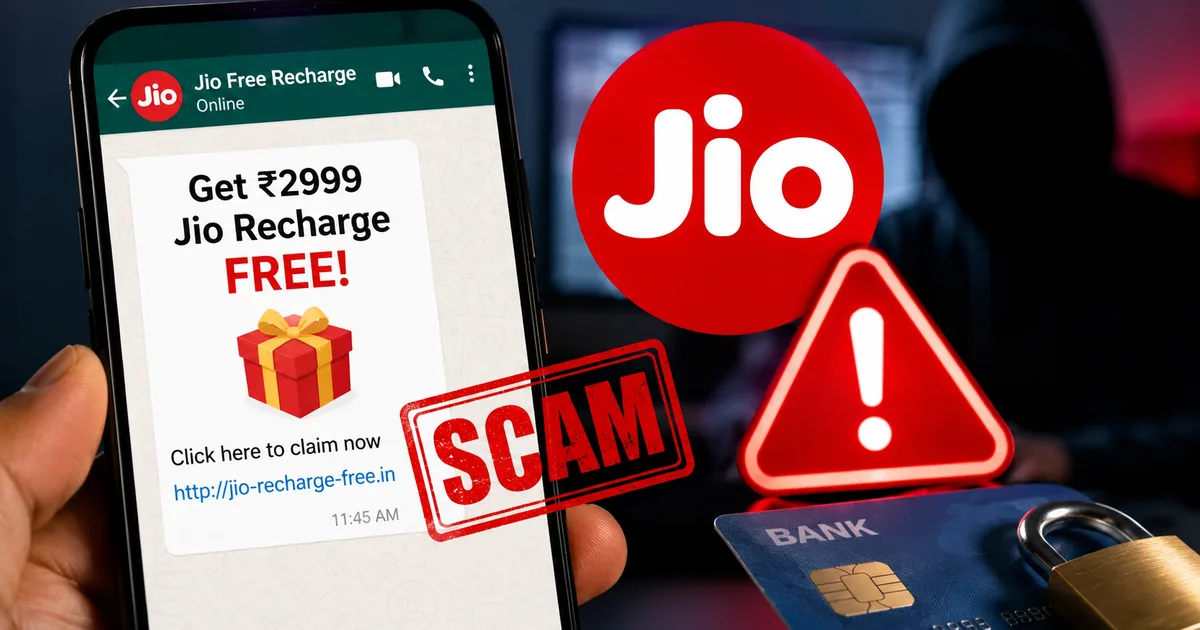
I got three messages from different family groups this morning about the exact same thing. You've probably seen it too on your phone. It's the fake Jio free recharge WhatsApp scam 2026 doing the rounds right now, and it's spreading like absolute wildfire. The message claims that because of the recent Ambani wedding, or sometimes they blame it on a brand new government telecom scheme, Reliance Jio is giving away three months of free recharge to absolutely everyone in the country. Honestly, it sounds great on paper. With grocery prices and daily expenses going up everywhere across India, who wouldn't want a nice break on their monthly phone bill?
But here's the deal. It's a complete lie. There is no free recharge waiting for you. If you click that blue link in the message, you aren't getting three months of free internet data. You aren't getting unlimited voice calling. You are basically handing your bank account keys directly to a scammer sitting in a room hundreds of miles away. I know people really want this to be real, and if you ask me, I'd love a free recharge too (data is expensive, actually). But falling for this cheap trick can cost you everything in your bank account. And I'm not exaggerating even a little bit.
What exactly is the fake Jio free recharge scam?
Scams like this usually pop up around major national events or big corporate news. The year 2026 is turning out to be no different at all. We are seeing a massive spike in these scam messages across Indian WhatsApp networks. They are targeting millions of unsuspecting users from small towns to big metros. The scammers behind these operations are smart. They know that throwing the Ambani name or mentioning a government initiative into a forwarded message makes it seem legitimate to ordinary people. They craft a message that looks extremely urgent to force you into acting quickly without thinking. Usually, the text says something like, "Offer valid only for today!" or "Only 10,000 free recharges left, click fast!"
They want you to panic just a little bit. They want you to think you're missing out on a massive freebie if you don't tap that link right this second. This is not a minor annoyance. This is a highly organized crime targeting everyday Indians who just want to save a few hundred rupees on their monthly expenses. Our friends over at the cyber security explainers desk have been tracking variations of this specific scam since last year. But I think the 2026 versions are a complete mess and much harder to spot.
"There is absolutely no official announcement from Reliance Jio, the telecom ministry, or the Indian Government regarding any nationwide free 3-month recharge scheme for all users. Do not click random links promising free mobile plans."
The entire goal of this operation is simple. They want to steal your hard-earned money. They aren't doing this by hacking Jio's secure servers, which is almost impossible. Instead, they're tricking you into giving them complete access to your smartphone and your sensitive UPI PIN.
How this WhatsApp fraud actually works
Here's exactly what happens, step by step, when that sketchy message lands on your phone. You really need to understand the mechanics of this scam so you can easily spot it the next time it appears in your inbox.
The bait arrives on WhatsApp
You get a forward from an uncle or a random neighborhood group. It almost always has a prominent blue link sitting at the bottom of the text. The URL often looks slightly weird if you look closely. It definitely won't be the official jio.com. It might be something strange like jio-free-offer-2026.xyz or recharge-jio-vip.com. Thing is, most people scrolling on their phones don't read the URL carefully (we're all guilty of this). They just see the blue text, the promise of three months of unlimited 5G data, and they tap it without a second thought.
The fake website trap
You click the link and it opens a website on your browser. It looks exactly like the real Reliance Jio app or their official website. They literally steal the official logos and exact colors. I've personally looked at a few of these fake sites recently. In my experience, they're getting terrifyingly good at copying the real thing. To an untrained eye, it looks completely genuine. The page usually asks you to enter your 10-digit Indian mobile number to check your offer eligibility.
The malicious app or fake payment gateway
This is where the trap snaps shut. It gets nasty. Depending on which version of the scam you've stumbled into, one of two dangerous things happens next.
Sometimes, the fake site asks you to download a small APK file to claim your recharge and activate the plan. Never, ever do this. If you install that third-party app, you're installing vicious malware directly onto your personal device. This malware runs hidden in the background and can read your incoming SMS messages. This means it can silently read your private banking OTPs before you even see them. It can track your screen taps. It basically owns your phone and relays all your secrets back to the scammer's server. I'm not sure exactly why phone operating systems still allow this so easily, but they do.
Other times, the site takes a different route. It'll say you're eligible for the free plan, but you just need to pay a tiny processing fee or activation charge of just 2 rupees or 5 rupees. They then redirect you to what looks exactly like a standard UPI payment page. You see the small amount and think it's harmless. So you enter your secret 6-digit UPI PIN. But that page isn't actually sending 5 rupees to Jio at all. It is a completely fake screen recording your PIN keystrokes. Within minutes, they use your stolen PIN to initiate a massive transfer. Your bank account is drained. Thousands, sometimes lakhs of rupees, are gone just like that in the blink of an eye.
Major warning signs you shouldn't ignore
You have to be completely paranoid about clicking links these days. It's exhausting, I know, but I think it is literally the only way to keep your money safe in this digital age. Here are the absolute red flags for this specific fake Jio free recharge WhatsApp scam 2026 that you need to memorize.
- The URL looks completely wrong. Always look at the link address before you even think about clicking. If it's not exactly jio.com or myjio.com, it's a fake. A dot in the wrong place, a weird spelling like jiiio.com, or strange extensions like .xyz are dead giveaways that you're dealing with criminals.
- The message has a Forwarded many times label. WhatsApp intentionally adds this double-arrow label at the top for a reason. If a message has been forwarded that much across the network, be highly suspicious. Real, official offers come directly from the company's verified app notifications or an official SMS sender ID, not from random forwards spreading through family groups.
- They ask for any kind of processing fee. Think about it for a second. A free recharge is supposed to be free. If anyone asks you to pay even 1 single rupee to get something that's advertised as free, run away. That's always, without exception, a scam.
- They push you to download an app outside the Play Store. If the random link tells you to download an APK file directly from their web page instead of the official store, stop immediately. Legitimate telecom apps are always found securely on the Google Play Store or Apple App Store.
- Grammar and spelling mistakes in the text. While the scammers are getting better at formatting, a lot of these fraudulent messages still contain weird phrasing, bad grammar, or obvious spelling mistakes. Official corporate promotional messages are usually checked thoroughly by marketing teams before going out to millions of people.
How to protect yourself and your family
I spend half my time explaining these exact concepts to my own parents and relatives. So I totally get how frustrating it can be to teach digital safety. You can't just tell people to never click links because sometimes we actually need to click links for work or school. But we can absolutely be much smarter about it. If you want more general advice on this subject, check out our recent guides on securing your smartphone from modern threats.
First and foremost, never enter your UPI PIN to receive money or gifts. Your UPI PIN is only used for sending money from your account. Period. There are no exceptions to this rule. If any website or app says to enter your PIN to receive a recharge, they're lying straight to your face. They are actively trying to take your money.
Second, verify absolutely everything yourself. If you see a message about a massive new Jio offer, don't trust the WhatsApp forward. Close WhatsApp and open your MyJio app directly on your phone. Go to their official verified Twitter or Facebook page. If there really is a massive three-month free recharge for the Ambani wedding celebrations, trust me, it will be plastered all over the front page of their official app and every major news channel. If it's not prominently displayed there, it simply doesn't exist.
Third, you need to turn off the setting that allows installing unknown apps in your Android phone right now. Go to Settings, search for Security, find Install unknown apps, and make sure absolutely no browser like Chrome or app like WhatsApp has permission to install APKs without explicitly asking you first (annoying, I know, but completely necessary). This one simple setting change can save you from a huge amount of devastating malware.
Finally, sit down and talk to your family members. The scammers specifically target older people and those who aren't super tech-savvy. Warn them clearly about the fake Jio free recharge WhatsApp scam 2026. Show them this article. Tell them exactly what warning signs to look out for before they touch their screens.
What to do if you clicked the link or lost money
Look, we're all human and mistakes happen. Scammers are ruthless professional criminals. It is their full-time day job to figure out new ways to trick you. If you realize you've accidentally clicked a bad link or entered your banking details, don't panic. But if you ask me, you need to move incredibly fast to limit the damage.
If you downloaded a suspicious app, put your phone in Airplane mode immediately to completely cut off the internet connection. Go to your device settings and thoroughly uninstall the app you just downloaded. If you can't find it, or you're still worried it is hiding, a full factory reset of your phone is the absolute safest option to clear the malware. Just make sure to back up your important photos first.
If you entered your UPI PIN or bank details, call your bank's emergency fraud line right this very second. Don't wait even five minutes. Tell them your account details are compromised. Ask them to freeze your bank account temporarily. You can also quickly block your UPI ID yourself through your banking app or by going into your GPay or PhonePe security settings.
Where to report the scam immediately
Reporting the fraud actually helps everyone. It helps the authorities track the criminals and take down these fake websites faster. I strongly suggest checking the regular public alerts from CERT-In, the Indian government's official cybersecurity agency. They regularly post detailed warnings about these exact phishing campaigns.
If you've actually lost money from your account, you need to file a formal legal complaint immediately. Don't rely on local police stations alone. They might not have the cyber expertise. You must use the national cybercrime portals set up by the government.
- Pick up the phone and call the national cybercrime financial fraud helpline at 1930 immediately. The faster you call this number, the higher the chance they have to freeze the fraudulent transaction before the scammers withdraw the cash from their mule accounts.
- File a detailed, written complaint at the official Indian government portal at cybercrime.gov.in. Make absolutely sure you have taken clear screenshots of the original WhatsApp message, the fake website, the phone numbers involved, and any transaction deduction messages from your bank.
It's a wild digital jungle out there right now. Vicious scams like this fake Jio free recharge WhatsApp scam 2026 are going to keep coming back in different forms every few months. Tomorrow it might be an Airtel offer or a fake Diwali festival gift. The names and excuses change. But the core trick to steal your money is always exactly the same. Stay highly skeptical of everything you receive. Don't click weird links sent by relatives. Keep your UPI PIN entirely to yourself. And please, tell your uncle to stop forwarding these unverified messages in the family group chat. The numbers here are a bit fuzzy, but we have more than enough scams in India to deal with already without spreading them ourselves.