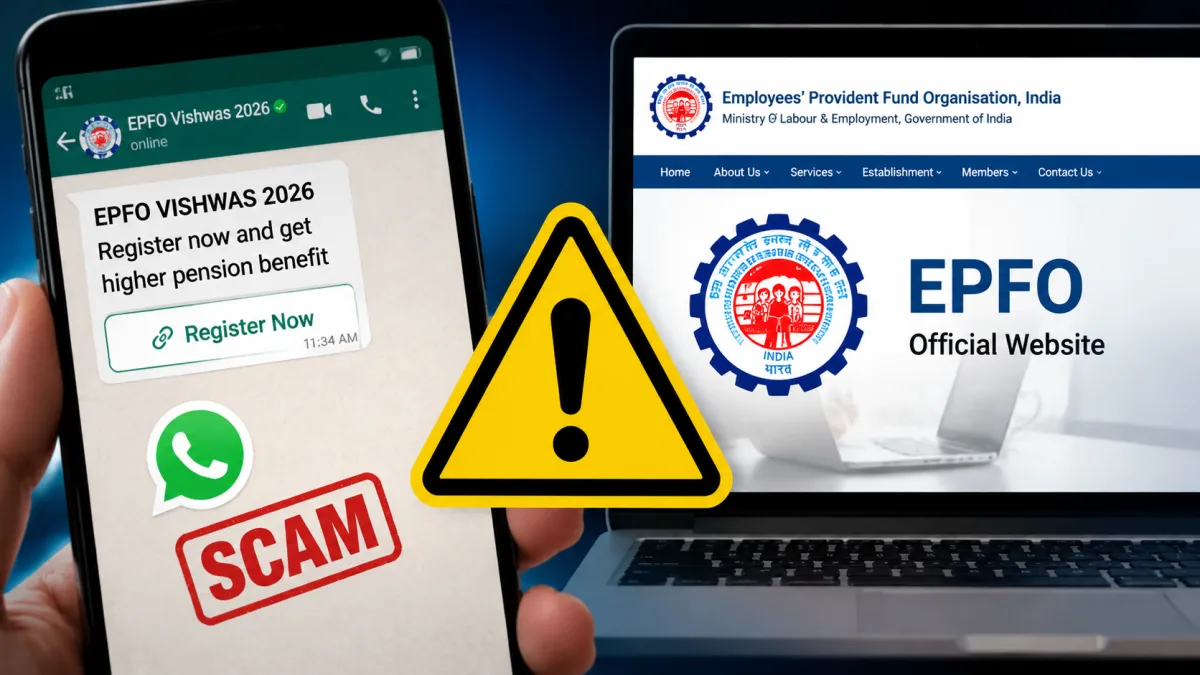
So, you just got a WhatsApp message about the new EPF scheme, and it sounds urgent. The fake EPFO Vishwas 2026 scheme registration WhatsApp scam is currently making the rounds, and it's specifically designed to drain your hard-earned Provident Fund. Look, I get it. The government actually did launch a real Vishwas 2026 scheme recently for dispute settlement. It's a genuine initiative meant to run for six months. But cybercriminals are twisting this real news into a highly effective trap. They know you care about your PF balance. They know you want to resolve any disputes quickly. And they're using that exact anxiety to steal your money.
Honestly, your Provident Fund is probably your biggest financial safety net. For most of us working in India, it's the money we count on for emergencies, buying a house, or retiring. It is years of deductions from your salary, built up over decades. Losing it because of a careless tap on a WhatsApp link is a nightmare scenario. But that's exactly what's happening right now across the country (which makes sense, actually, given how tricky these scammers are). I keep seeing stories of people waking up to find their accounts completely emptied. All because they thought they were following a mandatory government process.
I've been tracking these financial frauds for a while. In my experience, the sophistication is getting worse. You might have read about the Pune cyber scam cases crossing Rs 3.8 crore recently. Scammers are using trust and fear to break down your defenses. The Vishwas 2026 name is the perfect cover of official trust. Let me break down exactly what this scam is, how the hackers operate, why it tricks people, and what you need to do today to protect your retirement savings.
Why hackers are targeting your EPF account specifically
Your bank account usually has a daily transaction limit. Your UPI app has restrictions. But your EPF account often holds a massive lump sum. For a lot of salaried professionals in India, the PF balance runs into lakhs. Hackers know this fact well. They also know most people rarely check their EPF balance. We only look at it when switching jobs or planning to withdraw. This lack of daily monitoring gives criminals a huge window of opportunity. They can drain the account. And you might not notice for months.
The government digitized the EPF process to help honest citizens claim their money. You can now do almost everything online without visiting a physical office. The problem is that hackers exploit this exact convenience. They're using the same digital infrastructure designed to help you to steal from you. It's a mess. This is why you've got to be extremely paranoid about your UAN and passwords.
What is the fake EPFO Vishwas 2026 scheme registration WhatsApp scam?
Basically, hackers are weaponizing real government news. The Employees' Provident Fund Organisation (EPFO) did introduce a Vishwas 2026 scheme. It is meant to help employees and employers settle disputes faster. But the real scheme doesn't require you to click a random link on WhatsApp to claim your benefits.
The scam starts with a seemingly official message. It usually has the EPFO logo as the profile picture. The message claims your PF account has a pending dispute. Or it says you need to register for the Vishwas scheme immediately to prevent your account from being frozen. It's a classic phishing tactic, but tailored specifically for the Indian working class.
The hackers send a link. It looks remarkably similar to the official EPFiGMS portal or the main member e-Sewa portal. If you're stressed, you won't notice the slight misspelling in the URL. You think you're securing your account. Instead, you're handing over the keys to your life savings. And let me be clear about something. The EPFO will never threaten to freeze your account via a WhatsApp broadcast. They just don't operate that way. If you want to understand how these tactics evolved, we've covered similar tactics in our latest scam alerts.
The real Vishwas 2026 scheme vs. the WhatsApp trap
You might be wondering, what exactly is the real scheme? The EPFO did launch Vishwas 2026. It is a genuine dispute resolution setup for long-pending issues between employers and employees. If a company hasn't deposited PF dues correctly, this scheme is a window for settlement. It is operational for six months.
But here's the massive difference. The real scheme is handled entirely through the official EPFO portals and physical offices. You don't register for it through a random form sent on a messaging app (annoying, I know, but that's how government things work). Employers are primarily the ones dealing with the technicalities of this settlement process.
Scammers just took the name Vishwas 2026 because it was trending in the news. They know if you search for the term online, you'll see real news articles confirming the scheme exists. This confirmation bias makes you drop your guard. You think that because you read about it in the paper, the link must be real. You click the sketchy link, and the trap snaps shut. It's a vicious strategy.
How this EPF fraud actually works (step by step)
You need to know the mechanics of this theft. It isn't magic. It's just a very well-executed digital con. Here's exactly how hackers go from sending a message to stealing your PF funds.
Step 1: The urgent WhatsApp message
You receive a message in English or your regional language. It talks about the mandatory Vishwas 2026 registration. It might even quote real news snippets about the scheme being launched for six months to make it look authentic. Hackers watch the news just like we do. When the government announces something new, they immediately draft fake messages around it. The message includes a link. It might look something like epfindia-vishwas-gov.in or a shortened bit.ly link. To the untrained eye, it looks perfectly normal. You're busy at work. You glance at your phone. You see the EPFO logo and you just react.
Step 2: The fake portal
You tap the link. The page that loads is a near-perfect clone of the real EPFO member portal. The blue and white color scheme and the layout all look right. The page asks for your Universal Account Number (UAN) and your password. It even has a standard CAPTCHA. They've copied the HTML of the real site completely.
Step 3: The data theft
You type in your UAN and password. The moment you hit submit, the hackers have your credentials. But they need one more thing to access your account. They need the OTP sent to your Aadhaar-linked mobile number. So, the fake website prompts you to enter the OTP you just received. The OTP you just received was triggered by the hackers trying to log into the real EPFO portal using your UAN and password. When you type that OTP into the fake site, you give them the final key.
Step 4: The account takeover and drain
Once they're in, they move incredibly fast. They access your member profile. If your KYC isn't fully locked down, they'll attempt to change your bank account details. Sometimes they manage to compromise your phone through a malicious app. This is very similar to the SBI mobile number change frauds we saw recently. Criminals update the registered information to steal funds.
Once the bank account is changed to an account they control, they submit an online PF withdrawal claim. They might claim an advance for illness or marriage, since those rules were relaxed recently. Since EPFO claims are processed much faster now, the money leaves your PF account. It lands in the scammer's bank account before you even realize you've been robbed. I'm not sure exactly why the banks can't stop these transfers faster, but they don't. Scammers use mule accounts to quickly withdraw the cash from ATMs. Or they transfer it through a web of UPI transactions until it becomes untraceable. By the time you try to check your balance on the official Umang app, the money is gone.
Warning signs you should never ignore
I can't stress this enough. Awareness is your only real defense. Technical security measures fail when human psychology is hacked. Here are the red flags you need to watch out for.
- Never trust unsolicited WhatsApp links. The government of India and the EPFO don't use WhatsApp to send you account registration links. They might send informational text messages via SMS. They won't force you to click a link to keep your account active. If you get a link on WhatsApp, assume it's a trap.
- Check the URL carefully. The only official websites you should ever use for PF matters are epfindia.gov.in and the official Umang application. Scammers buy domains that look very similar. Take a few seconds to actually read the web address in your browser bar before typing anything.
- Stop entering your UAN and OTP on third-party sites. Always type the official website address into your browser manually. If you rely on a link sent by someone else, you're basically handing over your credentials.
- Ignore artificial urgency. Messages that claim your account will be suspended in 24 hours if you don't act are always scams. Government departments don't issue 24-hour ultimatums for scheme registrations. If a message tells you to hurry up, you need to slow down.
- Don't download security apps from random links. Sometimes the scam link asks you to download an application to complete the Vishwas registration. This is a tactic to install malware on your phone. This gives hackers complete control over your SMS inbox and OTPs. We've covered this extensively in our remote access trojan explainer if you want more details.
How to protect your hard-earned money
Look, staying safe isn't about becoming a cybersecurity expert. It's about slowing down and applying basic common sense. Here's your action plan.
First, lock down your UAN. Treat your UAN password with the same secrecy as your ATM PIN. Don't save it in plain text on your phone. If you've clicked a suspicious link recently, go to the official EPF member portal immediately and change your password. Use a strong password with a mix of characters.
Second, monitor your SMS alerts obsessively. The EPFO sends SMS alerts when a login happens or a claim is initiated. If you get an SMS about a claim you didn't make, you need to act instantly. Don't ignore it thinking it's a system glitch. Pick up the phone and call your HR department or the EPFO helpdesk.
Third, keep your Aadhaar details secure. Since your PF is linked to Aadhaar, securing one secures the other. Use the official UIDAI website to lock your Aadhaar biometrics if you don't use them frequently. You can unlock them temporarily when you need to authenticate something. This one step stops a massive percentage of identity theft dead in its tracks.
Fourth, rely strictly on official apps. If you want to check your balance or track a claim, use the official Umang app or DigiLocker. Don't rely on random websites you find through Google searches. Hackers often buy search ads to place their fake websites at the very top of the results. You search for EPFO balance check and the first link you click is a trap. Always use the government apps.
CERT-In, the Indian Computer Emergency Response Team, regularly issues advisories about phishing campaigns targeting government services. You should get into the habit of checking their updates. They've repeatedly warned about threat actors cloning government websites to steal credentials. You can read more about safe digital practices in our security best practices guide.
Also, talk to your parents and older relatives. They're the prime targets for these kinds of scams. They hear about the Vishwas 2026 scheme on the news. They get a message about it and they assume it's official. Sit down with them. Explain that government departments don't send WhatsApp links for registration. Tell them to call you before they tap on anything related to money or government IDs.
CERT-In regularly issues advisories about phishing campaigns targeting government services. You must develop a habit of verifying every single link before clicking, especially when it concerns financial portals.
Where to report this PF scam immediately
If you realize you've fallen for this, you can't afford to wait. Your response time dictates whether you get your money back.
1. Call 1930 right now: This is the National Cyber Crime Reporting Portal helpline. Dial it immediately. If the money has just been transferred, the authorities can sometimes freeze the scammer's bank account before they withdraw the cash. Speed is your only advantage here. Don't wait for the next morning.
2. Report online at cybercrime.gov.in: Go to the official portal at cybercrime.gov.in. File a complete complaint. You will need screenshots of the WhatsApp message and the fraudulent link. The portal is designed to track these organized crime syndicates. Your report helps them build a case.
3. Contact your bank and EPFO: Call your bank immediately to freeze your account so the hackers can't drain anything else. Then, raise a grievance on the official EPFiGMS portal. Try to reach the EPFO regional office physically if possible to block the fraudulent claim. The faster you inform them your account is compromised, the better your chances of stopping the withdrawal.
The sad truth is that recovering stolen PF money is incredibly difficult. The numbers here are a bit fuzzy, but the recovery rate is very low. The banking system is designed to disburse funds quickly. Reversing fraudulent transfers across multiple mule accounts and UPI wallets is a huge problem for law enforcement. Your absolute best defense is prevention. Don't let a moment of panic cost you years of hard work. Share this information. Tell your colleagues. And the next time a mandatory government scheme pops up in your WhatsApp chats, just delete it. We also have a dedicated news section covering similar ongoing frauds, so stay updated and stay paranoid.