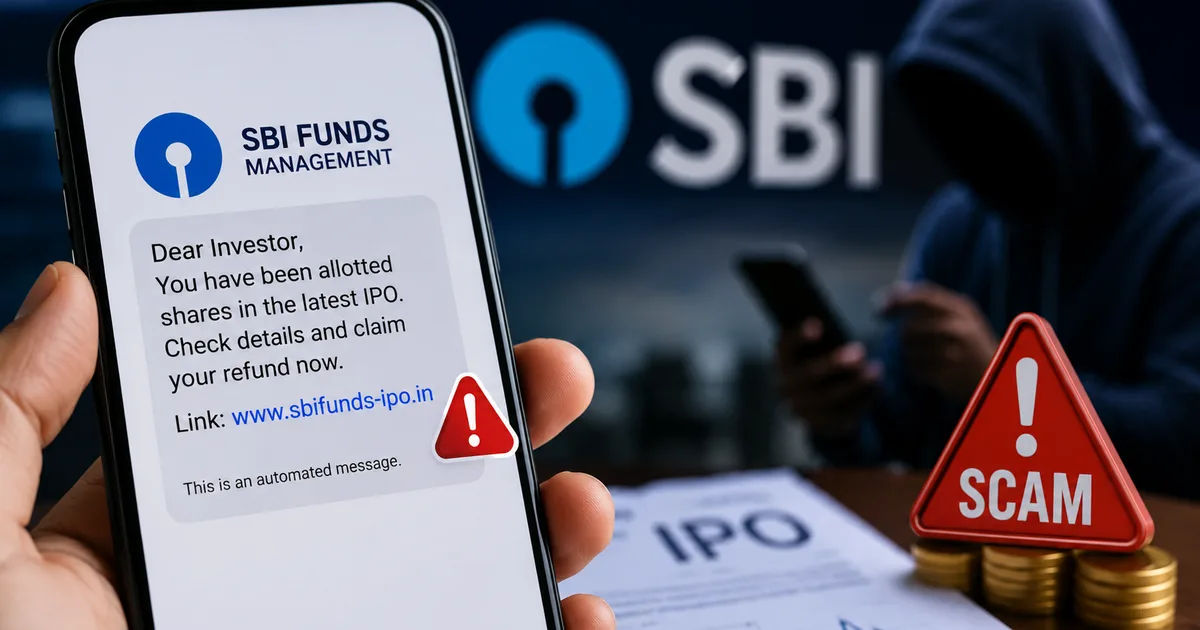
Look, I get it. We've all been refreshing our screens waiting for that one message. The SBI Funds Management IPO was massive. It was subscribed nearly 42 times on day 3, with everyone trying to get a piece of the action. The grey market premium is hovering around Rs 97, suggesting a sweet 17% listing premium. So when your phone buzzes with an SMS saying you've got shares, your heart skips a beat. You want it to be true. But before you click anything, stop. There is a massive Fake SBI Funds Management IPO Allotment SMS Scam 2026 making the rounds right now. And it's completely emptying bank accounts across India faster than you can say UPI pin.
I've been tracking online frauds for a while now, and honestly, this one is pretty nasty. These scammers aren't just blasting random spam into the void. They're highly targeted. They know the IPO timeline perfectly well, and they prey directly on our fear of missing out. In my experience, cybercriminals work serious overtime whenever there's a highly anticipated financial event in India.
What exactly is this fake IPO allotment scam?
Here's the deal. You get a text message that looks incredibly official, usually carrying a sender ID like VK-SBIFND or AD-IPOBSE. That little detail alone tricks your brain into trusting it. The message claims your IPO application was successful. Then it asks you to click a link to complete the payment or verify your demat account details.
Thing is, that's not how SEBI rules actually work. We have a solid system in India called ASBA, or Application Supported by Blocked Amount (which makes a lot of sense, honestly). When you apply for an IPO, your funds are just blocked in your bank account. They aren't deducted until the allotment is final. And if you don't get the shares? The block is simply removed. There's absolutely no reason to make a fresh payment. But in the heat of the moment, people totally forget this basic fact.
These guys are pretty sophisticated. They build landing pages that look exactly like the BSE or official registrars like KFin Tech. They even plaster fake SBI logos everywhere, complete with tiny copyright notices at the bottom to make the whole thing look legit. Basically, it's a complete trap to steal your money.
How the SBI Funds Management SMS fraud actually works
I want you to understand exactly how they operate so you don't fall for it. It's not magic, and it's mostly just manipulation.
The bait and the database
It always starts with an SMS or maybe a WhatsApp message. The timing is super precise. Usually it drops right around the official allotment date. But how do they get your number? I'm not exactly sure about the full pipeline, but they definitely buy databases of retail investors from the dark web. Sometimes these leaks come from third-party marketing agencies or sketchy brokers. So if you applied for an IPO recently or just opened a new demat account, your number is probably on their list. They blast these out by the thousands. They know a few people will be anxious enough to click.
The malicious link
The message contains a shortened URL. It might look like a bit.ly link, or something slightly misspelled like sbi-allotment-update.in. If you tap it, you aren't taken to a real website. You're taken to a phishing site controlled entirely by the scammers. These sites are often hosted on cheap overseas servers. That makes them really hard for Indian authorities to shut down quickly.
The fake gateway and data harvesting
Once you're on the site, they ask for your PAN number or bank details to verify your identity. Many people enter this without thinking because we're just so used to providing our PAN for every single financial transaction. But what you're actually doing is handing over the keys to your financial identity. They can use this PAN and Aadhaar data later on for fake loan scams or to bypass security questions.
After you type those details in, the site suddenly claims there's a technical error with your ASBA mandate. It says your bank rejected the block. Then it tells you to authorize a small payment of Rs 10 or Rs 50 to unblock the shares manually.
The UPI trap
This is where it gets incredibly dangerous. They redirect you to a fake payment gateway or ask you to scan a QR code using your GPay app. When you enter your UPI PIN, you aren't sending 10 rupees. They use dynamic QR codes to modify the exact amount on the backend. Suddenly, Rs 50,000 or even a full lakh is wiped from your account.
Sometimes they don't even ask for a UPI payment. Instead, the site prompts you to download a verification app. That app is actually a malicious APK file. Once installed, this app hides on your phone (annoying, I know). Then it reads your incoming SMS and silently forwards your bank OTPs to the scammers. Before you even realize what's happening, they've logged into your net banking and drained your accounts. I spoke to a guy last week who lost Rs 45,000 to a similar fake trading app. It seriously happens in seconds.
Warning signs you shouldn't ignore
Honestly, you need to be a little paranoid when it comes to your money. If you see any of these red flags, just delete the message immediately.
- A demand for money or a new mandate. I can't stress this enough. Legitimate allotments never ask you to pay more money or approve a new UPI mandate after the bidding closes. The amount is already blocked. If someone is asking for money now, they're robbing you.
- Urgent, threatening deadlines. Scammers use panic to bypass your logical thinking. Messages that say you must click within 1 hour or lose your allotment are massive red flags. Official registrars don't talk like that. They just process the data.
- Sketchy URLs and HTTP links. Look at the link. If it says something like sbi-ipo-allot-update.xyz instead of the official registrar's domain, it's fake. Also, if the site doesn't have a secure padlock icon, get out of there.
- Requests to download an app outside the Play Store. No official exchange or bank will ask you to download a random APK file via a text message to check your status. That is a guaranteed way to get malware on your phone.
- Poor grammar and spelling. They are getting better at this, but many scam messages still have weird phrasing or obvious spelling mistakes. Professional financial institutions have proofreaders. Scammers usually don't.
How to protect your bank details from scammers
So, what should you do? It's simple, but you really have to be disciplined about it. You can't let greed or excitement override your common sense.
First, go directly to the source. If you want to check your status, open a fresh browser window. Just type the BSE or NSE website address directly into the bar. You can also visit the official registrar's website. For SBI Funds Management, that's usually KFin Tech or Link Intime. Never click a link in an SMS or a WhatsApp forward to access a financial portal. Bookmark the official sites if you apply for IPOs on a regular basis. You can also check legitimate news updates on our latest tech updates.
Second, never enter your UPI PIN to receive money or verify an account. Your PIN is only for sending money or approving an initial mandate. Period. If a website asks for your UPI PIN to confirm your identity, just close the tab. It's a total lie.
Third, don't trust the sender ID. SMS spoofing is incredibly easy these days. Just because a message says it's from SBI or NSE doesn't mean it actually is. Scammers use bulk SMS gateways to manipulate the sender name. The Telecom Regulatory Authority of India is trying to crack down on this with blockchain-based scrubbing. But a lot of junk still gets through the cracks. Treat every SMS link as hostile until proven otherwise.
Fourth, keep your banking apps completely locked down. Use biometric authentication and set strict daily transaction limits. If you normally only spend Rs 5,000 a day via UPI, go into your bank app and set your absolute limit to Rs 10,000. That way, if a scammer tries to pull Rs 50,000, the transaction just fails automatically.
Fifth, be super careful with your Aadhaar and PAN documents. Don't upload them to unverified portals. Use DigiLocker for official verifications whenever you can. It provides a very secure way to share documents without uploading files to random servers.
Where to report if you get scammed
Look, if you've already clicked the link and entered your details, don't panic. But you do need to act fast. Speed is absolutely everything here. The golden hour for financial fraud is those first 60 minutes.
- Instantly freeze your bank account. Don't wait to see if the money comes back. Call your bank's emergency number or use their mobile app to block your debit cards and disable UPI access.
- Dial the national cybercrime helpline at 1930 immediately. I can't emphasize this enough. If you call 1930 within an hour of the fraud, there is a high chance the authorities can freeze the funds in the scammer's mule account before they withdraw it at an ATM or convert it to crypto.
- File a formal, detailed complaint at cybercrime.gov.in. You will need this official police record for any bank disputes later. Keep screenshots of the fake website and the transaction IDs.
We have noticed a surge in fake SMS campaigns targeting retail investors during high-profile IPOs. Users must verify all communications through official channels and never share sensitive banking information or OTPs with unverified platforms. - General advisory based on CERT-In guidelines.
You can read a bit more about securing your digital life in our comprehensive guides.
I know it's incredibly frustrating. You try to invest your savings in a solid company and follow all the rules, yet you still end up dodging these digital landmines. But that's just the reality of the Indian internet right now. We have world-leading tools like UPI that make life super easy. But they also make stealing incredibly easy if we aren't careful.
Stay sharp. Don't let FOMO cloud your judgment. And definitely tell your parents or older relatives about this stuff. They're usually the prime targets for these fake SMS campaigns because they might not fully understand how the ASBA system works.
Check your actual demat account to see if the shares hit. Log into your Zerodha or Groww app directly. If they didn't, well, better luck next time. The market always has another opportunity waiting. It's way better to miss out on a listing gain than to lose your life savings to a scammer operating out of a boiler room. Protect your data and always verify before you trust.