Listen, whenever a major tech platform goes down, scammers are the first ones to wake up. And that's exactly what is happening right now with the fake Facebook and Instagram outage 2026 account recovery scam. Millions of users across the globe faced disruptions on Friday after Meta experienced a widespread outage. Feeds stopped loading. People were randomly logged out. And within minutes, the WhatsApp messages started arriving.
I saw this coming from a mile away. Scammers in India have turned panic into a highly organized industry. They know you rely on Instagram for your small business. They know you need Facebook to stay connected with family. And they definitely know being locked out is stressful.
So they prey on that exact stress.
Think about the typical Indian user right now. You're sitting at a cafe in Bangalore or a shop in Delhi, trying to upload a product reel. The app just hangs. You refresh. Nothing. You check Downdetector and see a massive spike in complaints. Then your phone buzzes with an SMS. It claims to be from Meta Support. It warns you that your account needs immediate manual verification because of the server crash. In that moment of panic, clicking that link feels like the logical thing to do. That's exactly why this specific fraud is spreading so fast across tier-one and tier-two cities alike.
What this outage recovery scam actually is
You probably heard about the recent Meta blackout. News outlets like CNN and NDTV Profit reported that Facebook and Instagram were hit by a massive global outage. Users in the UAE, India, and basically everywhere else suddenly found themselves staring at error screens. (Which makes sense, actually, given how much we rely on them).
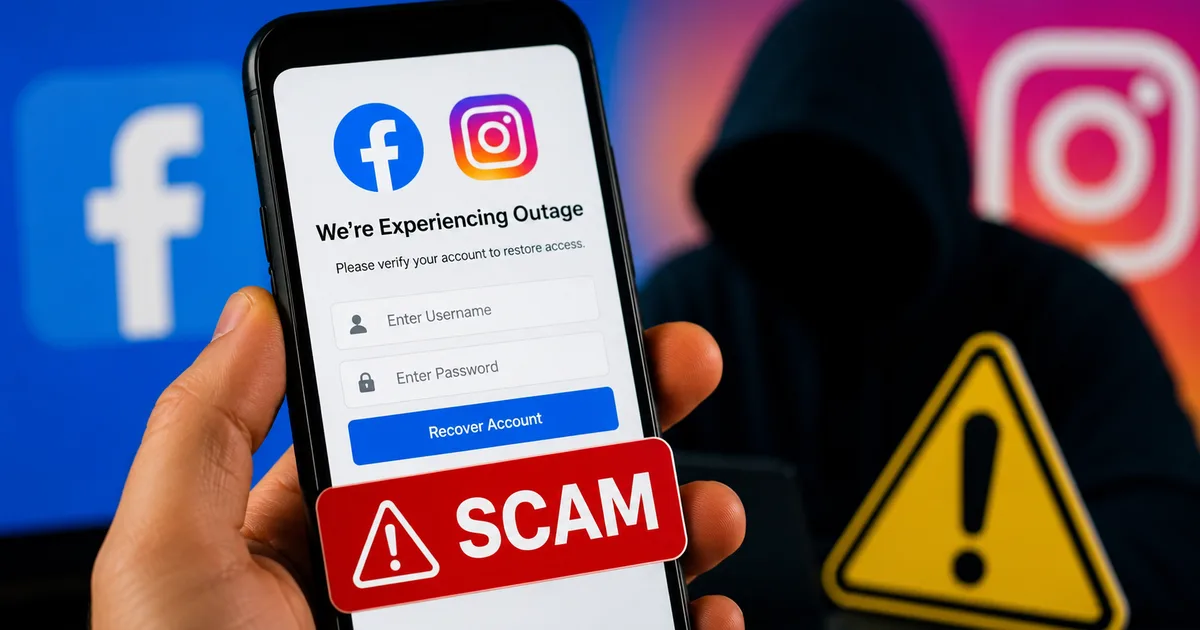
The fake Facebook and Instagram outage 2026 account recovery scam is a targeted phishing attack designed to steal your login credentials right when you're most vulnerable. The premise is simple. Fraudsters send you a message claiming your account is temporarily disabled due to the global server crash. They tell you that you need to verify your identity to get your access back.
Honestly, it looks incredibly convincing. The messages often use Meta's official logos. The sender names might be something like "Meta Support India" or "FB Security Team".
But it's a complete trap. Meta doesn't send WhatsApp messages asking you to log in to external links to restore your account after a server failure. They just fix the servers on their end. Read more about phishing attacks here.
I can't stress this enough. These scammers are technically sophisticated. They register domains that look almost exactly like the real thing. They use SSL certificates so your browser shows that little padlock icon. People mistakenly think the padlock means a site is safe. It doesn't. It only means your connection to the scammer is encrypted. I'm not sure exactly why browsers still display it that way, but it's a mess.
How the scam works step by step
The mechanics of this fraud are shockingly straightforward. Here's exactly how they operate.
The initial contact
You receive an urgent SMS or a WhatsApp message. It says something like: "Dear user, your Facebook account was suspended during the recent server outage. Click here to verify your identity and restore access within 24 hours or your account will be permanently deleted."
That 24-hour deadline is entirely made up. It's designed to make you act without thinking.
Sometimes they even call you. Yes, voice phishing or vishing is becoming huge. A person speaking decent English or Hindi calls you on WhatsApp, claiming to be from the Facebook India compliance team. They read a script about unusual activity detected on your profile during the blackout. Then they tell you to click a link they just sent. The sheer audacity is staggering.
The fake login page
If you tap that link on your phone, it opens a webpage that looks exactly like the real Facebook or Instagram login screen. The colors match. The fonts are correct. But look at the URL in your browser address bar. It won't be facebook.com or instagram.com. It'll be something slightly off, like "fb-recovery-india.com" or "meta-support-auth.net".
The data theft
You type in your username and password. The moment you hit submit, you hand your credentials directly to a scammer sitting in a call center somewhere in Jamtara or another cybercrime hub. The page might then redirect you to the actual Facebook homepage to avoid raising suspicion.
They might also ask for your email password. The fake page sometimes claims they need to verify your primary Gmail account. If you give them that, you're in serious trouble. With your email password, they can reset every other account you own. From your bank to your Amazon shopping profile.
The takeover and extortion
Once they have your login details, they work fast. They change your password. Then they swap out the recovery email address and enable two-factor authentication using their own phone numbers.
Now they control your digital identity. They might start messaging your friends asking for money via UPI. "I'm stuck in a medical emergency, please send 10,000 INR on Google Pay immediately." They might run crypto investment scams using your profile. If you have a business page linked to your account, they might hijack it. Then they run fraudulent ads using your saved credit card.
Some even demand a ransom. They'll ask you to transfer thousands of rupees via UPI to get your account back.
Never pay a ransom to a scammer. They'll take your money and still keep your account. It's a lose-lose situation for you.
And let's be real for a second. Even if you pay, they've already downloaded your private messages and your contact list. They'll use that data to blackmail you later. Don't negotiate with them.
Why losing your account is worse than you think
People often brush this off, thinking they'll just create a new profile. But losing access to a decade-old Facebook account is genuinely devastating. You lose photos you never backed up. You lose contact with old school friends. If you use Facebook Login for Spotify or a dozen other apps, you suddenly lose access to all those services too. (Annoying, I know).
For small business owners, the impact is purely financial. If someone hijacks your Instagram page, you lose your entire customer base overnight. Years of building an audience, gone in ten seconds because you clicked a bad link during an outage. Read how digital identities are stolen.
Warning signs you should never ignore
You need to spot these traps before you type a single letter of your password. Here are the red flags to watch out for.
- Unsolicited messages with links: Meta will never send you a random SMS or WhatsApp message asking you to log in through a provided link. They just don't operate that way.
- Urgency and threats: Real security alerts don't threaten to delete your account in 24 hours if you fail to click a link. That pressure is a classic scammer tactic.
- Strange URLs: Always check the web address. If it isn't exactly facebook.com or instagram.com, close the tab immediately.
- Requests for OTPs: If a page asks for a One Time Password sent to your phone when you're just trying to log in, be extremely careful. Scammers use fake pages to capture your OTP and bypass two-factor authentication.
- Poor grammar and spelling: Official communications from tech giants are usually polished. Scammers often make small mistakes. Look for odd phrasing or weird capitalization.
I also want to point out the fake urgency about Indian regulations. Some messages claim your account will be blocked under the IT Act, 2000 if you don't verify your identity. This is pure fiction. The government doesn't use random server outages to enforce social media KYC. In my experience, government processes are much slower anyway.
How to protect yourself right now
Don't wait until your account is compromised to take action. You need to secure your digital life today.
First, ignore the noise. When an app goes down, just wait. Make some chai. The engineers in California are already working on it. Your account isn't deleted just because the servers are offline.
Second, only use official apps. If you want to check if Facebook is back up, open the Facebook app on your phone. If it loads, great. If it doesn't, close it and try again later. Don't click links in messages to check your status.
Third, turn on two-factor authentication. Use an authenticator app like Google Authenticator or Microsoft Authenticator instead of SMS. SIM swapping is a huge problem in India right now. And SMS-based OTPs are becoming less secure.
Fourth, regularly check your connected devices. Go to your Instagram or Facebook settings and look at the list of devices logged into your account. If you see a phone or computer you don't recognize, remove it immediately and change your password.
Never share your Aadhaar or PAN details to recover a social media account. Some advanced variants of this scam trick users into uploading photos of their government IDs, claiming it's required under Indian IT rules. Meta doesn't ask for your Aadhaar card to fix a server issue. Check our detailed guide on securing your digital identity.
If you run a small business in India and rely on these platforms for customer orders, you have an even bigger target on your back. Set up a dedicated phone number for your WhatsApp Business account. Never use that number for random website registrations. Keep your personal and business digital identities separate.
You also need to talk to your parents and older relatives. They're incredibly vulnerable to these tactics. Sit down with them this weekend. Show them what a fake link looks like. Tell them to call you if they ever get a message claiming their Facebook account is suspended. They'll appreciate it, and it might save them a lot of grief.
Where to report this fraud in India
If you already clicked the link and entered your details, you need to act fast. Immediately go to the real Facebook or Instagram app and try to change your password. If you're locked out, use the official "Forgot Password" feature on the real website.
If you lost money or scammers are impersonating you to ask for funds, you must report it to the authorities. CERT-In (the Indian Computer Emergency Response Team) tracks these phishing campaigns and works to take down malicious websites. You can find their advisories at cert-in.org.in. The numbers here are a bit fuzzy, but reporting definitely helps. Stay updated on the latest security advisories.
And more importantly, report the financial fraud immediately.
Call the national cybercrime helpline at 1930. Do this as soon as possible, especially if a UPI transfer was involved. The faster you call, the higher the chance they can freeze the transaction in the bank's nodal accounts.
You must also file a detailed complaint on the official portal at cybercrime.gov.in. Keep screenshots of the fake messages and any UPI transaction IDs. Don't delete the fake message until you've taken a screenshot.
Look, I know how frustrating it is when these platforms crash. We rely on them for everything from news to running small businesses. But that frustration makes us sloppy. We want our access back so badly that we stop checking the details.
The scammers count on that. They want you distracted. And they definitely want you stressed.
So the next time Instagram goes dark and you get a text offering a quick fix, just ignore it. The platform will come back online eventually. Your credentials, once stolen, are a nightmare to get back.