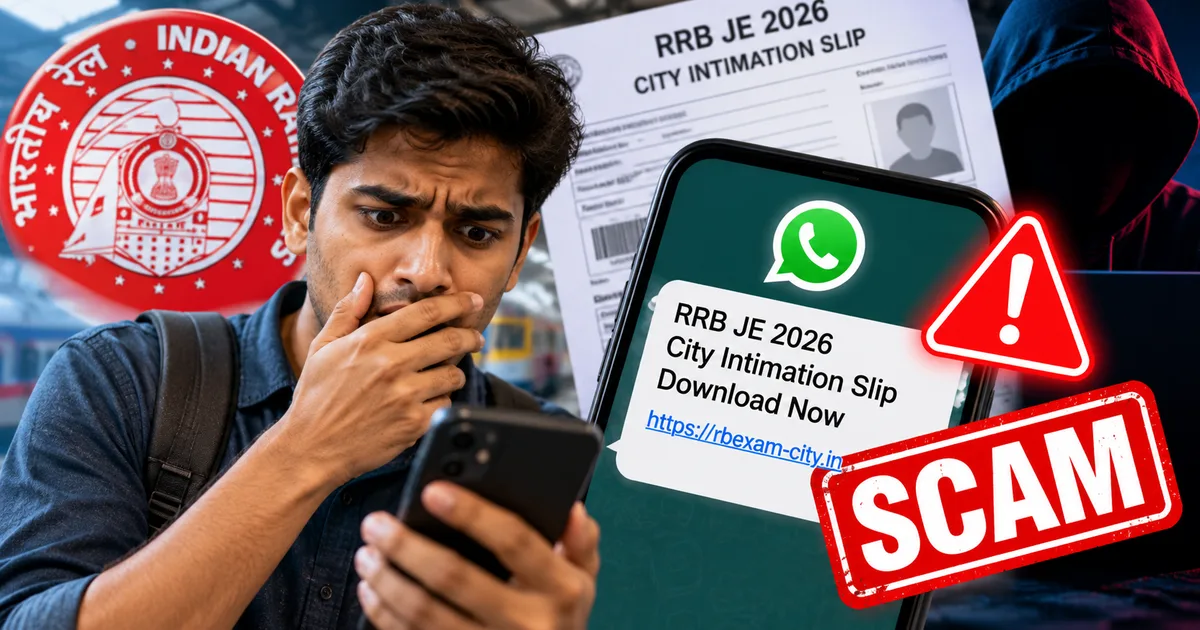
If you spent months preparing for the railway junior engineer exam, waking up to a sketchy text message can throw you off completely. A dangerous fake RRB JE 2026 city intimation slip WhatsApp link scam is spreading across student groups right now, trying to steal your login credentials and personal records. The timing is deliberate. Candidates are anxious to find out where they'll take their computer-based test, and scammers know nervous job seekers act fast before thinking twice.
Don't tap it.
Here's the deal. Railway Recruitment Boards officially published advance city details for CEN 04/2026 on October 17 and 18, 2026, covering 4,029 vacancies across Junior Engineer and Depot Material Superintendent posts, along with Chemical and Metallurgical Assistant roles. CBT 1 is scheduled for October 27 and 28. Because of that, everyone wants to know whether their exam venue is in their home district or three states away. In my experience, when you've got to book sleeper berths or figure out hotel budgets on a tight budget, every hour matters. And that rush makes thousands of applicants easy targets for fake download links. You can check our dedicated scam alert guides to see how common these recruitment frauds are across the country.
What is the fake RRB JE 2026 city intimation slip scam?
Basically, the scam runs on fake WhatsApp forwards and Telegram messages designed to look like real railway recruitment notices. These messages usually have flashy headlines like "RRB JE 2026 Exam City Allotment Active" or "Download Direct City Intimation Slip and Free Train Travel Pass." Attached is a short link. It takes you straight to a copycat page that copies the Ministry of Railways portal.
I looked at a bunch of these links in student Telegram channels yesterday. At first glance, the site looks pretty real. It copies the official Government of India emblem and mimics the familiar green-and-blue dashboard styling. If you ask me, the clone is alarmingly convincing (annoying, I know). It shows form fields asking for your registration number, date of birth, father's name, and mobile number.
Thing is, the moment you type your info and hit submit, it doesn't talk to any railway database. Not even close. Instead, everything goes straight to a sketchy offshore server run by scammers. I'm not sure exactly who runs the backend, but we saw an almost identical pattern earlier this season with fake RRB Group D links sent to hopeful applicants.
Once scammers have your registration credentials and date of birth, plus your phone number and password, they've got enough data to hit your other accounts. Sometimes they try credential stuffing on banking apps. Other times, they just sell candidate lists on underground Telegram forums.
How the RRB JE WhatsApp exam link trap works step by step
Scam syndicates run these setups with cold precision. They understand candidate stress and railway exam schedules inside out. Look, when your test venue could be 600 kilometers away and train tickets are already sitting at waiting list 90, checking your city feels like a race against time. (I get it, panic makes us rush, but taking thirty seconds to pause protects your savings.)
Here's how the trap actually works from that initial tap to stolen data:
- Scammers mass-forward messages into coaching community groups on WhatsApp and Telegram, using sensational captions claiming server overload on the main website.
- The link routes you through shorteners to a rogue website hosted on cheap, anonymous cloud servers with weird domain extensions like dot-site or dot-top.
- The fake portal asks you to enter your registration number, father's name, registered phone number, and date of birth to reveal your allotted exam center.
- Once you hit submit, the site displays a fake loading animation and presents a bogus screen saying your exam center is outside your home state.
- The page then asks for a processing fee of ₹50 or ₹100 via a suspicious UPI QR code to release an instant center change request or direct PDF slip.
- Alternatively, the page triggers an automatic download of a malicious package named RRB_City_Intimation_2026.apk on your Android phone.
That APK file is dangerous. If you install it, the app asks for sensitive accessibility permissions and SMS access. Once granted, the malware quietly intercepts your two-factor authentication codes and banking OTPs without showing any alert on your screen.
Never enter your date of birth or registration password on any site outside rrbapply.gov.in.
Telltale red flags in fake railway recruitment messages
Spotting these fake messages is straightforward once you know what to look for. Official railway boards follow strict publishing routines. And they never use informal chat forwards to announce exam cities.
Watch out for these dead giveaways whenever a strange link pops up in your chats:
- The website address does not end with gov.in or indianrailways.gov.in. Any portal using dot-biz, dot-info, blogspot, or raw IP addresses is completely fraudulent.
- The message creates false panic with phrases like last chance to verify or server closing in 30 minutes.
- The site demands any payment through PhonePe, Google Pay, or Paytm. Official city intimation slips are completely free for every single candidate.
- The page asks you to install an unknown mobile application file instead of displaying a web-based summary and downloadable PDF.
- The forward promises guaranteed local city allotment in exchange for a small administrative charge.
Honestly, it's the exact same trick. In my experience, this extortion playbook matches what we saw in fraudulent government exam result messages, where scammers demand UPI convenience fees just to release merit rank PDFs.
According to advisories from CERT-In, government recruitment portals never distribute exam authorization files through instant messaging apps, third-party APK installers, or shortened redirect URLs. Any message demanding fees for hall tickets or city allocation is fraudulent.
Indian Railways never sends exam city slips as direct downloads over WhatsApp.
How to download your real CEN 04/2026 city slip safely
Checking your real exam venue takes less than two minutes on the official sites. You don't need third-party apps or forwarded chat links. (It's way simpler than people think, actually.)
Here's how to get your official slip without any headaches:
- Open your web browser and navigate directly to the unified recruitment portal at rrbapply.gov.in or your respective regional RRB site, such as RRB Mumbai, RRB Chennai, RRB Allahabad, or RRB Chandigarh.
- Look for the notification marked Centralised Employment Notice 04/2026 for Junior Engineer posts.
- Click on the city intimation link and enter your authentic registration number along with your date of birth as your password.
- Solve the visual captcha and tap the login button.
- Review your allocated test city, scheduled test date (October 27 or October 28, 2026), reporting shift, and your free sleeper class travel pass if you belong to the SC or ST category.
- Download the official PDF document directly to your device and keep a printed copy ready for travel bookings.
One quick thing to keep straight: the advance city slip isn't your admit card. Your actual e-call letter only drops four days before your exam date, starting from October 23, 2026. If you want broader advice on protecting your phone from unauthorized downloads, check our step-by-step digital security walkthroughs.
What to do if you tapped the link or shared personal details
If you already tapped one of these sketchy links, don't beat yourself up. Scammers design these fake portals specifically to trick smart candidates under pressure. If you ask me, what matters right now is moving fast to shut down the damage.
Take these corrective steps immediately:
- If you simply opened the website and closed it immediately without typing anything, clear your mobile browser's cookies, site data, and cache history.
- If you entered your registration ID and password, log in to the official rrbapply.gov.in portal from a clean device and update your password immediately. If you reuse that same password for your primary email, change that as well.
- If your phone downloaded an APK package, do not tap install. Go straight to your phone's downloads folder and delete the file permanently.
- If you accidentally installed the APK file, turn off your mobile data and Wi-Fi instantly. Navigate to Settings, select Apps, locate the unfamiliar application, and tap Uninstall. Run a scan with Google Play Protect right after.
- If you shared banking information or approved any UPI request, freeze your UPI apps and net banking access by calling your bank's 24-hour emergency fraud line.
Honestly, the numbers here are a bit fuzzy, but acting within thirty minutes makes a massive difference in preventing serious financial or identity loss.
Where to report railway exam scams in India
I think reporting this stuff is the only real way authorities can pull down rogue servers before more students get scammed. It protects you, and it shields other applicants too.
If you lost money or spotted a fake site impersonating Indian Railways, report it through these official channels:
- Immediately dial 1930, the national cyber financial fraud reporting helpline operated by the Ministry of Home Affairs. Calling quickly gives law enforcement the best chance to freeze fraudulent bank transactions.
- File a formal complaint on the National Cyber Crime Reporting Portal at cybercrime.gov.in with screenshots of the WhatsApp chat, the sender's phone number, and the fake website link.
- Report the sender directly inside WhatsApp by opening the chat info, scrolling to the bottom, and selecting Report Contact.
- Alert the Railway Recruitment Board helpdesk or file a ticket on the RailMadad portal so recruitment officers can release public fraud warnings for other candidates.
So stay alert. Rely strictly on official railway domains, and verify any link before you tap.