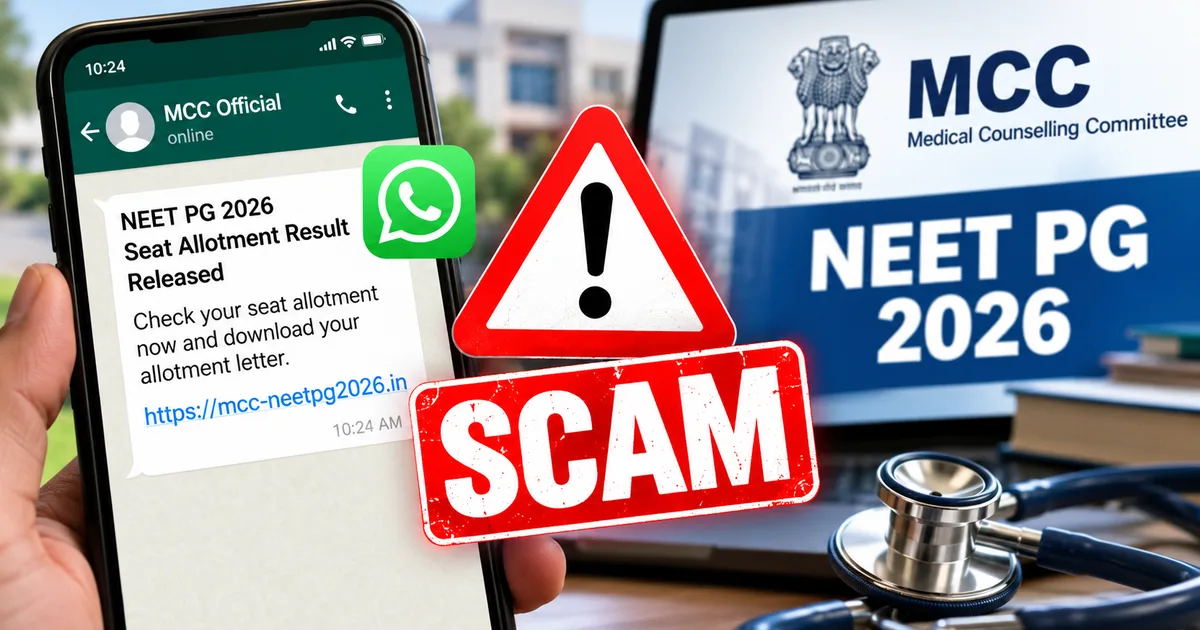
If you sat for NEET PG this year and spent sleepless nights refreshing counselling portals, your phone is probably blowing up with unsolicited messages. The most dangerous one making rounds right now is the fake MCC NEET PG 2026 seat allotment WhatsApp scam. Criminal syndicates are sending doctored allotment letters bearing the emblem of the Medical Counselling Committee to candidates, claiming a prized MD Radiodiagnosis or General Medicine seat has opened up under a phantom stray vacancy quota. All you need to do, according to these messages, is transfer several lakh rupees within two hours to lock it in.
Don't touch that payment link.
I spoke with a resident doctor in Delhi whose junior almost fell for this two days ago. It was close. That PDF looked genuine at first glance, complete with government logos and forged signatures of Directorate General of Health Services officials. But beneath all that official polish, it's just an extortion scheme designed to fleece young doctors. In my experience, panic makes people believe almost anything.
What is the fake MCC NEET PG 2026 seat allotment scam?
This scam thrives on pure panic. In India, post-graduate medical admissions are an absolute pressure cooker. The Medical Counselling Committee recently released the official seat matrix with 13,522 AIQ MD and MS seats across government medical colleges and central institutions. That means hundreds of thousands of MBBS doctors are fighting over a tiny sliver of clinical seats. When the gap between your dream branch and another exhausting drop year is just two or three ranks, emotions take over. Fraud rings know that reality inside out, and they exploit candidate anxiety every single day.
The racket works through direct WhatsApp messages from unknown numbers. The sender claims to be an MCC desk officer or a state quota coordinator. They address you by your real name. They even cite your exact NEET PG roll number. I'm not sure exactly how they get their hands on student contact lists so fast, but they have them. Then they tell you a clinical seat in a top government college just opened up unexpectedly (which makes sense, actually, given how messy stray rounds feel). All they want is a deposit between ₹2,50,000 and ₹15,00,000 to slide your name straight onto the allotment list before reporting closes.
It sounds tempting. Especially if you're hovering right on the cutoff rank.
Look, here's the plain truth: nobody can buy an All India Quota seat. If you ask me, believing an agent has special backdoor access is the quickest way to lose your savings. Centralized counselling is run strictly by software. The MCC has warned aspirants repeatedly that every seat allocation is handled through an automated merit-cum-preference algorithm on mcc.nic.in. There's no manual override, and there's definitely no secret offline quota for brokers.
How the WhatsApp admission racket works step by step
Understanding how this scam works helps you see through the illusion before panic sets in. The fraudsters follow a coordinated five-stage playbook built entirely on fake authority and psychological pressure.
- Data gathering from shadow test platforms. Fraud rings buy student registration dumps from unauthorized coaching portals, mock exam mobile applications, and rogue public discussion forums. That is how the scammer already knows your full name, testing category, email address, and approximate NEET percentile before they ever ping you.
- The targeted WhatsApp message. You receive a direct message, often accompanied by an official-looking profile picture featuring the Ministry of Health and Family Welfare emblem or the MCC circular crest. The text typically opens with an urgent notification that a candidate in round two or the stray round forfeited their seat at an institute like Maulana Azad Medical College, KGMU Lucknow, or Madras Medical College.
- The delivery of the forged allotment letter. To dispel your natural skepticism, the operator forwards a high-resolution PDF titled provisional allotment letter 2026. The document carries candidate details, an official-looking watermark, a bar code, and an embossed stamp. It looks identical to legitimate documents down to the administrative font. We saw an identical pattern unfold earlier this season during the fake TNEA counselling fee scam targeting engineering students in Tamil Nadu.
- The artificial two-hour payment deadline. The fraudster calls or messages continuously, claiming the state nodal officer will reassign the seat to the next waitlisted applicant if you fail to remit the initial seat confirmation fee immediately. They request payments via bank transfer to a current account or ask you to scan a UPI QR code linked to a personal handle.
- The immediate blackout. The moment you transfer the funds, the criminal either demands another ₹3,00,000 under the pretext of college security deposits or blocks your phone number completely. The website links they send suddenly stop resolving, and the money gets routed through multiple mule accounts across states within minutes.
It's brutal. And because doctor families are often ready to liquidate savings or borrow from relatives just to lock in a clinical seat, losses easily cross ten lakh rupees. In my experience, that kind of financial hit can derail an entire household for years.
Red flags on a fake MCC allotment letter
Scam PDFs look slick at first glance. But fraudsters always leave sloppy clues behind. Spotting them takes only a minute or two if you know what to check.
Start with the payment instructions, because this is where scammers slip up first. The legitimate Medical Counselling Committee never asks for fees via personal UPI IDs or individual bank accounts. Real counselling fees and security deposits must be paid strictly through the integrated gateway on the mcc.nic.in portal during your registered login session. Any letter telling you to transfer cash to an account under someone's personal name is an outright fake.
Next, scan the QR code printed right on the PDF. Genuine MCC allotment letters have a verification QR code that points directly to a secure government server. When you scan it with your phone, it redirects to a verified official record on a domain ending in gov.in or nic.in. Fraudulent PDFs embed QR codes that either fail to open or lead to a sketchy Google Form asking for your Aadhaar card (annoying, I know). If you ask me, scanning that code is the quickest way to bust their bluff.
Then check the seat matrix on the official site. Colleges must verify their vacant seats before every round and formally report discrepancies. You can view these lists yourself by downloading the vacant seat matrix PDFs directly from mcc.nic.in. If a broker promises you an MD Dermatology seat that isn't on the official vacancy PDF, they're making it up. It doesn't exist.
Here is what the MCC stated in an urgent advisory regarding admission fraudsters targeting aspirants:
The Medical Counselling Committee of DGHS does not allot seats through any agent, individual, or private agency. Candidates are advised to beware of unscrupulous persons claiming to arrange seats in medical colleges. All allotments are made through transparent online counselling conducted purely on merit on the official website mcc.nic.in.
Take that warning seriously. When you browse our latest scam alerts, you'll see that artificial urgency and fake authority are the two tricks scammers use in nearly every admission racket across India. Don't fall for either.
How to protect your NEET PG 2026 seat and savings
Protecting yourself from admission extortion takes basic digital discipline and a firm refusal to deal with anyone outside official portals. Counselling stress makes even experienced doctors second-guess themselves. That's why having rigid personal boundaries is so necessary.
- Check results only on mcc.nic.in. Bookmark the official URL directly in your browser. Never click links sent over WhatsApp or SMS to check your seat allocation status. If you are allotted a genuine seat, it will display inside your secured dashboard after two-factor authentication, complete with your downloadable provisional allotment order.
- Never install files or third-party apps sent by strangers. Cybercriminals frequently push modified software packages claiming to offer real-time allotment tracking or insider counselling updates. The Indian Computer Emergency Response Team has repeatedly warned against downloading suspicious APK packages from social media chat threads. Avoid falling for malicious WhatsApp APK clones and unverified diagnostic tools that can hijack your device and siphon incoming OTPs.
- Keep your scorecards and admit cards offline. Do not upload full photos of your NEET PG admit card, scorecard, or rank certificate to public discussion forums or guaranteed allotment Telegram groups. Those documents contain your testing ID, roll number, and personal identifying details that scammers turn into ammunition against you.
- Contact the college nodal officer directly. Every medical college participating in AIQ counselling lists an official nodal officer along with institutional telephone numbers and email addresses on the MCC portal. If anyone calls claiming to represent an institution, hang up, open the official college directory on mcc.nic.in, and speak directly to the institutional nodal desk.
- Never hand over your original documents to middle-men. Verification of original certificates, including your MBBS degree, internship completion certificate, and state medical council registration, happens in person at the allotted college or via verified government portals like DigiLocker during the physical reporting window. Legitimate authorities never ask you to courier physical certificates to private addresses.
Look, NEET PG counselling pressure is brutal. You've slogged through five and a half years of MBBS and grueling internships just to get here. I think every candidate dreads the idea of losing an admission cycle. But paying off a smooth-talking WhatsApp operator won't get you a residency seat. It'll just wipe out your family savings and leave you devastated.
Where to report NEET PG counselling 2026 fraud
Basically, if you or someone in your batch already sent money, every minute counts. The numbers here are a bit fuzzy, but police usually say the first two hours are your only real window to freeze the funds before scammers siphon everything into cash or crypto.
Here's what you need to do right now:
- Dial the national cybercrime helpline 1930 right away. The Ministry of Home Affairs operates this dedicated toll-free line to intercept financial fraud in real time. State the exact amount transferred, the beneficiary bank account number or UPI VPA, and the transaction reference ID. The system triggers immediate freeze alerts to the recipient banking node.
- Submit a formal complaint on the official portal at cybercrime.gov.in. Upload clear screenshots of the WhatsApp chat history, the fraudulent allotment letter PDF, the sender phone number, and your bank account debit statement. Keep the complaint acknowledgment number handy for police follow-ups.
- File an incident report with CERT-In. Submit the phishing URLs, malicious documents, and phone numbers through the incident reporting portal on the CERT-In website (https://www.cert-in.org.in/) so national security teams can take down the malicious payment infrastructure.
- Notify the MCC grievance cell. Email the Directorate General of Health Services counselling helpdesk with the details of the imposter and the fake allotment letter. The committee aggregates these complaints to file formal first information reports with state cyber police divisions.
- Block and report the WhatsApp number. Use the built-in report feature inside WhatsApp to flag the sender account for spam and fraud. This helps trigger algorithmic bans on scammer SIM cards across telecommunication networks.
Don't let embarrassment keep you quiet. These scam rings operate like full-blown call centers, and they target thousands of doctors at the same time across the country. Honestly, getting your complaint on record right away is the only shot you have at recovering that cash and stopping the next candidate from getting fleeced.