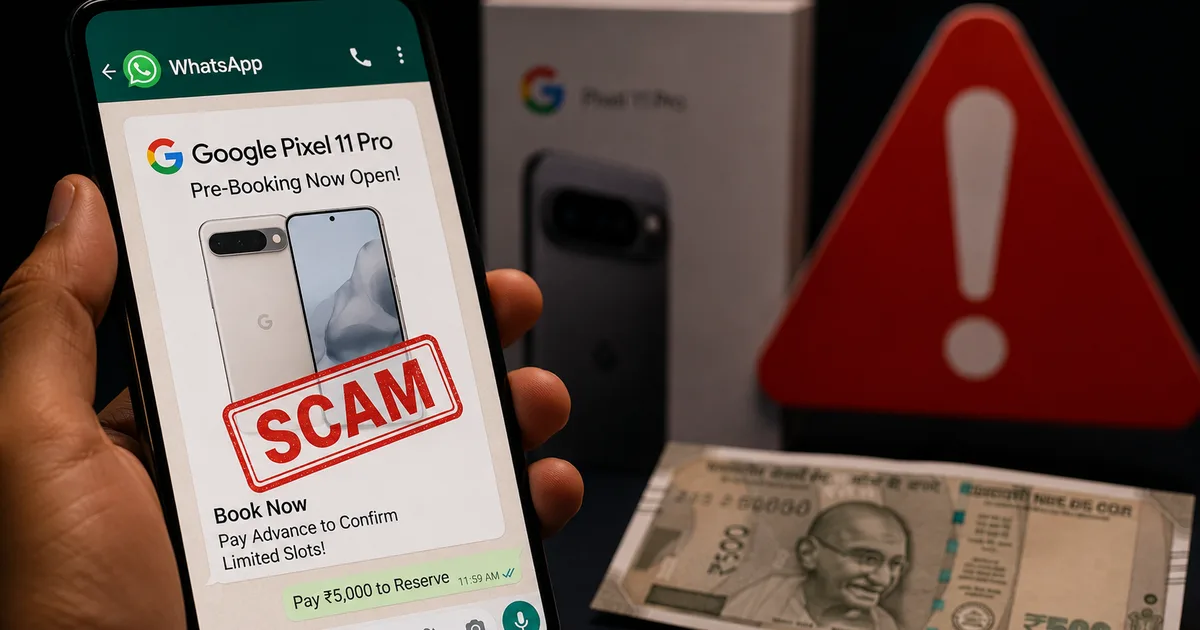
I know how much hype surrounds a new phone launch. Look, the Google Pixel 11 Pro is right around the corner. We're expecting the launch event on August 12. And as usual, the scammers are already working overtime. Right now, a fake Google Pixel 11 Pro pre-booking WhatsApp scam is spreading fast across Indian WhatsApp groups. Honestly, it's catching a lot of smart people off guard.
You probably got a message offering an exclusive early-bird booking. Maybe they promised a free pair of Pixel Buds or a massive discount if you pay a small advance amount via UPI. It sounds tempting. But here's the deal, it's a complete trap. Thing is, Google doesn't run secret pre-booking campaigns through random WhatsApp numbers. If you engage with these messages, you'll lose your money. Worse, you might hand over access to your bank account entirely.
I've seen variations of this scam before. But the current wave targeting the Pixel 11 series is highly sophisticated (which makes sense, actually, given the price). They send poorly spelled text messages, sure. But they also set up fake support desks. They send PDF brochures that look identical to Google's official marketing material. And they create a false sense of exclusivity. Don't fall for it.
What exactly is the fake Google Pixel 11 Pro pre-booking WhatsApp scam?
The scam is pretty straightforward in its execution. But it's complex in its setup. Basically, scammers are riding the wave of news about the upcoming Pixel 11 series. Leaks suggest the Pixel 11 Pro will cost around ₹1,00,000 in India, and the Pro XL model will go even higher. Scammers know you want a deal on these premium devices. So they send bulk messages on WhatsApp claiming to be official retail partners or Google India representatives directly.
These messages look surprisingly legitimate. They use official logos. They quote actual leaked specs, like the new Tensor processor and improved battery life. Sometimes they even reference real news about the August 12 launch date. The goal is simple. They want to trick you into making a small UPI payment. They call it a booking amount or a registration fee. Once you pay, they disappear.
This isn't a new tactic. In my experience, we see this every time a major tech product drops in India. But the scammers are getting significantly better at their craft. They now use fake Flipkart or Amazon invoices to make the offer seem genuine. Some of them even set up fake websites that look exactly like the Google Store, right down to the fonts and layout. If you don't check the URL carefully, you'd swear you were on the official site.
How this pre-booking fraud works step by step
Understanding the playbook is your best defense against these criminals. They don't ask for money immediately. They reel you in slowly, building trust before they strike. Here is exactly how the trap usually unfolds on your phone.
Step 1: The initial hook
First, you get a WhatsApp message from an unknown number. It might be a business account with a Google logo as the profile picture. The message congratulates you on being selected for a VIP pre-order program for the Pixel 11 Pro. They might offer a massive discount, dropping the expected price from ₹1,00,000 to ₹75,000. Or they promise a free ₹5,000 Amazon gift card. They make you feel special.
Step 2: Creating false urgency
Second, they create false urgency. They tell you the offer expires in 30 minutes. They claim there are only 50 units left for your specific pincode. This stops you from thinking clearly. They push you to act fast so you don't have time to call a friend or check online to see if the offer is real. If you ask me, urgency is the scammer's best friend.
Step 3: The payment link
Third, they send a payment link. This is the critical moment. They won't ask for a credit card. They almost always ask for a UPI transfer. They might say you need to pay a ₹2,000 or ₹5,000 token amount to reserve your spot in the queue. The link might look like a regular payment gateway, but it often redirects to a personal UPI ID. Once you authorize that transaction, the money is gone.
Step 4: The escalation
Fourth, things escalate rapidly if you pay the initial amount. They'll claim there was a technical error with the GST calculation. Or they might say you need to pay the full customs duty upfront because the phones are being imported directly. They'll keep asking for more money until you finally realize it's a scam. The details here are a bit fuzzy, but some users have reported losing over ₹50,000 this way just trying to secure a phone.
Sometimes they try to steal your identity too. They might ask for your Aadhaar card or PAN card details to verify the booking for KYC purposes. They'll tell you to upload these documents through a sketchy link. Don't do it. Your identity will be used to open fraudulent bank accounts or take out loans in your name.
The dangerous APK malware angle
This is where things get genuinely terrifying. Recently, we've seen scammers ditch the simple UPI payment request altogether. Instead, they send you a file over WhatsApp. They tell you it's the official pre-booking app or a special registration portal. I'm not sure exactly why people trust these random files, but they do.
The file is usually an APK file named something like Pixel_Booking_V2.apk. They instruct you to download it, bypass your phone's security settings to install unknown apps, and fill out a form inside.
If you install that app, it's game over.
That APK is malware. It sits silently on your phone and intercepts your SMS messages. It reads your banking OTPs. It can even view what's on your screen. The scammers then log into your banking apps remotely and drain your entire account while you sleep. We've discussed these tactics extensively in our malware explainers, but it bears repeating: never install apps from random WhatsApp chats.
Warning signs you should never ignore
You can spot these scams easily if you know what to look for. Here are the biggest red flags you should memorize.
- The message comes from a normal 10-digit mobile number. Real companies use verified business accounts with a green tick. Even then, Google doesn't randomly message Indian consumers with secret discount codes for unreleased phones.
- They insist exclusively on UPI payments. Official retailers like Amazon, Flipkart, Croma, and Reliance Digital offer multiple payment options, including credit cards and EMI. Scammers only want UPI because it's instant and incredibly hard for banks to reverse.
- The links look suspicious. A real link looks like store.google.com/in. A scam link looks like pixel-india-booking.com or something equally messy (which is a huge red flag, honestly). Always check the URL.
- The grammar and spelling are slightly off. You'll often spot weird capitalization or missing punctuation that a massive tech company would never let slip through their marketing department.
- They ask you to download a file. As mentioned, asking you to install an APK file is the biggest red flag of all. It's a direct attempt to hack your device.
Never download APK files sent over WhatsApp, especially when they promise deals on expensive electronics. This is how malware infects your phone and steals your banking passwords without you even knowing.
How to protect yourself and your money
You need to be proactive. Just ignoring the message is good. But understanding how to stay safe long-term is better (annoying, I know). We've seen too many heartbreaking cases in our scam alert tracker where people lose their life savings over a fake phone offer.
First, always verify offers on official channels. If there's a pre-booking offer for the Pixel 11 Pro, it will be loudly announced on Google's official social media pages and their official blog. You'll see it on the front page of Flipkart or Amazon. If you can't find any mention of the offer anywhere else on the internet, it absolutely doesn't exist.
Second, don't share your KYC documents on WhatsApp. Scammers often ask for Aadhaar or PAN details to process the fake booking. A real retailer doesn't need your PAN card just to book a smartphone. They might need it later for EMI financing, but they will never ask for it over a random WhatsApp chat.
Third, understand how UPI actually works. You only enter your UPI PIN when you want to send money. You never enter your PIN to receive money or get a refund. If someone says you need to enter your PIN to get your booking amount back because of a server error, they're lying. They're trying to steal from you again.
Fourth, block and report the number immediately. WhatsApp has a built-in feature to report spam and block the sender. Use it. This helps flag the account in WhatsApp's systems and protects other people from receiving the same message.
You should also read our safety guides to learn more about how UPI fraud operates in India and how you can lock down your banking apps. Knowledge is literally power here.
Where to report if you get scammed
If you made a payment or installed an app, you need to act immediately. Don't wait to see what happens. Every single minute counts when trying to recover stolen funds or secure a compromised phone.
First, call the national cybercrime helpline at 1930. This is the most important step. If you call within the first hour, the authorities and the banks have a decent chance of freezing the fraudulent transaction before the scammer withdraws the cash from their mule account.
Second, file a detailed complaint on the official government portal at cybercrime.gov.in. Keep all your evidence. Take screenshots of the WhatsApp chats. Save the transaction IDs from your UPI app like PhonePe or Google Pay. Don't delete the chat history with the scammer, even if you feel embarrassed about falling for it.
Third, contact your bank immediately. Call their customer care or visit the nearest branch. Tell them you're a victim of UPI fraud. They can block your account temporarily to prevent further unauthorized transactions. If you installed an APK, tell the bank your phone is compromised.
The Indian Computer Emergency Response Team (CERT-In) regularly issues warnings about these types of phishing campaigns and malware attacks. You can check their website for the latest technical alerts. But honestly, the best defense is just being cynical. If someone offers you a highly anticipated, unreleased phone for cheap on WhatsApp, they're trying to rob you.
Stay alert out there. Don't let the excitement of a new gadget cloud your judgment. A new phone is nice, but keeping your bank balance intact is much better.