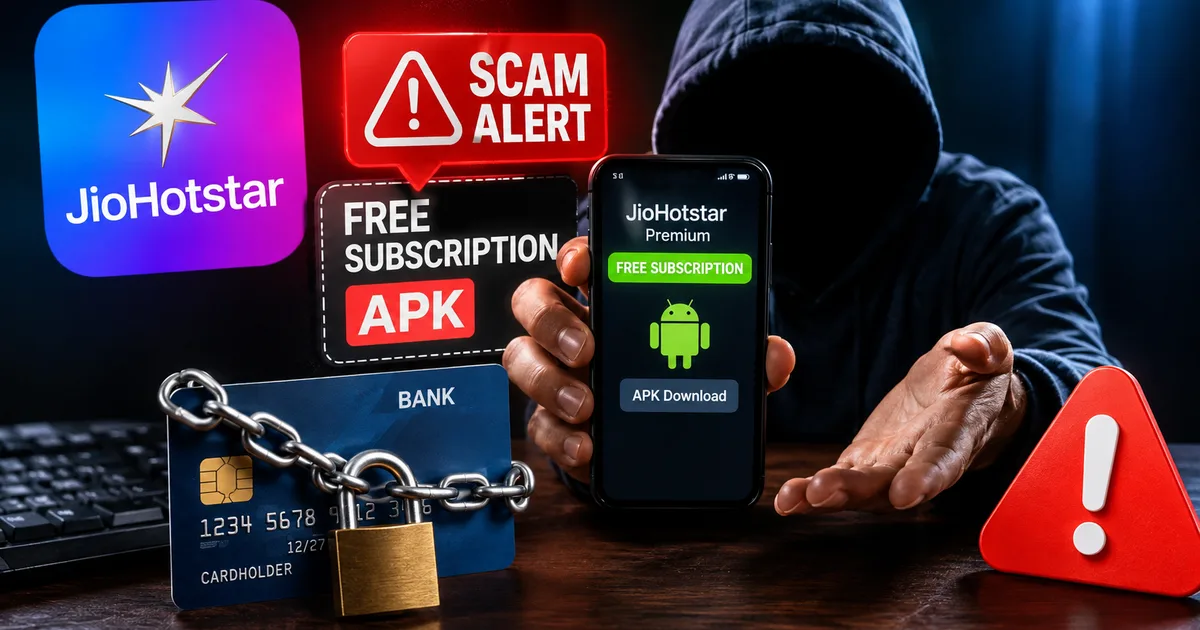
Everyone loves a good deal. And right now, with cricket season peaking and new releases hitting streaming platforms, we all want access to JioHotstar without paying the premium subscription fee. I get it. But scammers know exactly what we want, and they are weaponizing our search for "free" content. Right now, a massive fake JioHotstar free subscription APK scam is spreading like wildfire across WhatsApp groups in India, and it's designed to do one thing: empty your bank account.
Honestly, this isn't just another annoying spam message. It's a highly sophisticated financial fraud. If you or someone in your family downloaded a "free JioHotstar" app from a link instead of the official Google Play Store, you need to read this immediately. The risk is real, and the financial damage is swift. Recovering stolen funds is incredibly difficult.
I've seen people lose years of savings because they clicked a link forwarded by a trusted friend (which is terrifying, honestly). It's heartbreaking, and it happens every single day across India. The scammers sit in organized call centers. They treat this like a corporate job and hit thousands of numbers a day until someone takes the bait. And they specifically time these scams around major events when they know public demand for streaming platforms like JioHotstar is at its absolute peak.
The trap: what this JioHotstar scam actually is
Here's the deal. Scammers are blasting messages across WhatsApp and Telegram. They claim to offer a "secret trick" or a "modded APK" that gives you a lifetime free subscription to JioHotstar. Some messages even claim this is a special promotional offer linked to the recent Reliance Jio announcements about free AirFiber connections. But it's completely fake. If you ask me, the sheer scale of this is wild.
Basically, what you're actually downloading is a malicious Android application package. This is commonly known as an APK file. We've seen warnings about similar fake apps, like the "Cockroach Janta Party" app, that spread malware and act as Remote Access Trojans (RATs). This JioHotstar scam operates on the exact same principle. You think you're getting free cricket or movies. But you're actually handing over the keys to your smartphone to a criminal hacker.
The psychology behind this is simple. People are always looking for workarounds. We search for "JioHotstar mod APK" or "free subscription tricks" on Google and YouTube. Scammers optimize their fake links for these exact searches, or they just blast them into large community groups. They know that out of a thousand people, a few dozen will click the link out of curiosity. And that's all it takes to make a massive profit from stolen banking details.
How the fake APK scam works step by step
Understanding the mechanics of this fraud is your best defense. The criminals rely on urgency and the lure of free entertainment. Here's exactly how they drain accounts:
- The bait message arrives: You get a WhatsApp forward. It usually has a catchy headline like "Get JioHotstar Premium Free for 1 Year - Limited Time Offer" and includes a link to download an APK file directly. It might even have fake reviews or screenshots to look legitimate. Often, the message creates a false sense of urgency and claims the link will expire in ten minutes.
- You download and install the APK: Because the app isn't on the Play Store, your phone will warn you about installing apps from unknown sources. The scam message usually includes instructions on how to bypass this security setting. That's your first major red flag. Android disables "Install unknown apps" by default for a very good reason.
- The app demands excessive permissions: Once installed, the fake JioHotstar app will ask for permissions that a streaming app simply doesn't need. It will ask to read your SMS messages and access your contacts. Sometimes it even requests accessibility controls to view your screen. You might think it just needs these to verify your phone number, but the reality is much darker.
- The silent robbery begins: With those permissions granted, the malware goes to work in the background. It monitors your incoming SMS messages. When the scammer tries to log into your bank account or initiate a UPI transfer, your bank sends an OTP. The malware intercepts that OTP and forwards it to the scammer. Then it deletes the SMS from your phone so you never even see it.
- The money vanishes: The scammers authorize the transaction. Before you realize what has happened, your account balance is wiped out. People have lost anywhere from ₹5,000 to ₹50 Lakhs in these types of targeted attacks. By the time you notice money missing from your HDFC or SBI account, the scammers have already routed it through multiple mule accounts. This makes it nearly impossible to trace.
Why our OTP system is failing us
Look, I need to rant about this for a second. We rely heavily on SMS OTPs for banking security in India. It was a great system ten years ago. Today? It's a massive vulnerability. Text messages aren't encrypted end-to-end. And Android makes it dangerously easy for apps to request SMS reading permissions. We've normalized giving apps permission to read our texts just so we don't have to manually type in a six-digit code. We traded our financial security for three seconds of convenience. (A pretty bad trade, if you think about it.)
Until banks universally shift to hardware tokens or mandatory in-app approvals for all transactions, these APK scams will keep happening. The burden of security is entirely on you, the user, to not click the wrong link. And honestly, that's a terrible system design. I'm not sure exactly why it's taking so long to change.
Warning signs you shouldn't ignore
Thing is, you can spot these scams from a mile away if you know what to look for. Stop and think before clicking anything that sounds too good to be true. The signs are always there if you pay attention.
- The app is sent directly as an APK file on WhatsApp or Telegram instead of a link to the official Google Play Store or Apple App Store.
- The installation process requires you to go into your phone settings and enable "Install from unknown sources."
- The app asks for SMS and phone permissions immediately upon opening. It might ask for accessibility too. A real streaming app only needs network access and maybe media storage.
- The branding looks slightly off, or the app icon is pixelated when you look closely at it.
- The message urges you to act quickly before the "offer expires." This pushes you to skip reading warnings.
- You are asked to pay a small "processing fee" of ₹10 or ₹20 via UPI to activate the free lifetime subscription. This is a classic tactic to steal your UPI PIN.
If you see even one of these signs, delete the message. Don't interact with the sender. And definitely don't forward the message to your family groups. Forwarding these links only helps the scammers find more victims, which is the last thing we want.
How to protect yourself from fake app fraud
Keeping your money safe doesn't require a degree in computer science. Just follow some basic hygiene rules. You lock your front door at night. You need to apply the exact same logic to your smartphone.
Never download APK files sent via messaging apps. Period. No exceptions. If an app isn't in the official app store, you shouldn't be installing it on a phone that has your banking details or UPI apps like PhonePe, GPay, Paytm, or BHIM. The minor convenience or the few rupees saved aren't worth risking your entire bank balance. In my experience, the "free" stuff always ends up costing the most.
Keep your phone's security settings strict. Don't enable "Install unknown apps" for your browser or WhatsApp. If you previously turned it on for some reason, go to your settings right now and turn it off. Make sure Google Play Protect is enabled and actively scanning your device for harmful behavior.
Review app permissions regularly. Go to your phone's settings and look at which apps have access to your SMS and Accessibility features. If you see an app you don't recognize, uninstall it immediately. Accessibility permissions are particularly dangerous. They allow an app to read everything on your screen and even tap buttons on your behalf.
So, use common sense about subscriptions. Legitimate companies like Reliance or Disney don't distribute their premium services via sketchy WhatsApp links. If there's a genuine offer, you'll find it on the official website or within the official MyJio app.
"Malicious APK files are currently the most dangerous threat to Indian mobile banking users. Once installed with SMS permissions, they essentially give hackers complete control over your financial life."
It's also smart to keep your banking apps updated. And rely on secondary verification methods where possible. If your bank offers an authenticator app option or email alerts for transactions in addition to SMS OTPs, enable them. The more layers of security you have, the harder it is for a scammer to succeed.
What to do if you installed the fake JioHotstar app
If you suspect you've fallen victim to this, don't panic. But you must act extremely fast. Every minute counts when dealing with unauthorized access. The scammers work quickly, and you need to be faster.
First, turn off your mobile data and Wi-Fi immediately. Put your phone in Airplane mode. This severs the connection between the malware and the hacker. It prevents them from receiving any more intercepted OTPs or sending commands to the RAT.
Second, use another device to call your bank immediately. Tell them your phone is compromised. Ask them to freeze your account and block your cards. And disable your UPI access too. Don't wait until morning. Do it right now. The customer service lines for fraud are open 24/7 for a reason.
Third, uninstall the suspicious app. If you can't find it or it won't uninstall, the safest route is a complete factory reset of your Android phone. Yes, you might lose some photos if they aren't backed up. But that's way better than losing your life savings. Go to your phone settings and search for "Factory Data Reset" to wipe the device clean.
Where to report cyber fraud in India
Reporting the crime is crucial.
You want a chance to get your money back, obviously. You also want to help authorities track these syndicates down. The Indian government has specific portals for this. And they actually do take action when enough reports come in about a specific scam.
Call the National Cyber Crime Helpline at 1930. This should be your very first call after securing your bank account. They have mechanisms to potentially freeze the fraudulent transfer if you report it quickly enough. This works especially well if the money has only moved to a nodal account and hasn't been withdrawn as cash or cryptocurrency.
Register a formal complaint at the official government portal: cybercrime.gov.in. Provide all details. Include the phone number that sent you the malicious link and the exact time you downloaded the app. Also upload any screenshots you might have taken before resetting your phone. Documentation is key to building a case.
You can also find security advisories and updates from CERT-In. They are the national nodal agency for responding to computer security incidents. Staying informed is half the battle won. They regularly publish alerts about new malware strains and phishing campaigns that target Indian citizens. I'm not sure exactly how many people read them, but they are pretty helpful.
The lure of free streaming is strong, especially with big tournaments happening. But it's never worth risking your financial security. Stick to official explainers for managing your subscriptions and verified apps. Share this with your parents and older relatives. They are often the primary targets for these types of scam alerts. If you want to use tools to check sketchy links, do that on a desktop. Never do it on your primary mobile phone.