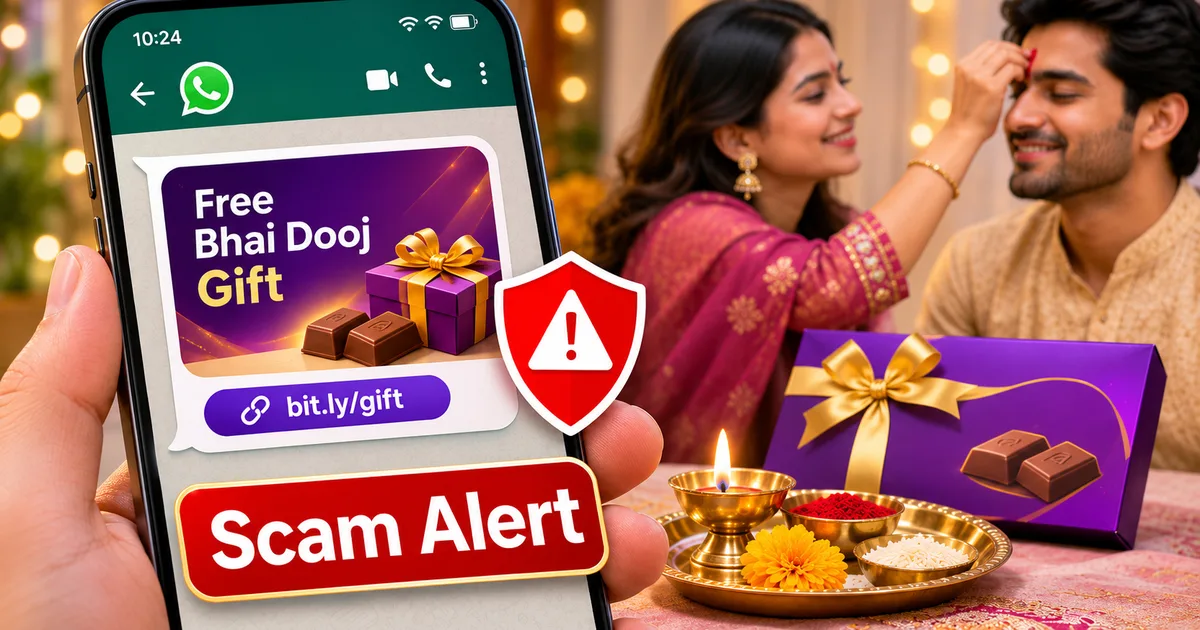
If you opened WhatsApp this morning, odds are good that someone in your family group sent you a link promising free chocolates. With Bhai Dooj celebrations happening across India, the fake Cadbury Celebrations Bhai Dooj 2026 free gift box WhatsApp scam is spreading through group chats and private messages. The message looks harmless at first glance. It claims that Cadbury India is giving away 50,000 festive hampers to mark the occasion. But before you tap that tempting blue link or forward it to your cousins, stop right there.
I spent an hour looking into the actual domains behind these messages after two of my own relatives shared them yesterday. Not a single one belongs to Mondelez India or Cadbury. None. They're cheap phishing traps registered on sketchy top-level domains (annoying, I know). And worse, they're actively hunting for your personal data and your bank balance.
What is the fake Cadbury Bhai Dooj gift box scam?
This scam is just an old festive phishing trick that reappears across India every single festival season with a fresh coat of paint. Back during Dhanteras, we watched scammers push a fake Tanishq gold coin scam. When mobile tariff hikes were all over the news, plenty of folks fell for a fake Jio recharge link scam. Now Bhai Dooj is here right after Diwali. So scammers simply switched over to Cadbury Celebrations gift packs. Honestly, it makes sense from a scammer's perspective (which shows just how closely they monitor Indian shopping habits). If you ask me, the timing is completely deliberate. Almost every Indian household buys or gifts a purple box of Cadbury Celebrations for Bhai Dooj, usually priced between ₹200 and ₹850 depending on the assortment. Offering one for zero rupees feels believable enough to lower people's defenses.
The message arrives from someone you already know. That's what makes it dangerous.
Thing is, your aunt or college friend didn't write the text, of course. They got tricked into forwarding it by a deceptive website. The text usually says something like: "Cadbury Celebrations Bhai Dooj Gift Box! Cadbury is offering 50,000 free chocolate boxes to celebrate Bhai Dooj 2026. Claim your free gift box now before stock ends." Right below that text sits a shortened link or an unfamiliar web address designed to mimic official branding.
Cadbury India and its parent firm Mondelez have repeatedly stated that the company never distributes free hampers or gift boxes through viral WhatsApp links or third-party survey pages.
Fact-checking teams at Vishvas News and BOOM Fact Check have already flagged identical campaigns multiple times over the past few years. But because the packaging looks familiar and the promise sounds sweet, thousands of people keep clicking without thinking twice. In my experience, nobody expects a festival greeting from a cousin to be a financial trap.
How the Cadbury Celebrations WhatsApp scam works step by step
Fraud syndicates don't run these campaigns for fun. They follow a deliberate, multi-stage funnel to get maximum viral reach and pull off financial theft. Here's the deal: each stage pulls you a little deeper until you either leak personal data or authorize an unauthorized payment.
The tempting festive message and survey hook
When you click that link in WhatsApp, you land on a webpage plastered with Cadbury logos and pictures of Cadbury Celebrations gift boxes. The site has a flashy countdown timer or a spinning wheel of fortune. And to make the offer feel exclusive, a pop-up declares that only 142 gift boxes remain in stock. Classic pressure tactic.
The page then asks you three or four simple questions:
- Do you like Cadbury Dairy Milk chocolate?
- How old are you?
- Will you gift this box to your brother or sister for Bhai Dooj?
- Which Indian state do you live in?
It doesn't matter what you pick.
You can choose random answers or complete nonsense. Doesn't matter. The site will always flash a celebratory message: "Congratulations! You have won a Cadbury Celebrations Rich Chocobox worth ₹500!"
The viral sharing trap
This is where the trap spreads like wildfire. The website demands that you share the giveaway link with 5 WhatsApp groups or 20 contacts before you can claim anything. The page flatly refuses to unlock until its progress bar hits 100% (which makes sense, actually, given how they operate).
Look, the scammers don't spend a single rupee on ads. Why would they? Victims willingly distribute the campaign across family circles and apartment societies. When a message pops up from your own sister or college roommate, you trust it without a second thought. I think that immediate personal trust is the secret sauce behind WhatsApp fraud, and scammers exploit it ruthlessly every single festive season.
Nobody stops to verify the sender.
The courier fee and rogue APK payload
Once the sharing requirement clears, you get redirected straight to the payment trap. The site asks for your full name, mobile number, home delivery address, and pincode. Then it hits you with a small catch: "Pay a nominal delivery and packaging charge of ₹25 via UPI to confirm dispatch."
Twenty-five rupees sounds like pocket change when you think you're getting a ₹500 chocolate hamper. Basically, that small fee is just bait.
When you tap "Pay Now", one of two things happens:
- The page opens your UPI app, whether that is Google Pay, PhonePe, or Paytm, with a hidden collect request for ₹25,000 or ₹68,000 instead of ₹25. In festive fraud cases tracked by state police departments, victims often assume they're approving ₹25 without looking closely at the requested amount.
- The page prompts you to download a "Courier Tracking App" or "Cadbury Delivery Assistant" APK file. That file contains an Android trojan. Once installed, it requests SMS permissions, forwards your incoming bank OTPs directly to cybercriminals, and silently drains your savings account.
In a reported incident from northern India during festive shopping, a victim lost ₹68,000 within minutes after trying to claim a similar online gift voucher. The money vanished through unauthorized IMPS transfers before the person even realized what went wrong. It happened that fast.
Telltale warning signs of a fake chocolate giveaway
Spotting these scams takes only a few seconds if you know where to look. In my experience, scammers make sloppy mistakes because they rely on speed and sheer volume rather than perfection. Check our scam alerts and safety guides whenever you spot an offer that seems too good to be true.
Here are the clearest red flags you'll find on fake Cadbury giveaway pages:
- The web address doesn't end in cadbury.in or mondelezinternational.com. Instead, you'll see strange extensions like .xyz, .top, .buzz, or hyphenated domains like cadbury-festive-rewards-free.site.
- The website forces you to forward messages to WhatsApp groups before you can claim the prize. Legitimate brands never demand viral forwarding as a condition for receiving an authentic gift.
- The countdown timer resets every time you refresh the page. That false urgency is designed to make you panic and skip basic verification.
- The page asks you to install an unknown APK file or grant SMS reading permissions on your Android device. No legitimate delivery company requires you to sideload software outside the Google Play Store.
- You're asked to enter your UPI PIN. Never enter your UPI PIN to receive a gift or payment. Your UPI PIN is strictly for debiting money from your own account.
Steps to protect your phone and bank balance
What if you already clicked the link or shared it in your family WhatsApp group? Don't panic. Taking fast, decisive action limits the damage before fraudsters can access your bank account.
First, if you downloaded any file from the webpage, delete it immediately. Go to your Android phone settings, open the Apps menu, and look for recently installed applications with generic names like "Delivery Update" or "Gift Tracker". Uninstall them without opening them. And if the app refuses to uninstall, boot your phone into Safe Mode and remove it from there.
Second, act instantly if you entered your UPI PIN. Call your bank's emergency helpline to block your UPI ID and freeze net banking before more funds vanish. SBI, HDFC, ICICI, and Axis Bank all let you freeze UPI payments directly inside their mobile apps with a single toggle (super handy in an emergency).
Speed is everything here.
Third, warn the groups where you forwarded the link. A quick message saying "Please ignore the Cadbury link I sent earlier, it's a scam" stops other family members from falling into the exact same trap. If you ask me, that five-second message saves everyone a massive headache. For deeper security measures, check out our digital security how-to guides to learn how to audit app permissions and protect your primary devices.
Where to report this festive scam right away
If you lost money or spotted a sketchy festive phishing website, reporting it helps Indian law enforcement trace the criminal network and recover funds. Timing is everything in cyber financial fraud. Literally every minute counts.
The Ministry of Home Affairs operates the National Cyber Crime Reporting Portal. If an unauthorized UPI transaction occurs, dial 1930 immediately. The 1930 helpline connects you directly to the citizen financial cyber fraud reporting system. The exact numbers are hard to pin down, but cyber cells receive thousands of festive complaints every week. And if you report the incident within the golden hour, which is the first two to three hours after the transaction, authorities can freeze the money in the recipient's bank account or digital wallet before the scammer can withdraw it through an ATM.
You must also register a formal complaint on cybercrime.gov.in. Upload screenshots of the WhatsApp message and your bank transaction details. Also, you can report suspicious phishing links directly to the Indian Computer Emergency Response Team (CERT-In) by emailing incident@cert-in.org.in. CERT-In coordinates with domain registrars and internet service providers to take down fraudulent websites hosted on overseas servers.
Festivals like Bhai Dooj are meant for celebrating bonds with family, not dealing with stolen savings and compromised phones. If a deal sounds impossible, it almost certainly is. Delete the forward and notify your family group. Then go buy real sweets from your local shop instead.