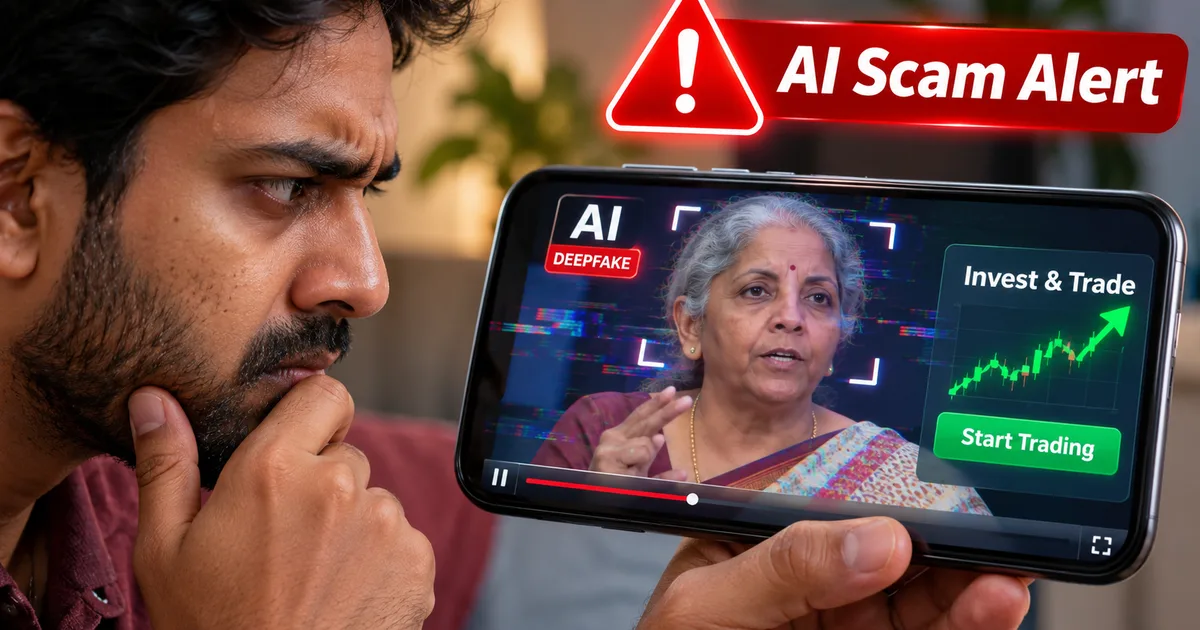
Losing nearly half a crore of your hard-earned savings because of a two-minute video clip sounds unthinkable until you see how convincing these doctored ads have become. The fake Nirmala Sitharaman AI video trading scam has just claimed another victim in Kerala, and it wiped out Rs 49.2 lakh from a 45-year-old woman's bank accounts over two months. She saw Union Finance Minister Nirmala Sitharaman on Facebook and heard a voice that sounded just like her promising guaranteed returns from an online trading platform. So she trusted it.
Why wouldn't an ordinary person stop and listen when the country's finance minister pops up in a sponsored news clip?
Look, I spend hours every week tracking recent online scam alerts across India, and the number of doctored videos slipping past Facebook and Instagram ad filters right now is a mess. I'm not sure exactly why Meta's ad review tools miss so many of these blatant fakes. Basically, scammers grab real clips from budget speeches or TV interviews and run the audio through cheap voice-cloning tools (which takes maybe ten minutes, honestly). Then they buy ads aimed right at middle-aged Indians. If you ask me, anyone with parents, grandparents, aunts, or uncles who scroll through Facebook video feeds at night needs to call them about this scam today.
What happened in the Kozhikode online trading fraud case
On November 11, 2026, the Kozhikode Rural Cyber Crime Police registered a formal case after a 45-year-old woman from Maikkavu in Thamarassery walked into the station clutching her bank statements. Police officials quoted by PTI said she'd been scrolling through Facebook back in July when a video ad caught her eye. In the clip, Finance Minister Nirmala Sitharaman was supposedly backing a new trading platform where regular people could make huge daily profits with almost zero risk.
So she tapped the link under the Facebook post.
That one tap put her in touch with scammers who helped her set up an online trading account and make her first deposit. Between July 15 and September 22, 2026, she sent them Rs 49.2 lakh across several transfers. The cash went straight from her accounts at the State Bank of India (SBI) and the Puthuppadi Service Cooperative Bank into a string of bank accounts run by the scammers. Then she tried to pull out her original money and her supposed profits. They cut her off cold. Not a single rupee came back. Now the Kozhikode cyber police have booked the scammers under the Bharatiya Nyaya Sanhita (BNS) and the Information Technology Act, and officers are trying to trace and freeze the accounts that got her money.
Thing is, the government actually tried to warn the public about this exact video while she was still wiring money. On September 16, 2026, the Press Information Bureau's Fact Check unit (@PIBFactCheck) called out a viral Facebook ad that used an AI deepfake of the Finance Minister to push a sketchy money-making scheme.
"An advertisement on Facebook is circulating a video falsely showing Union Finance Minister Nirmala Sitharaman endorsing an investment scheme that claims to offer Rs 90,000 per day on an initial investment of just Rs 22,000. The video has been created using Artificial Intelligence (AI). Neither Union Finance Minister Nirmala Sitharaman nor the Government of India has endorsed, authorised, or promoted any such investment scheme or platform." - PIB Fact Check Official Advisory (September 16, 2026)
Just look at those dates. PIB put out its alert on September 16, which was six days before the Kozhikode woman sent her last payment on September 22 (heartbreaking, honestly). But I think posting warnings on X only helps a tiny fraction of people, since normal Facebook users aren't checking government fact-check handles before they send money.
How the fake Nirmala Sitharaman AI video trading scam works step by step
You're probably wondering how someone goes from tapping a Facebook ad to wiring nearly Rs 50 lakh over ten weeks. Nobody hands over half a crore on day one. Instead, these gangs run a slow con that police call a pig-butchering scam (a grim name, I know, but it fits). In my experience, it follows the exact same playbook we've seen in fake NSE trading app WhatsApp groups over the past year.
- Scammers take a high-definition video of Nirmala Sitharaman speaking at a press conference or an anchors' roundtable, often keeping the logo of a major news channel like India Today or NDTV in the corner so it looks like a breaking news broadcast. They replace her original audio with an AI-generated voice clone that talks about a special government-backed trading app where a Rs 21,000 or Rs 22,000 deposit yields up to Rs 90,000 a day.
- When you tap the "Register Now" or "Learn More" button below the Facebook video, you don't go to the Google Play Store or an official SEBI-registered broker. You land on a spoofed webpage that asks for your name, phone number, and email address, sometimes displaying stolen emblems of the Ministry of Finance or Reserve Bank of India.
- Within twenty minutes of submitting your phone number, a polite "relationship manager" calls you on WhatsApp. They speak fluent English, Hindi, or regional languages like Malayalam and Tamil, and they help you install a custom trading web app or APK file on your phone.
- They ask you to start small, usually around Rs 10,000 to Rs 22,000, paid via UPI or IMPS to a random private bank account. Within two days, the fake app dashboard shows your balance has grown to Rs 45,000. To build complete trust, the scammer actually lets you withdraw Rs 2,000 or Rs 5,000 back into your real SBI or HDFC account. Once that real cash hits your bank, your skepticism vanishes.
- Over the next six to eight weeks, the handler convinces you to join "institutional VIP trades" or special allocation pools. Because the victim sees her virtual screen balance climbing into crores, she liquidates fixed deposits, borrows from cooperative banks, and sends lakhs via NEFT and RTGS to rotating mule accounts.
- The moment the victim asks to withdraw her Rs 49.2 lakh, the app locks her account. Customer support demands an upfront 20% "capital gains tax" or "SEBI clearance fee" to release the funds. If she refuses or runs out of money, they block her number and vanish.
Red flags that expose a deepfake investment scam
AI video tools have gotten way better over the past twelve months. I won't lie to you. When you're squinting at a four-inch phone screen without your reading glasses on, you usually can't spot the digital stitching. But these scammers are sloppy in ways that aren't about pixels, if you ask me.
No Union Minister or RBI Governor will ever promote a stock trading app or guaranteed return scheme on social media. If you see Nirmala Sitharaman or Prime Minister Narendra Modi pitching an app, or if Shaktikanta Das pops up telling you to put Rs 22,000 into a website, it's 100% a criminal fraud. No exceptions.
Past that basic rule, look out for these red flags before you tap anything:
- The math makes zero financial sense. Promising Rs 90,000 per day on a Rs 22,000 deposit works out to a 409% return every 24 hours. Even the best hedge funds in Mumbai celebrate when they make 20% in a full year.
- The audio and lip movements feel slightly out of sync, especially when the speaker transitions between English and Hindi words. Her jaw might look blurry around the edges, or her blinking pattern will seem stiff and robotic while her head loops through the exact same nod every eight seconds.
- Every time you deposit money for trading, the coordinator gives you a new bank account number or UPI ID belonging to some random enterprise or individual (like "Ramesh Traders" or a personal savings account) instead of a SEBI-mandated validated broker handle.
- The platform only exists as a mobile web link or a direct APK download sent over WhatsApp or Telegram. We saw the exact same trick used during fake NSE Muhurat trading scams last month, where fraudsters built clone apps that simply edited numbers on a screen while stealing the underlying deposits.
- The comments section underneath the Facebook ad is filled with generic, repetitive praise from strange accounts saying things like "Thank you madam I got Rs 85,000 today in my SBI account" posted within minutes of each other.
How to protect your family and bank accounts from AI trading traps
We cover plenty of phone security settings in our plain-English tech explainers, from two-factor authentication to SIM locks. Honestly, though, an antivirus app won't save you here. It can't stop you from logging into your own netbanking portal and approving an RTGS transfer to a scammer yourself, and since you're sending the money willingly, banks rarely block the payment in time.
First, make a family verification rule. My parents and I have a deal where nobody in the house puts more than Rs 10,000 into any new scheme, chit fund, fixed deposit, or trading app without dropping a message in the family WhatsApp group first (annoying, I know, when you're in a rush). Scammers love secrecy. They'll tell victims to keep the "insider trading window" quiet from relatives. I think a five-minute chat over dinner back in July would've saved that woman in Kozhikode her Rs 49.2 lakh.
Second, check every broker with official regulators. Before you send a single rupee for stock or commodity trading, look up the platform on the official SEBI registered intermediaries list on the SEBI portal. SEBI now makes real brokers collect client money only through specific verified bank accounts and `@valid` UPI handles. So if a "relationship manager" tells you to wire money to three different cooperative or private bank accounts over two months because their payment gateway is down, stop right there.
Third, keep an eye on alerts from the Indian Computer Emergency Response Team (CERT-In) at https://www.cert-in.org.in/. CERT-In has warned Indian internet users again and again about deepfake tricks and bad links hidden inside social media ads. If your parents are on Facebook a lot, grab their phone and open Ad Preferences in their settings so you can cut down political and financial ad targeting as much as Meta lets you. And warn them about follow-up scams too. Scammers who lose a trading victim often call back weeks later posing as police or recovery agents, just like the CBI digital arrest video call scams that squeeze victims a second time with a fake investigation.
Where to report cyber crime in India and freeze lost money
If you or someone in your home has already tapped one of these fake Nirmala Sitharaman ads and sent money, don't spend days arguing with the fake support chat on WhatsApp. They won't send your money back. Ever. They'll just try to squeeze one last fake "tax payment" out of you before they delete their account.
Call the national cyber crime helpline at 1930 immediately if you have sent money to a suspected trading scam. Every single hour counts here because scammers move your cash through four or five layers of mule accounts within hours of getting your NEFT or UPI transfer (which makes sense, actually, since they know police freeze first-layer accounts fast).
When you call 1930 or file an urgent report on the National Cyber Crime Reporting Portal at cybercrime.gov.in, your complaint goes straight into the Citizen Financial Cyber Fraud Reporting and Management System (CFCFRMS). This network links police cyber cells with major Indian banks like SBI, HDFC, ICICI, and regional cooperative banks. In my experience, reporting within the first couple of hours is your best shot, though the recovery numbers once money hits third-layer accounts are a bit fuzzy. Still, the system lets officers put an automated lien or freeze on the scammer's bank account before a runner pulls the cash out at an ATM or turns it into crypto.
Here's what you need to have ready when you report the scam:
- Complete bank statements from all accounts you used (such as your SBI or cooperative bank passbook) showing the exact dates, amounts, and 12-digit UTR or transaction reference numbers for every transfer.
- Screenshots of the Facebook advertisement, the URL of the fake trading website, and the phone numbers or WhatsApp profiles of the people who guided your trades.
- Details of the recipient bank account numbers and IFSC codes that the scammers gave you for depositing funds.
Once you've logged your complaint on 1930 and cybercrime.gov.in, print out your acknowledgement number and your bank statements. Take them straight to your nearest cyber crime police station so officers can file an official FIR under the Bharatiya Nyaya Sanhita (BNS) and the IT Act, just like the Kozhikode Rural Cyber Crime Police did this week. And if you see one of these fake Nirmala Sitharaman videos on your feed without losing money, don't just scroll past it. Send the link or a screenshot to PIB Fact Check on WhatsApp at +91 8799711259, or email factcheck@pib.gov.in so they can get it taken down.