I apply for almost every mainboard IPO these days. The retail quota is packed, and getting an allotment feels like winning a small lottery. You wait for days. You constantly check your phone for that debit message from your bank. And scammers know exactly how anxious we get during this waiting period. That's why the fake KFintech IPO allotment link SMS scam 2026 is spreading so fast across India right now. Fraudsters are preying on our impatience. They send a text message that looks exactly like an official update from KFin Technologies, one of the biggest IPO registrars in the country. If you applied for a recent high-demand IPO, your brain is already expecting a message. You see "KFintech" and "Allotment Status," and you click without thinking.
I saw this happen to a friend last week. He lost access to his Demat account and nearly Rs. 45,000 from his linked bank account before he even realized what went wrong.
So let's talk about how this scam works and what the warning signs are. We'll also cover what you need to do to protect your investments. Because honestly, the news reports are missing a lot of the practical details.
What the fake KFintech IPO SMS scam actually is
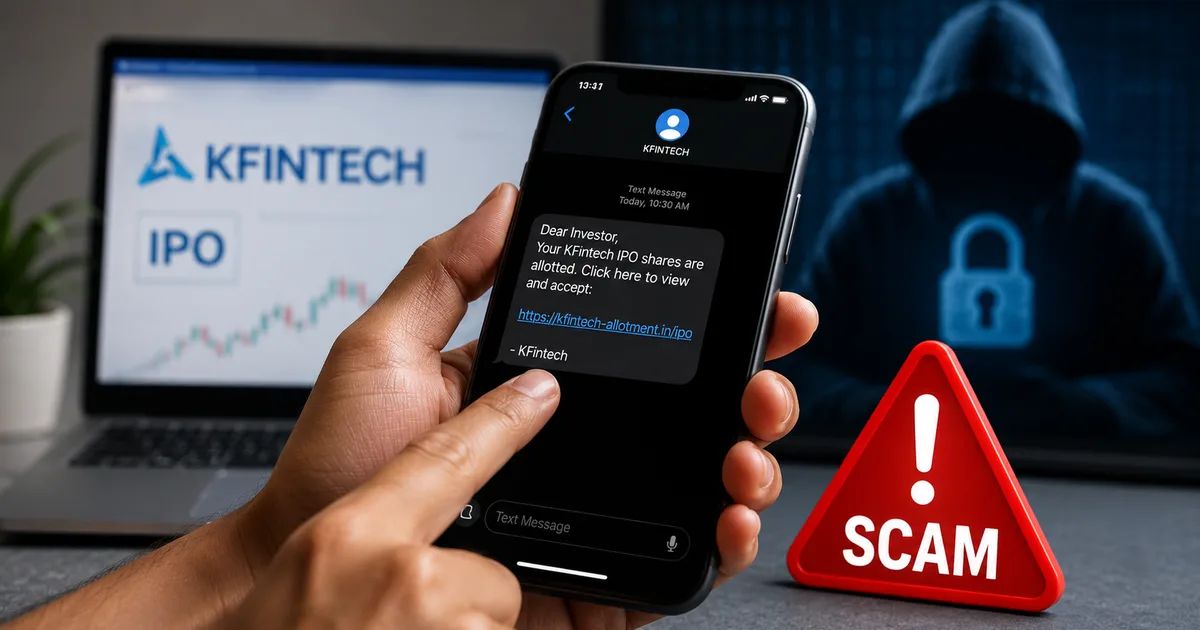
This is a targeted phishing attack. Scammers send SMS messages or WhatsApp texts claiming to be from KFintech. The message usually says something like, "Your IPO allotment for [Company Name] is confirmed. Check status and complete KYC to receive shares in your Demat account." It includes a link.
They often time these messages perfectly. For example, when the Midwest IPO was subscribed 88 times recently, thousands of investors were desperately waiting for updates. The scammers blasted out fake SMS messages on the exact day the allotment was supposed to be finalized. People clicked. It's a mess, in my experience.
The goal is simple. They want to steal your Demat account login details and your PAN number. They also want your bank account access. They aren't trying to sell you a fake course or a tip. They want direct access to your money. The scam operates on the basic principle of urgency and trust. KFintech is a legitimate, well-known entity in the Indian stock market. When you see their name, your guard goes down. The scammers are banking on that momentary lapse in judgment.
And it's not just SMS anymore. They use WhatsApp and Telegram (which makes sense, actually). They even send targeted emails. But the SMS route is the most effective for them because an SMS feels more urgent. Your phone buzzes. You look at it. You react immediately. That split-second reaction is all they need to get you.
How the fraud works step by step
The mechanics of this scam are dangerously smooth. Here's exactly what happens if you engage with the message. I've broken it down so you know exactly what to watch out for.
Step 1: The panic-inducing SMS
You get an SMS. It looks official. The sender ID might even say "KFIN" or something very similar. It tells you there is an issue with your allotment. Or it says you need to verify your details to get the shares credited. Sometimes they phrase it positively, saying you have won a guaranteed allotment but you need to pay a small processing fee. Whatever the hook is, the goal is to get you to tap the link in the message.
Step 2: The fake registrar website
You click the link in the message. It takes you to a website that looks exactly like the official KFintech portal. The logo is there. The colors match. The layout is identical. But if you look at the URL in your browser, it's a sketchy string of characters. Or it's a slight misspelling, like "kfintech-allotment-update.com" instead of the real address. Most people don't check the URL on their mobile phones because the screen is small and the fake site looks so convincing.
Step 3: Stealing your data
The fake site asks you to enter your PAN number, your DP Client ID, or your application number. Once you type those in, it takes you to a second screen. This is where the real theft happens. It asks you to "verify" your identity by entering your net banking credentials. Or it asks for your UPI PIN or an OTP.
They might even display a fake loading screen saying "Processing your allotment" while they are busy logging into your actual bank account in the background using the details you just gave them. They use bots to automate this process. So they are fast. Much faster than a human typing. The numbers here are a bit fuzzy, but I think they can drain an account in seconds.
Step 4: The financial drain
Once they have your OTP, they empty your bank account. In some severe cases, they might even use your Demat credentials to sell off your existing holdings and transfer the money out. That is harder because of recent SEBI regulations requiring TPIN for authorization. Still, they can do a lot of damage very quickly. They often transfer the money to mule accounts, making it incredibly difficult for the police to trace.
It's a highly coordinated operation. The people sending the SMS are not the same people building the fake websites. And they are not the same people withdrawing the cash. It's a massive illegal industry.
Warning signs you should never ignore
You can spot these scams easily if you slow down for just ten seconds. Here's what you need to look out for.
- Suspicious links: The official KFintech website is kfintech.com or kosmic.kfintech.com. If the link in the SMS has words like "update," "kyc," "free," or weird numbers in it, it is a scam.
- Requests for sensitive info: An IPO registrar will never ask for your bank login password, your UPI PIN, or an OTP to show you your allotment status. Never. All you need is your PAN number or application number.
- Threats of cancellation: If the message says your allotment will be cancelled in 24 hours if you don't click the link, that is a huge red flag. Scammers use urgency to make you panic. Official registrars don't operate like that.
- WhatsApp messages from unknown numbers: KFintech doesn't usually send official allotment updates from a random 10-digit mobile number on WhatsApp. If you get a message like that, block it.
- Grammar and spelling mistakes: While the fake websites are getting better, the initial SMS often has weird phrasing or poor grammar. Official communications are proofread. Scammer texts usually aren't.
"We have noticed a sharp rise in fake SMS alerts mimicking official IPO registrars. Investors must verify URLs and never share banking OTPs for checking allotment status." - CERT-In Advisory (Paraphrased)
How to check your allotment status safely
Checking your IPO allotment status is actually very simple, and you don't need to rely on random text messages. Here's how you should do it.
First, you can go directly to the official registrar's website. If KFintech is the registrar, type their actual URL into your browser. Don't click a link to get there. Just type it in. They have a dedicated section for IPO status. You select the company name and enter your PAN. It takes ten seconds.
Second, check the BSE or NSE website. Both stock exchanges have an IPO allotment status page. You'll need your application number and PAN for this. It's slightly more tedious than the registrar website, but it's totally safe.
Third, just open your broker's app. Zerodha, Groww, Upstox, or whatever you use. They'll show you if you got the allotment in the IPO section of their app. It's the safest way because you're already logged into a secure environment.
I usually just wait for the bank mandate revocation message. If I don't get the allotment, the bank sends an SMS saying the blocked UPI mandate has been released. That's usually my cue that I didn't get lucky this time. It saves me the trouble of checking the websites altogether. And if I do get it, I'll see the shares in my Demat account eventually anyway.
How to protect yourself and your money
You have to be proactive about this. You can't just hope you won't fall for it. You need rules.
Never click on links in SMS messages about financial transactions. It's a good habit to build. If someone texts you a link about an IPO, ignore the link and go to the official website manually. This one rule will save you from a lot of phishing scams (annoying, I know, but it works).
Use two-factor authentication (2FA) for your Demat account. Most brokers in India mandate this now. Make sure it's set up properly. Use an authenticator app if possible. Relying solely on SMS OTPs is risky because scammers can intercept them or trick them out of you.
Don't search for "IPO allotment link" on Google and click the first result blindly. Scammers sometimes run ads that look like the official KFintech page. They pay to be at the top of the search results. Always double-check the URL before you enter your PAN.
Keep a separate bank account for your investments if possible. Don't link your primary salary account to your Demat account. That way, even if something goes wrong, they can't drain your main source of funds.
Read our guides on securing your digital life. The basic principles apply everywhere.
Where to report this scam
If you get one of these fake messages, you need to act fast. And if you accidentally clicked the link and shared your details, move even faster. Don't wait to see what happens.
First, call your bank and your broker immediately. Tell them you suspect a phishing attack and ask them to freeze your accounts temporarily. Better safe than sorry. Don't hesitate because you feel embarrassed. It happens to a lot of smart people if you ask me.
Then, report the scam to the government. Go to cybercrime.gov.in and file a complaint. It takes a few minutes, but it creates an official record. This is important for insurance claims or if your bank needs proof of the fraud.
If money has already been deducted from your account, pick up your phone and dial 1930 immediately. This is the national cybercrime helpline. The faster you call them, the higher the chance they can freeze the transaction and recover your funds. I'm not sure exactly why it works this way, but time is literally money in this situation.
You can also check out our detailed scam alerts page for more information on similar frauds going around. Be careful out there. Stay vigilant, verify everything, and never trust a random SMS with your financial security.